
 Written by
 SJ: When I read about the show, it was described as a journey through Tony Bennett’s career. Is that the main concept?
EB: Yes, though it’s not a strict timeline. It’s not “this hit came in ’53, then this one in ’54”—that’d be too easy. We’re exploring facets of his career.
We’ll do some of the earliest hits, of course, but I also want to showcase songs people don’t automatically associate with him—songs where his arrangements transformed the material. He loved to feature the arranger’s craft. For instance, he’d do *Old Devil Moon*, a tune from “Finian’s Rainbow,” and hold a note for what feels like 39 seconds! He gave that song his own Latin swing treatment—it’s not a signature Bennett hit, but it shows his showmanship and musical daring.
He was also a master of shaping a live moment—I used to watch him draw five ovations from a single song. He’d spotlight the pianist, pause, build back up, shift the key, take it home again. I want to recreate that interplay. The audience becomes part of it—it’s participatory.
And you know, he never sat down—even in his eighties. He never took a stool. He was always moving, always engaging, and always featuring the musicians. So we’ll do that too. We’ll bring together some of the finest jazz players we can find in Europe—where jazz is often appreciated even more deeply than in the States.We’ll give the soloists their space to shine because Tony loved his musicians.
We’ll also showcase those big orchestrations—those soaring ballads and swing numbers—then bring it down for the more intimate moments, like the piano features he did with Bill Evans. There are so many facets to his career, and we’re going to explore as many as we can.
SJ: It sounds like a show that offers something for everyone.
EB: I think so. Sure, most people who come will already have some affection for Bennett, but there are stories behind the songs that surprise even longtime fans. *I Left My Heart in San Francisco*—his biggest hit—he didn’t even like at first. The song sat in a drawer for years until he decided to try it onstage in San Francisco one night, and history was made.
He also loved to end a show by putting down the microphone. He’d say, “The acoustics here are marvelous,” no matter the venue, and then sing unamplified. That’s terrifying for most singers—but he did it, and I do it too in my show. It draws the audience closer; you can feel the air change. It’s just voice and piano—no help, no tricks—and it’s incredibly powerful.
We’ll include moments like that, along with a few surprises. I want the experience to be immersive—a journey through this artist’s extraordinary 70-year career. He had his first hit in 1953 and somehow managed to remain relevant well into the 21st century. That’s a legacy that deserves to be told.
SJ: Right, as we said before, his career had more lives than a cat.
EB: Exactly—and who else from that era managed that? Nobody. Either they passed away or couldn’t adapt. Frank lost his voice in the ’70s—too many cigarettes and too much Jack Daniels. But Tony? He was still singing A-flats in his nineties, flawlessly. It’s extraordinary.
SJ: Truly. There aren’t many artists with a fan base spanning five generations.
EB: That’s true. Maybe Jagger—he’s still bounding around the stage—but even then, Tony did it his own way. Watch him with Lady Gaga—he’s turning, dancing, still completely present. To my knowledge, he never fell off the stage! When I’m 95, I hope I’m still performing like that. Actually, when I’m 95, I just hope I can still pee!

SJ: Eddie, let’s move on, you’ve got a new album coming out, right?
EB: Yeah, I just happen to have it here, actually. It just landed in my hands. We’re gearing up to release the first single, then the full album shortly after. It’s my first record with a full big band, seventeen pieces and me, and it’s really something special. A real eclectic mix of tunes.
SJ: Tell us about how you chose the repertoire, because there are some familiar songs on it, but also some pretty unique picks.
EB: A lot of it came out of my work with a local big band. The arranger—also the lead sax player—is a wonderful musician named Ed Vezinho. He’s been writing for me for years. Sometimes I’d show up and sing with the band for free, just to get two new charts out of it and build my library.
After a while I realized I had this incredible backlog of charts—some I’d only performed once, some never at all. So Ed and I started going through them, pulling out things that really worked. Some are pieces I’ve done in previous shows, like songs from my Anthony Newley tribute. Newley, of course, wrote “Willy Wonka” with Leslie Bricusse, so we’ve included “What Kind of Fool Am I?” and “Pure Imagination”. That song especially has such a life of its own. We’ve also got “Feeling Good” and *Once in a Lifetime*—all Newley-Bricusse tunes, but done with fresh arrangements.
We do “Feeling Good” over the groove from Miles Davis’ “So What”. It’s a mash-up that really swings. Then there’s “The Folks Who Live on the Hill”, a gorgeous Jerome Kern standard about a couple who’ve been together forever. On the other end of the spectrum, I’ve always loved that one-hit wonder, Spiral Staircase’s “More Today Than Yesterday.” Carmen McRae did it once—I borrowed her feel, but expanded it for big band and it really cooks.
There’s a little tribute to Ella with “How High the Moon”, and a nod to Jimmy Webb with two of his songs combined—”Didn’t We” and “MacArthur Park”. They’re different pieces, but together they tell one story. And then, for fun, we took Mancini’s “Charade” and swung it as hard and fast as the band could play it—ending, conveniently, on a nice high A-flat. So yeah, I’m still alive!
The title of the album is “For Dreamers and Their Dreams.” It comes from one of my all-time favorite songs, “Here’s to Life”, which was a hit for Shirley Horn. The lyric, written by Arnie Butler, who also wrote “What a Wonderful World”, has that beautiful line: “For dreamers and their dreams.” It just felt right.
SJ: That’s very fitting—and I understand the album’s release ties in with a big concert at the Kimmel Center with the Philly Pops.
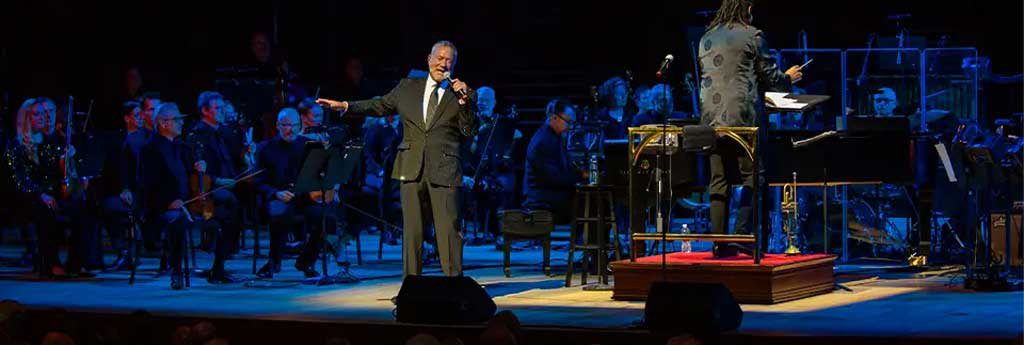
EB: That’s right. We’ll have fifty-seven musicians on stage. I can’t wait. Honestly, I might be looking forward to the rehearsal even more than the performance. There’s something magical about standing in the middle of that sound without an audience—just you and the orchestra. We rehearse at eleven in the morning, finish around one-thirty, and the audience comes in at three. I actually like tiring myself out a bit before a big show—it cuts the adrenaline just enough so the audience can refill me with their energy.
SJ: And the album itself drops later, around the end of November, right?
EB: Yes, around November 24th. The first single, “Pure Imagination”, comes out beforehand. There’s just something timeless about that song. Everyone loves it. So that’s our lead single. The album will stream everywhere at the end of November, and we’re pressing CDs too—for those who still like something physical and we’ll be releasing this in the Summer together with a few release shows.
And, hey, if you need a coaster, it doubles as that! But honestly, I think CDs are starting to make a modest comeback—kind of like vinyl did a few years ago. Suddenly there are CD players all over Amazon again. I just bought one myself.
SJ: Perfect. So, Eddie, What’s the goal for the next coming years?
EB: Honestly, taking my music to Europe has always been on that list. This upcoming tour means the world to me. I’ve heard for years how deeply jazz is loved over there, how engaged and appreciative those audiences are. I’ve never had that opportunity before—I’ve only worked in the States. So this is a huge milestone on a professional level.
Beyond that, I just want to keep singing—as long as I can stand and make a sound. My career has taken such an exciting turn at this stage in life, with new recordings and concerts on the horizon. I’ve never brought a show like this to Europe, so that’s big. On a personal level, it’s all about family—my kids, my grandchildren—that’s what really matters. But musically, I can’t wait to feel that moment: stepping onto a European stage in front of people who genuinely love this music and know every note of it. That’s going to be a dream come true.
SJ: And I’m sure it will be. I’ll definitely come and catch a show when you’re here.
EB: I hope you do—I’ll count on it!
Last modified: May 4, 2026