
 Written by
 The sixth meeting of the Jazz France Balkans Network, held in Dijon from 12–15 May 2026, was something rather more than a gathering of jazz professionals comparing notes. It was, by any measure, one of the more complete conversations about jazz development I have encountered — one that drew educators, journalists, city officials, policy makers and presenters into genuine, substantive dialogue. As someone who opened the conference with a keynote address, I say that not to flatter the organisers, but because the event genuinely made me think differently about what a jazz conference can and should be.
Dijon is not simply the host city for this sixth meeting — it is the coordinating force behind the entire Jazz France Balkans Network. For the past five years, the city has been driving a multilateral cultural cooperation project that connects Dijon and Chambéry with Tirana, Korça, Niš, Podgorica, and Bitola: an ambitious reach across some of the more complex cultural and political terrain in contemporary Europe.
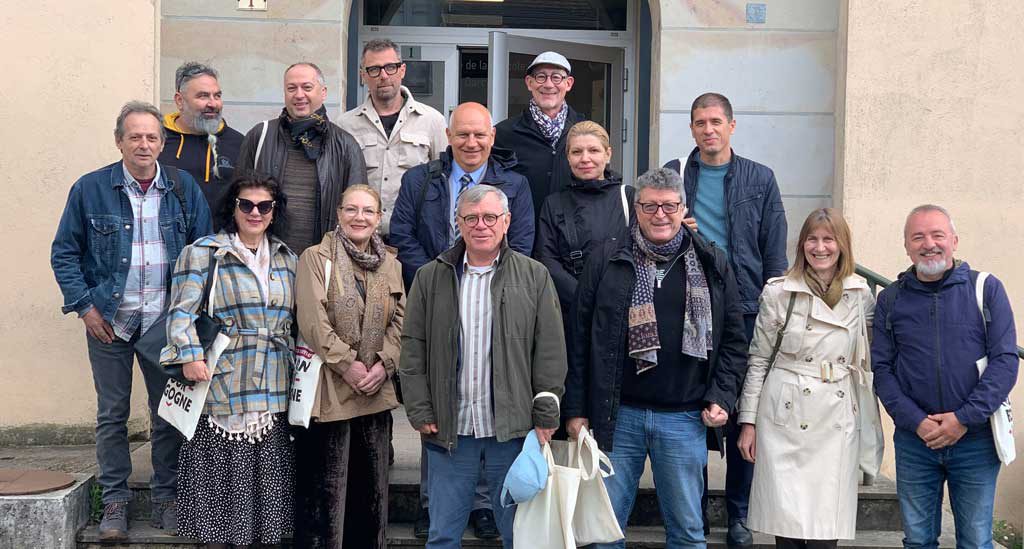
France Balken Jazz Network Delegates
Supported by the French Ministry for Europe and Foreign Affairs, the network is, by any measure, one of the few genuinely cross-border jazz cooperation initiatives of this scale operating anywhere on the continent. Previous meetings have taken the network to Fier, Tirana, Podgorica, Bitola, Chambéry, and Niš since 2021. Returning to Dijon for the sixth meeting — using the former Council Chamber of the Palace of the Dukes and States of Burgundy, the auditorium of the International Organisation of Vine and Wine, and the stage of the long-running D’Jazz dans la Ville Festival as its settings — carried a logic that was more than logistical. This is a city that has put genuine institutional weight behind jazz as a vehicle for cultural exchange, and the surroundings reflected that commitment.
That civic investment was visible throughout the proceedings. The conference opened with a welcome from Lydie Pfander-Mény, City Councillor for Europe, Partner Cities, and International Relations, which set the tone for what followed: a two-day programme in which the presence of municipal and policy voices was not a formality but a structural feature of the event. The question running beneath much of what was discussed — how a city, a ministry, a network of institutions can meaningfully support jazz beyond the level of a festival grant — was one that Dijon, by virtue of its coordinating role, was unusually well placed to have in earnest.
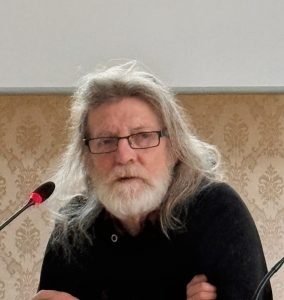
Andrew Read | Key Note Speaker
For my own opening remarks, I found myself returning to two themes that seem to me inseparable when we talk about jazz’s future: the music’s nature as a permanently evolving art form, and the structural resilience that only comes through collaboration. Jazz has always moved — in vocabulary, in geography, in the mix of traditions it absorbs and transforms. That movement is not a problem to be managed. It is the music’s identity. But evolution without institutional support, without connected ecosystems of education, presentation, journalism, and policy, becomes fragile. The musicians find a way, they always have, but the infrastructure that sustains them is not self-renewing. It requires deliberate cultivation. The framing I kept coming back to was this: no matter where jazz goes, as long as it carries tradition with it, the music remains jazz. The challenge for the sector is to carry the tradition in the same spirit — to keep moving, but to carry the foundations with us.
The conference programme was structured around four roundtable discussions, each tackling a distinct dimension of jazz’s position in society. The first, on jazz as a potential force for peace and diplomacy, brought together historian Anne Legrand, Couleur Jazz Radio director Jacques Pauper, Bertrand Fort from Dijon’s International Relations Department, and Saša Miljković, honorary Consul of France in Niš. It is a conversation that might sound abstract, but it was grounded in specifics: the use of jazz exchanges during the Cold War, the way the music crosses borders that other cultural forms cannot, the question of whether that diplomatic function is still active or has become a comfortable mythology. The panel did not resolve those tensions neatly, and it was better for not trying.
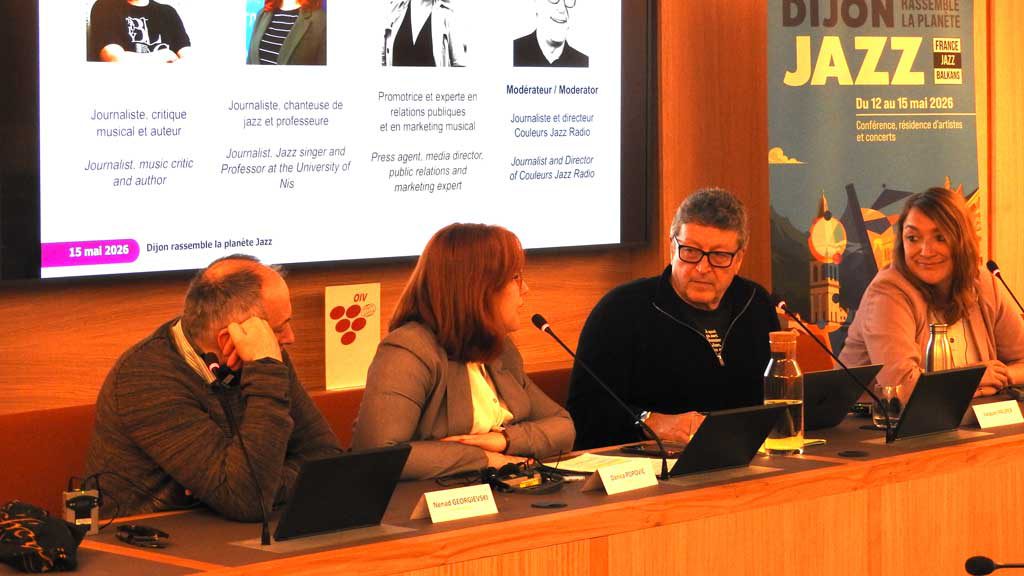
Jazz Media Pannel | L to R: Nenad Georgievski, Danica Popovic, Jacques Pauper, Arlette Hovinga
The second roundtable addressed jazz in the media, and here I confess a personal interest. The discussion, moderated by Jacques Pauper and featuring journalist and author Nenad Georgievski, publicist Arlette Hovinga, and journalist and academic Danica Popović, examined the divergence between traditional jazz journalism and the requirements of social media platforms. The diagnosis was not new — shorter formats, algorithm dependency, audience fragmentation — but what gave the conversation weight was the mixture of voices: French media, Balkan media, print and digital, academic and practitioner. The panellists were careful not to write off digital communication, but equally careful not to pretend that the shift has been cost-free for the depth of coverage the music deserves. That is a conversation I find myself having constantly in my own work with Jazz in Europe, and it was useful to hear it mapped against different national contexts.
The third roundtable turned to education, with jazz teachers Benoît Lallemant of the Jazz On training association, Bertrand Furic of APEJS in Chambéry, and Gentian Rushi — of whom more shortly — joining a discussion moderated by Emilija Sarafska of the city of Bitola. The central thread was the gap between graduation and professional integration: a musician finishes conservatoire and then what? The consensus around the importance of ensemble learning and early exposure to the music struck me as correct, though I would add that ensemble experience only goes so far without the presentational infrastructure to give young musicians somewhere to play in front of real audiences.
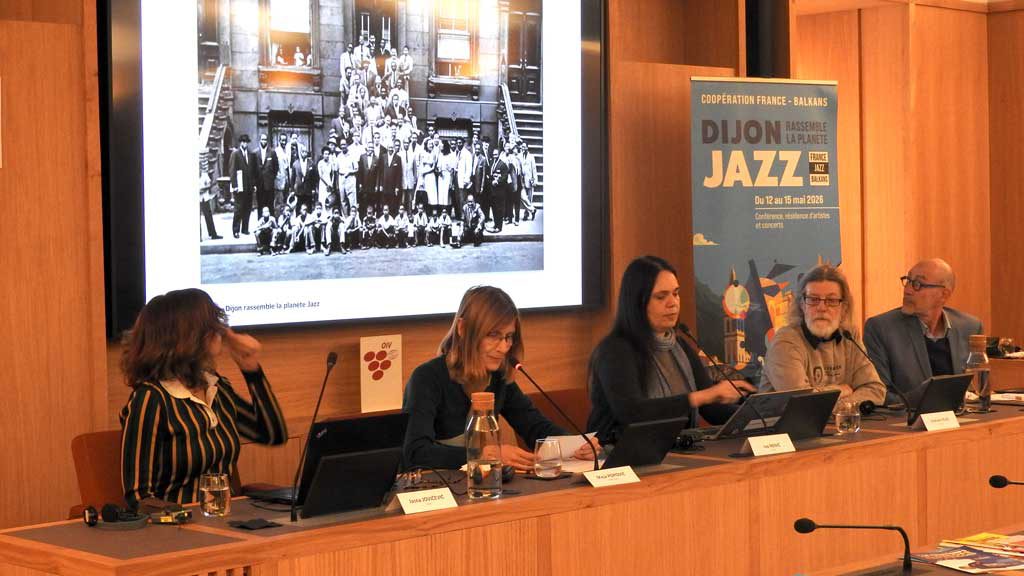
Women in Jazz panel | L to R Jasna Jovićević, Maja Popović, Iva Nenić, Andrew Read, Bertrand Fort
The fourth and final roundtable addressed what the network has made one of its defining commitments since its inception: supporting women in jazz. Moderated by Maja Popović, president of the Jazz Art association, the discussion featured multi-instrumentalist and composer Jasna Jovićević, musicologist Iva Nenić, and included my own contribution as one of the panellists. We discussed the persistent structural barriers — not just the familiar arguments about representation in festival lineups, but the subtler dynamics that affect young women’s confidence and sense of professional possibility in a field that still carries a great deal of gendered mythology about who jazz belongs to. The question of quotas and affirmative action generated genuine disagreement in the room, which is as it should be. These are not settled questions, and a conference that pretended they were would be less useful than one that held the tension open.
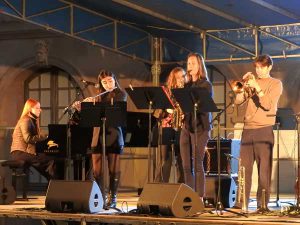
L to R Mina Stojanovic, Iris Sula, Tezan Hayrettin, Elsa Donon & Gabriel Zanlonghi
Running alongside all of this was the artist residency that is perhaps the network’s most tangible output: the France Balkans Jazz Band, a small ensemble of young musicians drawn from France, Albania, North Macedonia, Serbia, and Montenegro. This is the kind of project that looks better on paper than it often sounds in practice — cross-border youth ensembles can produce music that is diplomatically admirable and musically polite. What I heard on the Friday night, in the Cour de Bar at the heart of the Palace of the Dukes, in front of around five hundred people as part of the D’Jazz dans la Ville Festival, was something considerably more than that.
The residency had begun at the Jean-Philippe Rameau Regional Conservatory on the Wednesday; by the Friday evening the ensemble was on stage in front of a festival audience of around five hundred people. The programme was largely original material — an ambitious choice for a group at pre-conservatoire level, many of them meeting for the first time — with two standards, one of them Miles Davis’s Milestones. The rhythm section, with Johrin Triomphe on drums, Nikolina Strugar on double bass, Mina Stojanovic at the piano, and Tezan Hayrettin on guitar, provided a solid foundation throughout, while Gabriel Zanlonghi’s trumpet solos were well-constructed and assured, and Iris Sula’s vocal contributions held their own comfortably within the ensemble.
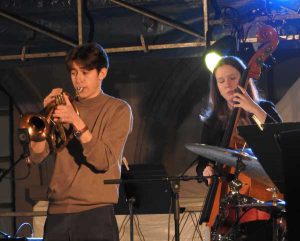 What struck me most was the degree of collective listening across the group. Under the direction of Gentian Rushi, head of the jazz department at the University of Arts in Tirana, and Julien Vuillaume, these young musicians delivered a set that would not have embarrassed a considerably more experienced group — and that, in the end, was the most persuasive argument the network could have made for what it is trying to do.
The evening closed with a set from the Saso Popovski Trio — Saso Popovski, Aleksandar Sekulovski, and Ivan Bejkov — who played from shortly after ten until midnight and gave the Dijon audience a direct line into the North Macedonian jazz scene. That the festival’s programming could hold space for both the student ensemble and an established touring trio, in the same outdoor venue, on the same night, captures something important about what the France Balkans Network has achieved in its second phase: it has made the exchange of musicians and ideas feel normal rather than exceptional.
The Jazz France Balkans Network is now moving into its third phase, and if this meeting is any guide to how it is thinking about its work, the next chapter should be worth watching closely.
Last modified: May 30, 2026