 Written by
 SJ: Yeah, exactly. I wanted to talk about that because it ties in with something we’ll discuss later—your connection with Tony Bennett.
EB: Right. Well, the concert with the Philly Pops is related to that, but it’s a little different. The show is in two acts: the first act is Tony Bennett, and the second is Sinatra. It’s a kind of pairing of two of the greatest interpreters of the Great American Songbook—artists who really defined that style of vocal interpretation.
Frank, of course, developed that whole approach that came after Bing Crosby’s more relaxed style. Before Bing, singing was very formal. Crosby opened it up, and Sinatra perfected it. So this concert is a tribute to those two giants—two great Italians who shaped the art of American popular singing.
SJ: Yeah, exactly. So let’s actually talk about Tony Bennett, because from what I’ve heard on the grapevine, you’re coming over to Europe to do a show that’s essentially a tribute to Tony Bennett—on the anniversary of his 100th birthday, if I’m right, which happens next year. Tell me a little about your relationship with Tony Bennett.
EB: It really starts with Sinatra, you know, because as a kid in the ’60s, my friends were listening to the Stones and the Beatles—the whole British Invasion—and there I was, an old soul, listening to Bennett, Sinatra, Ella, Sarah Vaughan, Carmen McRae, Nancy Wilson. Who knows what shapes a kid’s taste? But here in Philadelphia we had Sid Mark, a broadcaster who became the world’s top Sinatra DJ. I learned a thousand Sinatra songs by listening to his shows.
Then I discovered Tony, and I thought, that’s interesting—his approach was different. It was a little less commercial, more expansive, often with lush ballads and strings. His voice had a different texture that really grabbed me, even as a kid. I auditioned for a local TV show with “If I Ruled the World,” one of his big songs, and I performed “For Once in My Life” on the Ted Mack Amateur Hour. I fell completely in love with his singing style.
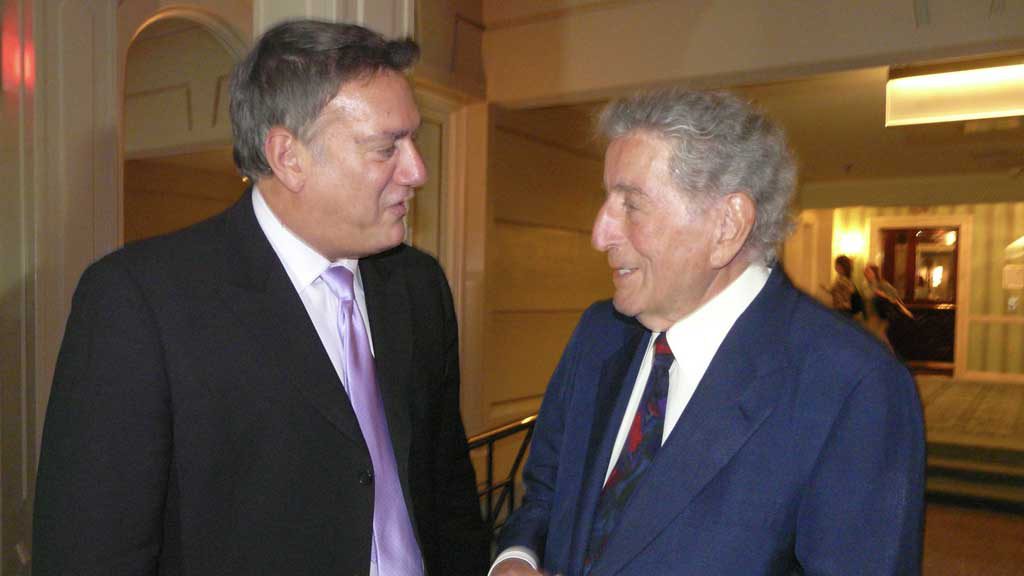
Eddie Bruce with Tony Bennett
Years later, when I started doing concert and cabaret work—after years of band-leading for events—I decided I wanted to perform music for people who listened. I went to see Tony at the Mann Center, our big open-air amphitheater here, and I bought front-row seats. I didn’t care what they cost—it was like tuition. My mind was blown. I said to myself, “I have to sing these songs and honor him.”
He was already 85 then, already in his career renaissance, but that’s when I first put together my Bennett tribute show. It’s evolved over time and eventually led to an album honoring him, which I had the joy of handing to him when we met. That was amazing. He’s been part of my musical life ever since.
SJ: Right. The interesting thing about Tony Bennett is that Frank was incredibly commercial—amazing, of course, no one phrased like him—but Tony took more chances. He was edgier, a little riskier in his artistic choices. Do you see it that way too?
EB: I do, and I love that about his career. Look, there’s Frank—and then there’s everyone else. But at the top of “everyone else,” there’s Tony. Frank felt it, too—he called Tony “the best singer in the world.” Tony never let him forget that either; he used that line to introduce himself more than once.
But Sinatra had the movie career, the acting, a whole wider universe. Tony didn’t. He just stayed laser-focused on good songs and artistic integrity. He protected the genre, chose fantastic material, worked with great orchestrations—and then did those albums with Bill Evans.
SJ: I was just about to bring those up—those two records with Bill Evans were monumental.
EB: Exactly. Those albums changed everything for Tony in terms of jazz credibility. Once he made them, people started hearing him differently. The connection between Evans and Bennett is extraordinary—intimate, conversational. They did two albums, both absolute treasures, now legendary.
Tony used to talk about Ruby Braff, the cornet player, and I always heard that influence in his phrasing—the way he’d attack notes like a horn. He could belt powerfully, hitting those B-flats with clarity and control, but also turn around and sing with extraordinary intimacy. That duality—the ability to do both—is what made him so special.
SJ: I completely agree. Those albums bought Tony credibility as a true jazz singer, not just a pop interpreter. So would you say the difference is that Frank was more about the act, and Tony was more about the concert?
EB: Maybe. Tony could certainly put on a show, but it was less schtick, more pure singing. Still, Frank never phoned in a performance. Every note mattered to him. Both of them later made duet albums—Frank’s came when his voice was fading, often recorded remotely, while Tony’s were done live, face to face in the studio. And you can hear the difference immediately.
SJ: You mentioned Tony’s many phases—he seemed to have more lives than a cat. How do you handle that in your show?
EB: We focus on the Renaissance. His early years in the ’50s brought hits like “Because of You.” Those lush orchestral ballads were the pop music of their time. But as the ’60s and ’70s rolled in—with rock, disco, funk—the stations stopped playing that music. Tony kept working, mostly in Vegas, but he wasn’t happy. He partied too hard, surrounded by hangers-on, and creatively he was frustrated. Then, around the early ’80s, he made an album that I see as the turning point—“The Art of Excellence.” It had lush arrangements, a duet with Ray Charles, and beautiful takes on “How Do You Keep the Music Playing?” and “I Got Lost in Her Arms.” That record floored me—I must’ve listened to it 400 times.
After that, his son Danny took over managing him. Danny said, “You just sing. I’ll handle the rest.” He put Tony on MTV—huge at the time—and reintroduced him to a whole new audience with “Tony Bennett: MTV Unplugged.” Tony walked out in his suit and pocket square at 65 and sang “Steppin’ Out” and other classics—and suddenly he was hip again. It bought him another 30 years of artistry.
SJ: So that MTV moment was really the career rebirth?
EB: Absolutely. It made him beloved again. Then came another iconic moment—his 1988 Grammy performance. He sang “When Do the Bells Ring for Me,” a song written by a New York piano player named Charles DeForest. Nobody knew it, but when Tony performed it with a full orchestra rising out of the stage, the audience—rockers, rappers, everyone—went wild. It was electric, like that Michael Jackson moonwalk moment. After that, Tony became untouchable, a master respected by every generation.
SJ: And then, of course, there was the collaboration with Lady Gaga.
EB: A brilliant move, both commercially and artistically. No one knew Lady Gaga could really swing. Her own journey—wearing a meat dress to get noticed, then revealing this incredible artistry and musicianship—was amazing. Their partnership was a perfect storm. It gave Gaga jazz credibility and gave Tony a new generation of fans.
SJ: It was the ultimate win-win, Gaga got credibility, Tony got Gen Z.
EB: Exactly. There’s a great moment in the documentary “The Zen of Bennett” where he’s furious after a session—someone thanked him for performing at John Mayer’s father’s 80th birthday. Tony says to his son, “My demographics are better than that—I don’t just sing for 80-year-olds!” He really cared about reaching young people.
SJ: He did. I saw him with Gaga at the North Sea Jazz Festival in Rotterdam, and the crowd was incredible—people from teens to seniors, and they were all in.
EB: Amazing, right? Very few artists can do that. He brought new ears to the Great American Songbook—kids hearing “Cheek to Cheek,” “The Lady Is a Tramp,” “I’ve Got You Under My Skin”—and at the same time brought their parents and grandparents to Lady Gaga. Everyone won.
SJ: Let’s talk about your show, the one you’re bringing to Europe. I understand it’s not just a Tony Bennett tribute—it’s something more. Tell us about the concept and what motivated it.
EB: Well, first and foremost, the heart of it is the music—because that’s how Tony was. From there, we asked ourselves, how can we make it even more engaging and emotionally connecting for the audience? So we’re using visuals from his career—photos, film clips, maybe even some duet footage.
We’re still shaping the format, but I also want to incorporate some of his incredible artwork. People forget he was an amazing painter. That gives us the chance to explore his catalog more deeply—especially the jazz side, like the Bill Evans duets and his Duke Ellington repertoire. He adored Ellington, so we’ll feature some of the small-group jazz he loved, and then balance that with the lush orchestral pieces.
There’s nothing that connects emotionally quite like pairing visuals with music. That’s our goal—to find the emotional core of each song and make it resonate both sonically and visually. Give people something to hear and something meaningful to look at. You can’t just stare at me the whole time, no matter how lovely that might be!
SJ: So it’s more of a theatrical approach—like a show, but not quite a musical?
EB: Exactly—a theatrical concert. You see this kind of thing done all the time in rock and pop shows, where they use lighting, video, and effects to enhance the performance. So why not do that for this music? We’ll approach it differently—more subtly, less bombastic—but still with an emotional connection between what you’re seeing and hearing. The idea is that the audience isn’t just listening with their ears—they’re feeling it with their hearts.
READ MORE …
Last modified: May 4, 2026