 Written by
 Andrew Read: I was about to ask about that.
Ed Partyka: Yeah, exactly. I love combining all those textures. Sometimes Bob would go for a thick, fully orchestrated and very homogenous sound—which works for him. Gil Evans, on the other hand, was all about constant changes, swapping instrument roles, always keeping the soundscape moving.
One Gil Evans example I always mention when teaching is the *Porgy and Bess* album, especially “Bess, You Is My Woman Now.” In just over five minutes, Gil cycles through 27 unique instrument combinations, sometimes swapping the combo from measure to measure. But when you listen, it all sounds so organic and natural. If you really analyze it, you see the jaw-dropping amount of planning and thought that goes into his orchestrations.
The core of my style, I think, is a blend of Brookmeyer’s voicings and Gil Evans’s orchestral palette, plus a strong strip of Ellington and blues vocabulary.
Growing up in Chicago, I was steeped in rhythm and blues and the city’s blues tradition. Even though I’m basically a white kid from the suburbs, I spent a lot of time in the city listening to blues bands—Big Twist and the Mellow Fellows and other local bands were a huge influence for me.
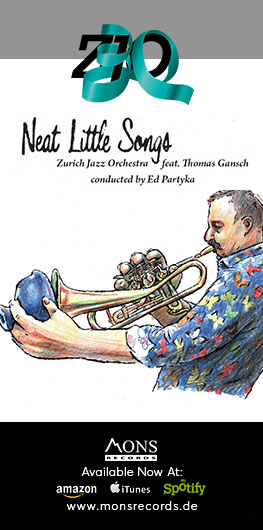
Andrew Read: A perfect example on the new Zurich album is the track with a New Orleans second line feel. That blues language is there with a twist.
Ed Partyka: Exactly. And I always try to get across to my students and younger musicians that you have to stand on the shoulders of those who came before. Knowing where the music comes from is everything. I realize it’s sometimes tough for young Europeans, because they may not get to hear as much blues or jazz live as you would in the States. I’ve had students ask why they should bother with the tradition when all they want is to make their own music. But I always say, it’s just as important for them to know the roots of jazz as it is for American kids to learn about Bach and Beethoven.
Jazz and big band music are becoming these “big tents” that can include so many styles—which is great. Europe’s great strength is that every country, sometimes even every region, has developed its own dialect for big band music.
But even with all those regional flavors, the foundation really needs to be deep knowledge of jazz history. That’s what I encourage young musicians to explore. There’s so much richness there, and it always pays off creatively.
Andrew Read: So, Ed, I want to move on to the future and what’s coming up. I’ve heard through the grapevine that you’re working on a project for yourself. Perhaps you could tell us a little about that?
Ed Partyka: Well, actually, the album just came out—on September 26th—on the TCB label, the Montreux label. It’s a label I’ve admired for years, and now I’m thrilled to be working with them. You might know that the founder was a Swiss drummer who passed away about ten years ago. For a while, the label went quiet, but now his widow, Barbara Schmidlin, is reviving it and continuing his work. She’s preparing new releases, and I’m very happy that my new album is among them.
The album is called Ed Partyka Arranger Composer, which is a direct tribute to my mentor and inspiration, Bob Brookmeyer. The title references his famous 1981 record Composer Arranger, which had a huge impact on me. Although I compose and teach composition, I’ve always seen myself primarily as an arranger. So this album is both a personal tribute to Bob and an honest reflection of how I see myself in 2025.
It features four long-form pieces—two original compositions and two arrangements—and it’s the first album with my own jazz orchestra that doesn’t have a guest soloist or vocalist. It’s just my band, my writing, and the soloists from within the group. For me, that’s a big milestone. The timing just feels right, and so far, the feedback and reviews have been really encouraging. It feels like one of those rare moments of serendipity.
Andrew Read: So it sounds like this marks not just a release but maybe a shift in focus for you?
Ed Partyka: Exactly. I’m very optimistic. For much of the last decade, most of my work has been arranging—writing for others, which I love—but now it feels like time to focus more on my own composing. People keep telling me there’s something special in my compositions, so I want to lean into that. With my Helsinki tenure wrapped up, I finally have some time and space in my schedule again.
Composing, for me, is a slow and sometimes difficult process. I know musicians who can turn out a composition a week, but I’m definitely not one of them. It takes time. Arranging, on the other hand, comes fast and is genuinely fun. I’ve always joked that composing is like eating your vegetables—hard work—but the reward is that afterward, you get dessert, which is arranging the piece you just wrote. That’s what keeps me going.
So, in the next few years, my goal is to carve out more time to compose—not just for my own jazz orchestra but also for the Zurich Jazz Orchestra.
Andrew Read: You mentioned that arranging feels like the fun part. Do you see the two processes as separate, or are they intertwined? How do you think about where composing ends and arranging begins?
Ed Partyka: That’s a great question, and honestly, they’re deeply connected. Even when I’m writing a straight arrangement, there’s always composition involved. Every introduction, shout chorus, or background line is a form of composition in itself.
When I write a new piece, it usually starts with a simple melody—often just in my head, sometimes without any particular style or rhythm attached. That’s something I learned from Brookmeyer. He always encouraged us to start with melody alone, completely neutral—no swing feel, no Latin groove, no accompaniment—just the line itself.
Once I’ve got a melody that feels natural, I start finding the bass notes underneath it, then the harmonies grow around that. It’s like building layer by layer. Eventually, groove, tempo, and the character of the piece begin to define themselves. By that stage, I’ve got a basic lead sheet, and from there, it naturally evolves into an arrangement.
Every composition is a bit different. Sometimes the form is planned out in detail before I even start writing; other times, I dive straight in and let it unfold. There’s no one proven formula. In fact, that’s part of the beauty—and the frustration—of music. I’ve written pieces quickly that turned out beautifully, and others that took months and still didn’t land the way I hoped. And I’ve seen the reverse happen too. That unpredictability keeps me on my toes.
Andrew Read: I always end my interviews with this one: What’s still on your bucket list? It doesn’t have to be musical.
Ed Partyka: Oh, there’s still plenty left to do. Musically, I definitely want to keep composing more. I’d love to write a full-scale suite at some point—not just for big band, but something that bridges orchestral writing and jazz language.
As for travel, I’ve been fortunate to see a lot of the world, but I’ve never been to Japan, and that’s at the top of my list. It has such a great jazz and big band culture. I’ve done collaborations with Japanese musicians but never set foot there. If the invitation doesn’t come soon, I’m just going to book the trip myself.
And I want to get back to Australia. In 2017 and 2018, I spent the European summers—Australian winters—on Rottnest Island, near Perth. It’s this gorgeous, almost deserted island in winter, and they used to offer long-stay artist residencies there. I spent eight weeks one year and ten the next, and they were two of the most creative and productive times I’ve ever had. I wrote a lot of music there.
It’s something I’d like to do again—just take the time to step away from everything, disconnect, and focus purely on composing. So yeah, that’s still high on my list. Besides that, I have a lot of projects I’d like to finish—more albums, more collaborations, perhaps a standards album with Efrat Alony, and continuing the ongoing partnerships with Ola and China. I’m definitely not out of ideas yet.
Those are the big goals—just to keep creating, keep writing, and keep loving what I do.
Last modified: May 5, 2026