 Written by
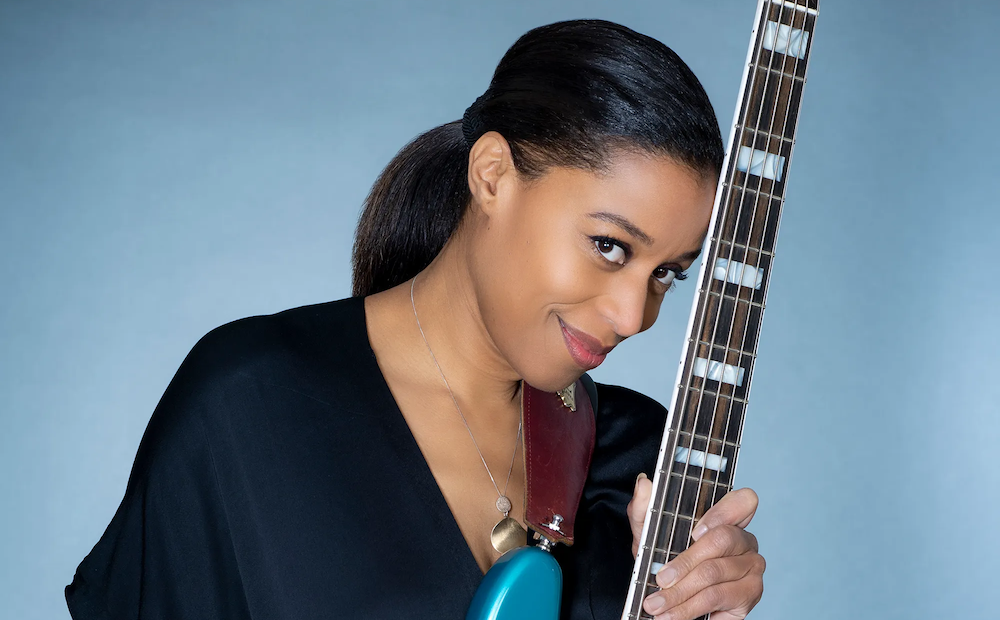
 When I was first told I was going to be speaking to Yolanda Charles, I instantly recognised the name. Like many, I was guilty of knowing Charles for her incredible career as a session musician with the likes of Paul Weller, Squeeze, BB King, Mick Jagger… the list goes on. Charles has been playing professionally since 1989 and is a definite force in the industry. But I wanted to take this opportunity to understand Charles as a bassist and music maker in her own right, as she builds on her own bands, Project PH and Triometry, and music support consultancy, The Dawning Cooperation, as well as running her own record label Mamayo Records. It is understandable that she was awarded an MBE through the 2020 Birthday Honours for services to music.
Photo by Tina Korhonen
It would be almost impossible to narrow down Charles’ musical interests, as she does it all so well. From fusion to film music, Yolanda Charles has an understanding of the bass like no other, and it is fantastic to see this skill being passed down through her teaching at institutions like the Royal Northern College of Music and Trinity Laban Conservatoire of Music and Dance. I caught up with Yolanda Charles, to find out more about her past and how it has influenced her ever exciting present life and career.
So firstly, how are you? And what have you been up to recently? Any projects or music that you’ve been working on?
Yes, I’m in a trio called Triometry. We were looking for a science-y name as it’s a personal interest of mine. Previously I’ve led my own bands, this band is led by myself and Nick Linnik, who is the guitarist of the band. He’s writing most of the stuff because it’s a guitar-led trio and I’m involved in the arranging side of things. There’s three of us including drums, with our drummer Nicolas Viccaro. He’s a bass player’s drummer.
What does that mean?
Well, it’s just that if you look at his resume, you’ll see that he often gets hired by bands that are led by bass players. So Étienne M’Bappé books him often, Richard Bona also, even Kinga Głyk, who’s a rising star on the jazz scene. So, I’m looking forward to people getting to know their music because I think they are pretty special musicians. And then there’s me playing fusion, which is new for me really at this level. So I’m excited to change my direction a bit as well. I also have another band called Project PH, which is a vocal-led band. That band is parked briefly while I focus on this other project. And also because we put an album out and it’s awaiting promotion. We’ve got a new track coming out this year for that band too, loads of new stuff happening.
So with this band that you’re currently with, you’re currently recording an album. And then what happens after? Do you go on a kind of touring route? Or is it just performing anywhere?
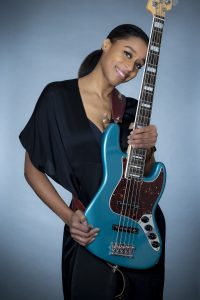
Photo by Tina Korhonen
There are a few venues and promoters that I can approach to give us one-off gigs. But because our drummer lives in France, we should be doing block bookings and trying to book a tour. It’s hard to get a tour in place. So I think the idea is just to get some videos out there to show people what we’re doing, and hope that you can get enough interest that people will agree to give you a gig. In the jazz scene, it’s less tricky because the scene is so small, so it is easier to get gigs in some ways compared to big pop venues. But they’re usually not very well paid.
So you were talking there about playing between different genres. What changes in your style of playing when you go from one genre to another? Or is there kind of a ‘feel’ change?
Each genre has its own particular identity for the bass player. So the bass player needs to understand what’s appropriate for that genre. And you get that knowledge through listening or just learning what someone else has played and then adapting it to your style a little bit. Influencing the part in the way you play, but you’re still playing the right kind of combination of notes that is appropriate for that genre. And that goes for every style.
You have the right rhythmic interplay, the right understanding about the harmony and the feel. I mean, every bass player and musician should be able to adapt their feel to whatever is required. But it’s a skill, definitely, and not everyone can do it. And those of us that can, get booked from all different directions, as we’re highly adaptable, which is great.But it also makes you a bit known for doing a lot of different things and not necessarily known for doing one specific thing, which has its value as well. So it’s not to say that it’s better to do everything, but it’s definitely a pathway for a career if you can do a lot of different styles, you know?
And do you have a particular favourite?
Well, my first, what I was raised with, I think everybody loves what they were raised with. I was raised with funk, soul and jazz. In terms of taste now, I like jazz fusion a lot because it gives me a chance to stretch out as a musician. And it’s sort of almost formative years stuff. I started listening to jazz fusion when I was in my late teens. And it just opened my eyes and blew my mind. So I’ve never sort of lost that love for being surprised and impressed by the music. This trio that we’re doing is jazz fusion, and it feels like I’ve come full circle to do the thing that I wanted to do when I was young. So it’s quite exciting.
Could you tell me a bit about how you got into the bass and your background in music?
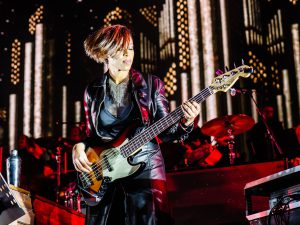
Photo by Maria Zhytnikova
I’ve got a book that I’m releasing chapter by chapter on Substack where I include a lot of detail about how I began playing and what influenced me. But a broad overview is that music was mega important in the house. I had a musical ear, but no musicians around me. School enabled me to learn an instrument because they had that programme for people from my background. And I ended up falling in love with playing an instrument. I found the right instrument after many years. You know, I started when I was seven. I found the bass when I was about 15. I went on to do a little bit of Further Education in music, but stopped at a point before degree and postgrads and A-levels even, I didn’t even do that. And became self-taught from that point onwards. The reason for that was because I actually ended up starting work. I think I know that I’m an innate musician and I would have been doing something musical, even just for fun, if I hadn’t done it as a career. It’s just the thing that makes the most sense to me in terms of the way the world works, you know.
You’ve had such a broad career so far. What is a standout moment for you?
I’d say that most standout moments have always been personal victories that no one else knows about: things you’ve overcome, anxiety moments or bucket list things that nobody else knew. I think playing my own music for the first time ever, that I’d written. That was monumental for me.
What’s your composition process? How do you write a song?
I realised that my songs are all written from real life experiences, but not necessarily mine. So I might be witnessing somebody else’s story, I might be inspired by a conversation I’ve had or listened to. It’s got to a point, because I’ve done that a lot, that I’m a writer as well. It’s not my career, but I do consider myself a wordsmith. I would say that now, because I’ve done it so much over the years, that I can write a story from anything: the elements, objects, other people’s stories, ideas, abstract concepts.
Do you ever start from a bass riff? Or do you start with the harmony, coming up with a chord progression? Or is it just kind of what happens in the moment and the story you want to tell?
I could intentionally decide I want to write a bass riff heavy tune and then everything will come from the bass. If I’m writing based on a story, then it comes from the story. The story gives me harmony because the harmony is chosen based on what the sentiment is. Also, writing from the melody and then harmonising it afterwards so that the harmony can go in any direction, that’s always fun as well.
I was just wondering if you’ve ever faced difficulties as a woman in the music industry?
I think that’s the experience of most women, isn’t it? I mean, I’ve been in many situations where I’ve offered and volunteered ideas. Then seeing that it’s been disregarded or ignored and then the same ideas pop up as if they’re new but they’re offered by a man and taken seriously. This happens in my business too. So it’s not even that I’m not respected. I have some kind of credential people seem to respect, but it does feel that there’s this barrier that people have that doesn’t allow them to accept a woman being in a role of responsibility unless it’s very official.
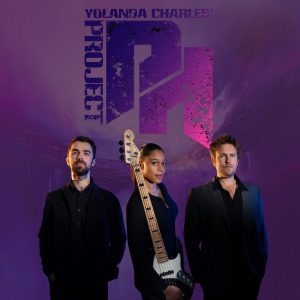 I’ve got to a point now where I’m really tired of it in terms of asking or waiting for anybody to notice my work or to listen to the ideas I have and see the value in them. It feels like every space I’ve been in there’s this diminishing, reducing, ignoring, disregarding, and form of invisibility of your skillset. I might be applauded for being a bass player but not really be applauded for having any kind of brain or anything to say of note. So rather than waiting, I’ve carved my own space out and I’ve started my own company where I can be the boss and I know that I won’t be treating anyone like that, and I also know that I won’t be there waiting for an invitation. I can actually make more of a statement.
When it’s around race, it feels the same individually but societally it has a different kind of impact. It’s not that it’s to downplay other people’s suffering when they go through similar things, but it’s just that when an individual is ignored it’s because of a perception of their character, not because of their skin colour. If it’s a perception of your character you can kind of alter that a bit. You can kind of like get some training, get some positive affirmation stuff going on, learn how to be more assertive and find the correct verbalisations and the correct terms to then impress upon others that you are someone to be trusted, and then you can change that perception of yourself. When it’s based on your skin colour, you can’t. You’re forever judged no matter what you do, no matter how much training, credentials, skill and that’s where it’s not equal. All of the discrimination is not equal. Some of the discrimination is something that is so unfair and leaves you feeling so helpless and unable to change a single thing about the perception of yourself, that it’s debilitating. Whenever I have conversations about these things, I do like to acknowledge that we all can suffer from discrimination, but I think it’s worth highlighting that when you can’t change people’s perception by anything you do, then it’s up to them to make the change.
This interview was originally published in the March 2026 Women in Jazz Media magazine
Follow Yolanda Charles:
Last modified: May 8, 2026