
 Written by
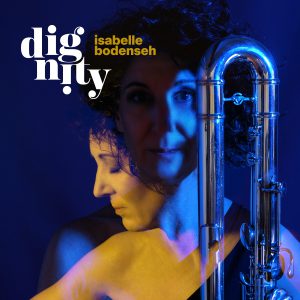
 Isabelle Bodenseh’s new album Dignity presents us with a deeply personal insight into her multi-faceted world. Through her music, we see Isabelle – musician, composer, wife and mother – and how all those worlds connect through truly stunning soundscapes. Her improvisational skills shaped her navigation through life, and the album shines a much-needed light on the gift of bringing a severely disabled child into the world. The joy and challenges of motherhood, the growth that comes out of that explicable bond and where music is at the forefront of human connection. Isabelle lays herself bare and we are all the better for it.
 Coming from a family of musicians with French and German heritage, Isabelle found the flute at a young age and it has been her companion ever since. Initially trained as a classical musician, Isabelle found quite early on that the rigidity of classical music left her wanting something more and the moments she spent as a child with her father, just freely playing without sheet music, stayed with her. Exploratory spaces have driven her throughout her career, embracing different musical cultures across the world, with time spent in Cuba and Los Angeles and Isabelle says that she ‘became a free world musician with a universal understanding of music, without barriers’
Looking back over her albums, Isabelle reflected on their themes and what has driven her work. Her first album in 2017 ‘The Good Life’ speaks to exactly that, ‘the good life’, followed by the musical recipe driven Mrs Bo’s Cookbook in 2018, Essenza (2020) reflecting upon communication and the essence of life in the Flowing Mind (2023) brought Isabelle to the place when her new album Dignity started to take shape.
‘Being a mother and after 20 years, you start thinking about what happened, what is, not the end of the story, but what is on the other side. Shortly after Flowing Mind, I was thinking well what is actually flowing in your mind, Isabelle? I had this feeling, thinking about everything over my past albums and I realised for me it was about dignity. I was always searching for something and this is what happens when you are curious, and you look to your inner voice and you actually listen to it.’
As a classically trained musician, Isabelle found her home in jazz.
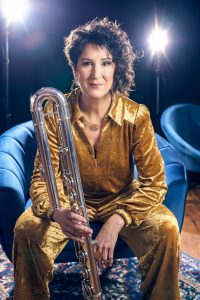
Photo by Carola Schmitt
‘These are two worlds and I think in the middle is the best. You have the hard structure of classical music and the freedom of jazz and in the middle is the gold for me where I really feel very comfortable and I feel complete. I started with classical music but didn’t feel complete and felt that there was something missing. For me, it was important to open the door to other cultures and I always wanted to be able to play anywhere in the world. To go to another country and to understand the rhythms and the tonality. It was always my wish to be a world musician, to go to Japan or to Indonesia, any country, and to be able to play with the people there.’
Music – and in particular, improvisation – has been an inspired and vital part of communication with Juliette, Isabelle’s daughter. Due to a birth defect, Juliette cannot walk, sit up on her own, speak, or hold her head up herself. She cannot coordinate even the smallest movement. Isabelle explains that Juliette ‘chose’ her.
‘Shortly after her birth, it suddenly became clear to me that nothing would be as I had imagined. I abandoned the societal clichés of ‘a happy family’ and instead, with all my creativity, built my own independent perspective on happiness.
My lifelong experiences and perspective on music provided me with a solid foundation. Right from the beginning, it was clear that Juliette felt the music from when she was young, always. She went to my concerts, always in the first row, and she knows every melody, every composition. When I was teaching, she was always lying on the floor, listening to my pupils and laughing when I had to say you didn’t practise, she was always very funny.
It can be joy.
It can be fear.
It’s all about dignity.

Photo by René van der Voorden
We had to learn what was dignity? What was respect? What is tolerance? When I see my family now after 23 years, I realised that she was a present for us. She was really a present. And as a family, we could do this, and we were able to handle it. I had to learn patience, but many of these things I already had because of improvisation. In Jazz you have to be flexible and invent something new and this was an enormous base for me to understand my daughter and to never give up, to be very patient, to continue, to keep going even if things don’t work.’
A deeply personal album, and yet so much that resonates with the audience. The beautiful depth of the bass flute is truly an extension of Isabelle and the connection she has is exhilarating.
‘I hope the audience can feel the deepness and the breath, especially with the bass flute. That they fuse the authenticity of the music and find their own room in the music and just feel. The bass flute can be very intense, intense vibrations, but it is an extension of me, and sometimes people tell me that I am the flute.’
Listening to this album is truly inspiring. Thank you Isabelle for sharing this gift with us all.
Isabelle Bodenseh website click here
This article was originally published in the March 2026 Women In Jazz Media magazine
Cover photo by René van der Voorden
Last modified: May 8, 2026