 Written by
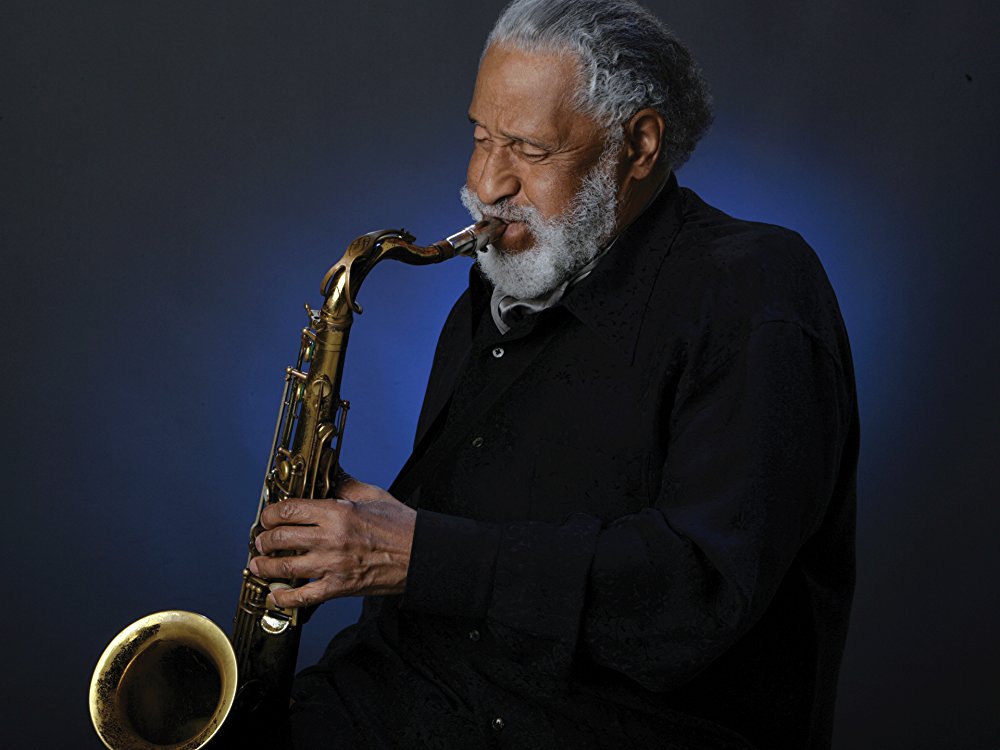
 I have been listening to Sonny Rollins for most of my life, but it is only now, in the wake of his death on May 25, 2026, that the full weight of his presence feels measurable. Rollins, who died at 95 at his home in Woodstock, New York, was never simply a saxophonist. He was a force of continuity in jazz, a restless mind who refused to settle, and a musician who treated sound as a lifelong inquiry into selfhood. When the news was announced “with deep sorrow and profound love,” it carried an unusual resonance, because Rollins himself had long framed life and death as part of a larger, ongoing process. “I think when the creative person ends, he continues in the next existence,” he once said. It is difficult to listen to his music now without hearing that belief embedded in every phrase.
I often think back to where his story begins: Harlem, 1930. Not just a birthplace, but an ecosystem. Rollins—born Walter Theodore Rollins—grew up in a neighborhood that seemed to generate rhythm as naturally as breath. Harlem was swing and stride, Caribbean memory, political awakening, and Black American self-invention all at once. His parents, migrants from the Virgin Islands, brought with them a quiet dignity and resilience, while his grandmother, who had marched with Marcus Garvey, connected identity to history in a way that would stay with him for life. Even as a boy, he was already listening with intent, standing outside the Apollo Theater and the Savoy Ballroom, absorbing what he could not yet fully understand.
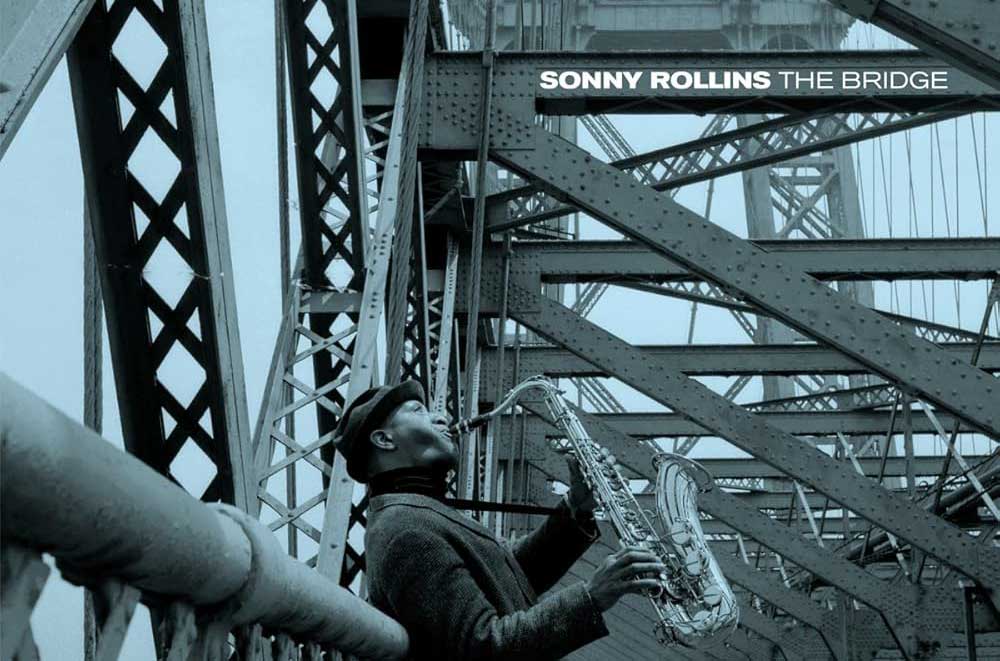
Limited 180g vinyl LP reissue of The Bridge (Jazz Wax), Sonny Rollins’ 1962 comeback album following his self-imposed hiatus from public performance between 1959 and 1962.
When he heard Coleman Hawkins, something clicked. That tenor sound—muscular, lyrical, unapologetically full—became a point of departure. By the time his mother managed to buy him a saxophone during the Depression, Rollins had already decided, consciously or not, that this would be his language. He disappeared into practice with a kind of total commitment that would define him. Music, at that stage, was not a career. It was a necessity.
What strikes me, looking back, is how quickly he found himself among giants—and how naturally he belonged there. At Benjamin Franklin High School he was already surrounded by future architects of modern jazz: Jackie McLean, Kenny Drew, Art Taylor. Thelonious Monk entered his life not as a conventional teacher but as a catalyst. Monk did not instruct; he permitted. He showed Rollins that originality was not optional. It was the work.
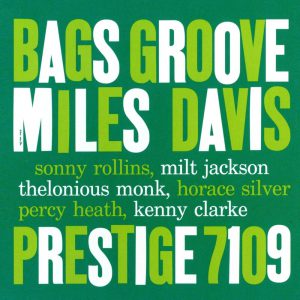
Miles Davis – Bags’ Groove (Prestige, 1954), featuring Sonny Rollins compositions “Airegin,” “Oleo,” and “Doxy,”.
By his early twenties, Rollins was recording with J.J. Johnson, Fats Navarro, Art Blakey, and Max Roach, and contributing compositions to Miles Davis sessions that would become part of jazz’s core vocabulary: “Airegin,” “Oleo,” “Doxy.” These were not just tunes; they were frameworks that musicians still think through today. Davis once remarked, with characteristic brevity, that Rollins had “that thing you can’t teach.” I hear that “thing” most clearly not in speed or virtuosity, but in the way Rollins thinks inside a solo.
He builds. He questions. He returns.
Where many improvisers move elegantly across harmonic structures, Rollins constructs narratives. He takes a motif, turns it over, stretches it, interrupts it, jokes with it, and then resolves it in ways that feel both inevitable and surprising. Listening to him, I often feel less like I am hearing a performance and more like I am following a line of thought as it unfolds in real time. Even his humor—quoting nursery rhymes, bending familiar melodies—feels deliberate, a reminder that intelligence and play are not opposites.
And then there is the decision that still feels almost mythic: his withdrawal at the height of his success. By the late 1950s, already celebrated, Rollins stepped away because he was dissatisfied with his own playing. He went to the Williamsburg Bridge and practiced, relentlessly, for hours each day. Not for an audience, not for a recording, but for alignment. When he returned in 1962 with The Bridge, I hear not just technical refinement but a shift in consciousness. The playing breathes differently. It listens to itself.
This pattern—withdrawal, transformation, return—became central to how I understand him. His later travels to India, his deepening engagement with meditation and breath, his emphasis on long tones and endurance: these were not side notes to the music. They were the music. Rollins often spoke less about scales than about awareness. Are you listening? Are you honest? These are deceptively simple questions, but in his presence they carried weight.
I met him once, briefly, in San Francisco in the late 1990s, during a rehearsal for a festival performance. What stayed with me was not anything he said in particular, but the intensity of his focus. There was no separation between the man and the music. That encounter sharpened my own sense of what jazz could demand—not just technically, but ethically.
In his later years, Rollins came to be seen, rightly, as a kind of conscience of jazz. He carried the lineage—Hawkins, Parker, Brown—not as nostalgia, but as responsibility. Each performance felt connected to those who came before and those who never had the chance to continue. Even when he played something as outwardly light as “I’m an Old Cowhand,” there was an underlying seriousness of intent: a refusal to let the music become static. That sense of stewardship was formally recognized in 2011, when he received the Kennedy Center Honors, one of the United States’ highest cultural distinctions. Still performing with undiminished focus in his eighties, Rollins accepted the award not as a culmination, but as part of an ongoing journey—an acknowledgment of a lifetime spent expanding the music while remaining accountable to its history.
I find myself returning now to that image of the bridge. Not just the Williamsburg Bridge where he practiced, but the idea itself. Rollins understood music as a bridge between solitude and community, discipline and freedom, body and spirit. That is what I hear when I listen to him today: not closure, but continuation.
He leaves behind an immense body of work, but more importantly, a way of thinking about music that resists finality. His solos do not conclude so much as open outward. They invite participation. They ask something of the listener.
And somewhere in that sound, I still hear the boy outside the Savoy Ballroom, listening closely, already becoming.
Last modified: May 29, 2026