 Written by
 As the jazz world marks the centenary of three of the music’s most towering figures — Miles Davis, John Coltrane, and Tony Bennett, all born in 1926 — the releases and tributes are coming thick and fast. Of all the recordings being revisited and repackaged this year to honour Miles Davis, one stands apart for its historical significance, its enduring musical power, and its particular resonance for European audiences. Decca Records France has announced a suite of deluxe reissues of Davis’s legendary soundtrack to Louis Malle’s 1958 film Ascenseur pour l’échafaud, available from 22 May 2026. This is the release I have been most looking forward to, and it will be the centrepiece feature of the Summer edition of Jazz in Europe magazine.
To understand why this recording matters so much, it helps to understand where Miles Davis was in December 1957, and to that end, where jazz itself was heading. The previous eighteen months had been among the most creatively turbulent and productive of his career. In the summer of 1955 he had announced his return to the scene at the Newport Jazz Festival with a performance of “Round Midnight” that stopped the crowd in its tracks and led directly to his signing with Columbia Records. By 1957 he was leading what many still consider the greatest small group in jazz history, the first great quintet, with Coltrane, Red Garland, Paul Chambers, and Philly Joe Jones, and recording at a pace and level of inspiration that remains astonishing in retrospect. Cookin’, Relaxin’, Workin’, and Steamin’, all recorded in two marathon sessions in 1956 for Prestige, were in the process of being released. Miles Ahead, his first major collaboration with arranger Gil Evans, had been recorded for Columbia in May 1957 and would be released that autumn — a record that opened an entirely new chapter in his relationship with orchestral colour and impressionist mood.
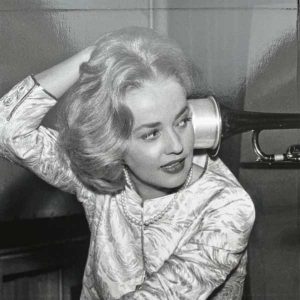
Juliette Gréco
It was in this context, with Miles already in the process of dismantling one approach and building another, that Davis arrived in Paris in late 1957. He felt a real connection to the city and to France in general, where people appreciated his music more deeply and tended to take him more seriously than he often experienced back in the USA. He had first visited in 1949 and had formed a deep personal connection with the city. Also there was Juliette Gréco, with whom he had a significant relationship during that earlier visit. Paris represented something for Davis that went beyond music: a place where he was seen and respected as an artist without qualification. His return in 1957, performing at the Club Saint-Germain on the Left Bank, was both a professional engagement and a homecoming of sorts.
Louis Malle, meanwhile, was twenty-four years old and preparing his debut feature as sole director. He had previously co-directed Le Monde du silence with Jacques Cousteau, but Ascenseur pour l’échafaud — a taut, stylish thriller adapted from a novel by Noël Calef — was his first fully independent work. The film’s plot turns on a meticulously planned murder that begins to unravel through a series of accidents and misfortunes, and its visual language — cool, shadowy, deeply indebted to American film noir — was strikingly assured for a first feature. Malle had initially planned a more conventional score, but once persuaded to approach Davis he recognised immediately that the trumpeter’s sound — introspective, ambiguous, capable of conveying both menace and melancholy in a single phrase — was exactly what the film needed. The instinct was impeccable. It is almost impossible now to imagine the film with any other music.
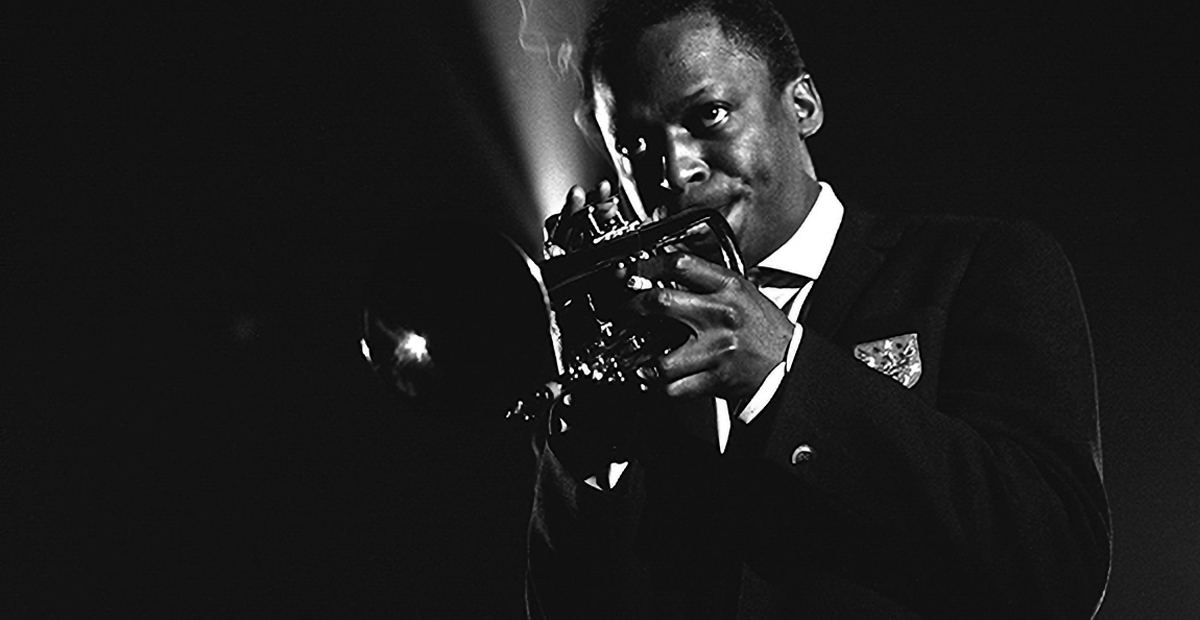
The story of how this recording came to exist is one of the great pieces of jazz folklore, and it deserves retelling. Davis attended a private screening and agreed to record a soundtrack. On 4 December he arrived at the studio with four musicians then based in Paris: Barney Wilen on tenor saxophone, René Urtreger on piano, Pierre Michelot on bass, and Kenny Clarke on drums. What followed that night, and the night after, produced one of the most atmospheric and original recordings in the history of jazz. The circumstances were, even by Davis’s standards, extraordinarily minimal. He had sketched a handful of simple harmonic sequences in his hotel room and shared them with the band shortly before recording began. No composed themes, no elaborate arrangement — just loops of key scenes from the film projected in the studio while the musicians improvised directly to the images. Bassist Pierre Michelot later recalled that Davis simply asked the band to play two chords — D minor and C7, four bars of each, ad lib. It was a characteristically Davisian approach: strip everything back, trust the atmosphere, trust the players.
François Leterrier, the film’s second assistant director, was present through the night and remembered the session beginning around ten in the evening and continuing until dawn, the musicians watching Henri Decaë’s black-and-white images — including Jeanne Moreau’s celebrated nocturnal walk along the Champs-Élysées — in a darkened auditorium. “All of us there were aware that something extraordinary was taking place,” he recalled. “Something that had definitely never happened before.” The band he had assembled was well chosen for the task. Barney Wilen, just nineteen years old, was already one of the most promising saxophonists on the Paris scene. René Urtreger was among the finest French pianists of his generation. Pierre Michelot and Kenny Clarke — the latter a founding father of bebop drumming who had relocated to Europe permanently — gave the rhythm section both weight and sophistication. It was a group capable of the sensitivity and the musical intelligence the session demanded, and they delivered.
What makes Ascenseur pour l’échafaud so remarkable, nearly seventy years on, is not merely the mythology surrounding its creation but the music itself — tense, nocturnal, charged with dramatic intensity and a spare, haunting lyricism that feels as contemporary today as it did in 1957. It is one of the only film scores in history to have been entirely improvised while the musicians watched the film, and it remains one of the most successful marriages of jazz and cinema ever achieved. Davis’s muted trumpet, floating over the sparse harmonic framework provided by the rhythm section, defines the mood of Malle’s film as completely as Bernard Herrmann’s strings define Hitchcock. In the broader arc of Davis’s career, the session also points clearly towards the direction he would pursue with increasing conviction over the following two years — the modal language, the economy of means, the emphasis on atmosphere and space over bebop complexity — culminating in Kind of Blue in 1959, arguably the most influential jazz album ever recorded. Ascenseur pour l’échafaud is not a footnote to that story. It is one of its essential chapters.
The recording was first released in 1958 on Fontana in Europe and Columbia in the United States, awarded the Grand Prix du Disque by France’s Académie Charles Cros, and later earned a Grammy nomination in 1960 when it appeared in the United States on Columbia’s Jazz Track compilation. It has never been out of circulation for long, but the new Decca France reissue programme is by some distance the most comprehensive and handsomely produced presentation the recording has ever received.
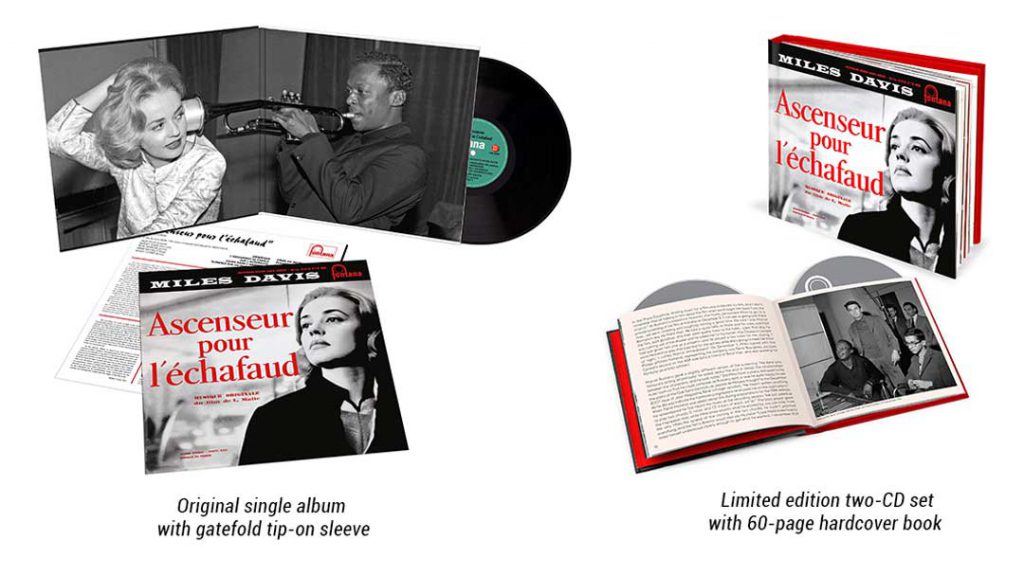
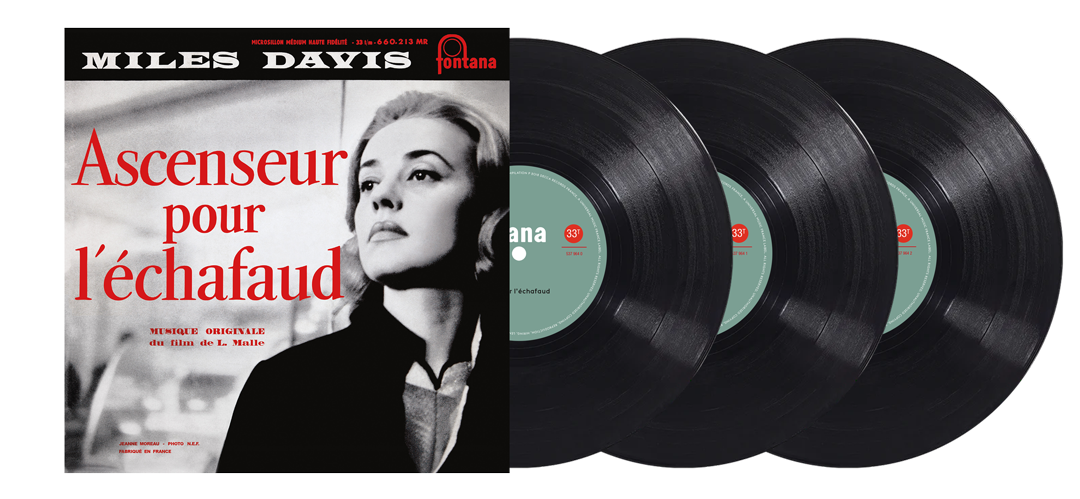
Three formats are available. A 180g vinyl LP presents the original album in a gatefold tip-on sleeve, complete with an English translation of Boris Vian’s original liner notes and Jean-Pierre Leloir’s iconic studio photograph of Davis with Jeanne Moreau. A deluxe three-10″ vinyl edition expands the release to include the complete session takes from the December 1957 recordings, housed in a three-panel gatefold with Franck Bergerot’s essay A Present from Miles Davis to Louis Malle. The most comprehensive option is a limited edition two-CD set, which brings together the original album and all surviving takes from the sessions of 4 and 5 December 1957, accompanied by a 60-page hardcover book featuring notes by both Ashley Kahn and Franck Bergerot. For anyone seriously interested in how this music was made — and what was left on the studio floor that December — the CD set is the edition to have.
In a centenary year that will produce no shortage of Davis reissues and tributes, this one stands out. It is not simply a repackaging of familiar material — it is a genuine archival event, presenting the complete surviving documentation of one of the most remarkable recording sessions in jazz history. We will be devoting the feature interview slot in the Summer edition of Jazz in Europe to this release, and I cannot think of a better way to mark one hundred years of Miles Davis than sitting down with this music and hearing it properly, in the best possible sound, for the first time in decades. Highly recommended in all three formats.
Ascenseur pour l’échafaud — deluxe reissue editions are released on 22 May 2026 via Decca Records France.
Last modified: April 19, 2026