 Written by
 Natalia’s new album sets her own compositions for string quartet and voice, and it is the product of a fairly unusual route through music — gypsy violin, a decade in a chamber quartet, a late switch from violin to viola, and years of playing wedding and jobbing gigs alongside it all. It’s a quietly personal record, built from music she has been carrying around for a long time. I spoke with her about how that background shaped it, and how a violinist ends up writing and arranging for four strings and a singer.
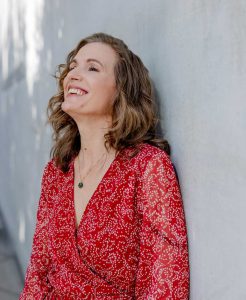 I have known players who came to jazz violin by the obvious road — classical training, then a slow conversion. Natalia’s road was stranger than that, and more interesting, and it is worth telling properly. She did not choose the violin. It chose her, in the way these things sometimes happen to five-year-olds: a teacher at an elementary music school decided she was musical enough to be handed the hardest instrument in the room, and that was that. A tiny violin, an indifferent teacher, and a child who — by her own account — never took to classical music with any real conviction. What she loved was the instrument itself, not necessarily the repertoire she was given to play on it.
That distinction matters, because it explains a good deal of what follows. Classical training, for Natalia, came with a lot of pressure attached. “If you make one mistake, it’s a catastrophe,” she told me, describing the mindset that hung over performances in those early years. It’s a familiar enough experience among classically trained musicians who later move into jazz, but for Natalia it was pronounced enough that it took an entirely different kind of teacher to loosen it.
It is not the usual route into jazz violin, and Natalia is the first to admit that. At seventeen she found a teacher who taught gypsy violin entirely by ear — he couldn’t read music himself — and built his whole method around one instruction, repeated constantly: first sing, first sing, if you can’t sing it, you can’t feel it, you can’t play it. Around the same time she was doing weekend courses in body percussion, picking up the berimbau, and drifting into a free jazz school housed in the same building. None of it added up to a curriculum. It was more a string of unlikely doors opening one after another.
Her teacher also taught her to accompany — to comp chords and rhythm on the violin behind another soloist — and she points to that as a real turning point, the moment she started thinking like a rhythm section player rather than a melody instrument waiting its turn.
Finding anyone to formally teach jazz violin proved harder. A few players she approached could perform but had no idea how to teach it; one simply told her she couldn’t afford him. She eventually landed a two-year private jazz course, then, on a friend’s example, applied to study jazz violin as her major at the conservatorium in Arnhem — a genuinely unusual credential for the instrument, and the point at which an informal, self-directed education turned into something official.
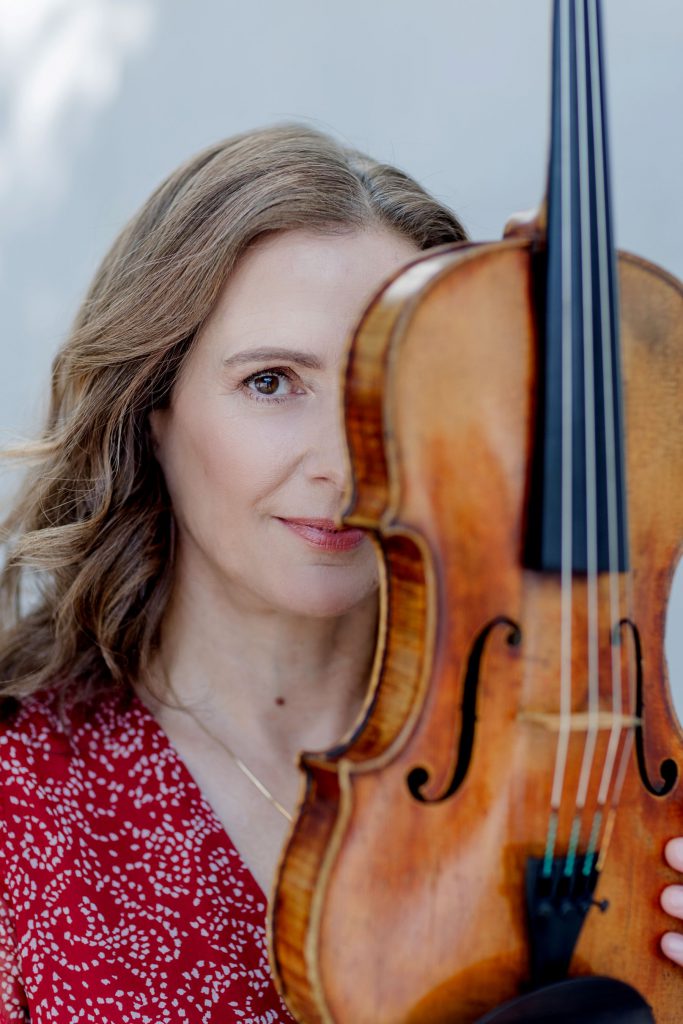 What she says about the violin’s place in a jazz idiom gets at something real about the instrument’s identity problem in the music. It can sound artificial, she agrees, but it also carries a wider tonal palette than it’s usually given credit for — portamento slides between pitches, sul ponticello for a thin, scraped edge near the bridge, or a full, open tone that comes close to a human voice: crying, a door, rain, wind, sometimes barely more than breath. Where a horn player has to stop and breathe, shaping jazz phrasing into natural units, a bowed string player doesn’t have that built-in punctuation — for Natalia, that’s both the instrument’s gift and its central problem when it comes to swing. Classical players, she notes, tend to draw a lot of notes out in one long bow when playing jazz; players coming from gypsy music cross the strings more, breaking the line up differently. She worked at closing that gap the way her teacher had shown her years earlier — hearing a chord on the piano, playing it, recording it, singing it, playing it again — building a bowed equivalent of vocal phrasing by ear. That instinct toward the vocal runs straight into how she composes: she describes herself as drawn to vocal jazz and to words, and it’s no surprise the new album’s writing is lyric-led and built around a singer.
That vocal instinct, and the years spent finding her own place within a group rather than out in front of one, set up the next chapter of her story. By the time the quartet came together, Natalia had already walked away from her own band — the jazz group she’d led through her studies and for several years after, before the constant organising and other people’s opinions about who she should be wore her down enough that she folded it. What followed was a quieter stretch: teaching, a trio doing swing and gypsy material, singing lessons, filling in as an alto in a choir when they were short a voice. A classical string quartet was not part of any plan.
It began, appropriately, on a bus. Natalia noticed a woman with a violin case sitting nearby, twice, at the same time on the same route, and eventually the two struck up a conversation. That was Johanna, and the meeting turned into a ten-year musical partnership. Johanna, Natalia points out, is also an excellent pianist, and when the quartet needed a viola player she switched to it herself without much fuss — a piece of quiet versatility Natalia clearly admires. When the roles settled, Johanna took first violin, the instrument she’d always loved, and Natalia took viola. It suited her: she had never wanted to be the one standing out front, and after years of leading her own band, playing a supporting role inside a quartet was, if anything, a relief.
That quartet soon pulled her into repertoire she had never intended to play — Schubert’s Death and the Maiden, Mozart divertimenti, Haydn quartets — genuinely demanding writing, and quartet playing is widely considered one of the toughest settings a string player can work in. The adjustment took real effort. She couldn’t properly read alto clef at first, so Johanna covered for her on viola in early rehearsals while Natalia sat in on first violin, swapping back once she’d caught up. She learned bow discipline from her colleagues in that period — where to play in the bow, how to use the frog and the tip, how to loosen a wrist that classical training had tightened rather than freed. Classical repertoire never became her main love, but she’s unequivocal about the writing itself: quartet music, she says, is unbelievable, and unusually rewarding for viola — rhythmically driving, technically demanding, and quietly central to the sound of the whole ensemble.
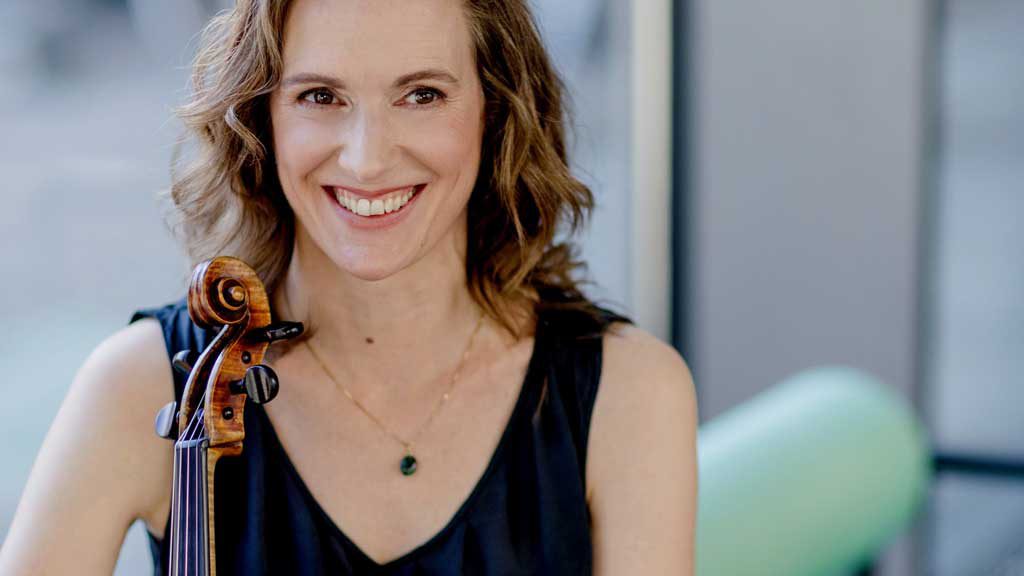
The album itself grew out of a Covid-era pause, when bookings across every part of her working life — weddings, singing jobs, quartet gigs — simply stopped. With a little time and a little savings, she decided to build a band again around her own compositions, working with a singer she has known for years, and testing whether older songs she had once recorded with a conventional jazz rhythm section could survive being rearranged for four string instruments and a voice. One track, “Love Is All There Is,” is one of the oldest songs in her catalogue — a piece about letting go and accepting things as they are, without pretending everything is fine, and one she was determined to include.
The real challenge behind the album wasn’t emotional but artistic: how do you arrange music built on jazz harmony and feel for an instrumentation with no natural home in that language? A string quartet and a jazz vocal are, on paper, two different worlds — one built on notation and blend, the other on inflection and swing — and Natalia’s approach was not to force the quartet to imitate a rhythm section, but to let it stay a string quartet and layer the jazz sensibility on top, largely through the voice. She stayed close to her original lead sheets and chord charts rather than rewriting the material from scratch, adjusting only where something didn’t sit well on strings, and worked out the arranging by ear, in the room, through trial and error: a piano-like figure split between viola and second violin for a pedal effect, a cymbal-like shimmer built from double stops on the first violin’s top string, the cello standing in for the double bass and forcing real care over intonation on long static harmonies. In the bridge sections she broke her own patterns deliberately to let the music open up, shifting an octave here, swapping which instrument carried a line there, refining until three voices did the job better than four. The record was never conceived as a jazz album trying to sound like something it wasn’t — it’s a set of songs interpreted through a classical quartet, with a jazz voice sitting across the top of it, using exactly the instrumentation she had rather than the one a more conventional jazz record would call for.
The record itself — released as Spring Again, credited to the ensemble High Fiddelity — resists easy labelling, and that’s clearly by design. It isn’t a conventional jazz record, and it isn’t a classical one either; it sits in the space between, closer in spirit to 1930s cabaret writing and French chanson than to any standard jazz-strings crossover. The eleven originals are lyric-first songs, built outward from the words rather than the other way around, which tracks with everything Natalia says about her own writing process. Karin Bachner’s vocal is the album’s clearest asset — warm, precise, and fully inhabiting the material rather than sitting on top of it, which is exactly the balance Natalia was aiming for when she talks about wanting the singer to carry the emotional weight while the quartet stays a genuine chamber ensemble rather than a jazz-rhythm-section stand-in.
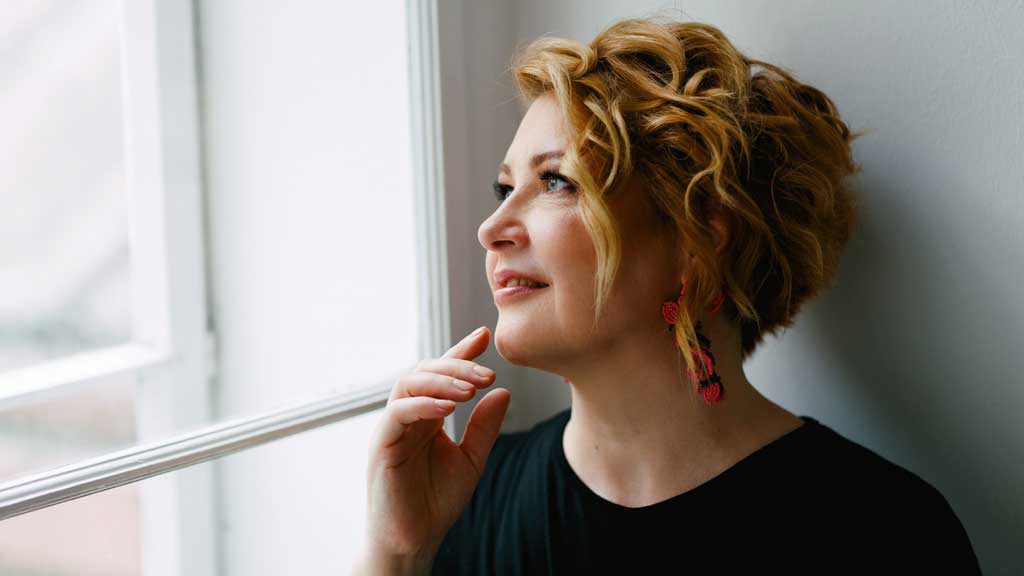
Karin Bachner | Photo by Maria_Frodl
That balance didn’t come easily, and it’s worth hearing it against what she described about making the record. The absence of a bass, for one, meant real attention had to go into intonation on the more static harmonic passages, with the cello taking on a role it wasn’t originally built for. The written-out solos — a response to realising early on that open improvisation didn’t sit naturally across four classically trained players — give the album its more composed, through-written character, the string writing doing real structural work rather than just colouring the songs. And recording everyone together in one room, without overdubs, meant the ensemble blend heard on the record is the real thing, captured live rather than assembled afterward. The opener, “Love Is All There Is,” is a good example of all of this coming together — atmospheric, strings used with real restraint, giving Bachner’s voice room rather than crowding it. It’s an album that sounds the way it does because of the choices Natalia made under those constraints, not despite them.
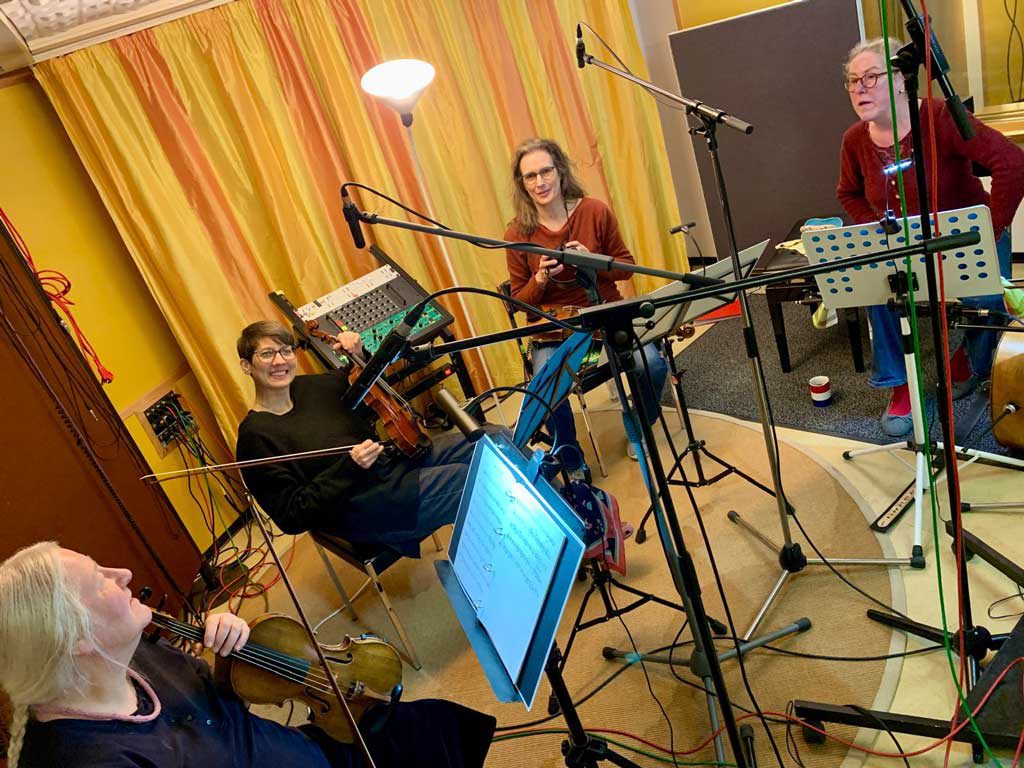
High Fiddelity_in the Studio
As for what comes next, the picture is modest but active. The quartet’s most recent concert has been filmed for release, though Natalia is trimming one song from the footage before it goes out. Live performance clearly still matters to her more than the studio version of any of this — every stage is different, she says, every audience reshapes the material a little — and she is still working out how best to describe the project to promoters and audiences who haven’t yet heard it: cinematic, image-driven listening, or simply chamber jazz. Whichever language ends up on the poster, the record itself makes the case better than any description could — four strings and a voice, telling one musician’s own story, in a shape she spent forty years finding her way toward.
Last modified: July 20, 2026