 Written by
 It takes someone like trailblazing Arooj Aftab to fill the Stavros Niarchos Hall on a Monday night in Athens. The highly anticipated concert already gained traction thanks to Arooj’s worldwide status as a Grammy – winning Bonafide rockstar. The timing of her concert was ideal, culminating the end of the three day WOW Festival. Presented by the Stavros Niarchos Foundation Cultural Center (SNFCC) in collaboration with the British Council, spirits were high for the third installment of WOW- Women of the World Festival, the world’s largest event for girls, women and nonbinary people. The festival’s two-year success in Athens has given hope to Greece as it focuses on promoting gender equality and attempting to raise public awareness of women and non-binary people. Arooj Aftab closing the event was pure poetry, as she delivered a performance that left spectators immersed in her ever transformative and ultimately, transcendental world.
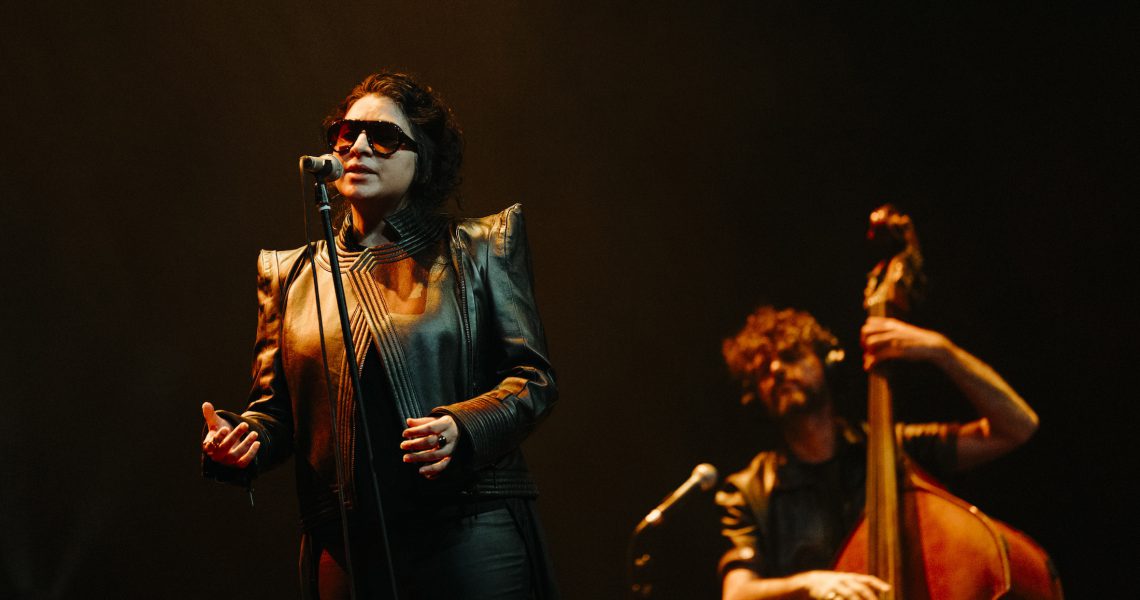
Arooj took to the stage dressed as I predicted in a glorious black ensemble and her in dubiously cool black shades, slowly and confidently taking strides shortly after her band began playing the opening song ‘ Suroor’. You could immediately tell why she has been referred to as a ‘dark chanteuse’, though as the night progressed her insatiable quirky stage banter showed another lighter side to her already wonderfully layered personality, both as an artist and human. Featuring Perry Smith on guitar, Engin Kaan Gunaydin on drums and Greece’s own Petros Klampanis on bass and electronics, Arooj’s otherworldly voice soared over the theater hall, softly at first and gaining confidence up until a magnetic moment where Smith and Gunaydin held the space for Arooj’s heavenly vocal solo. It was clear to me at that point that this was a formula Arooj had truly , whether intentionally or not claimed as one of her most admirable traits as a vocalist ; her desire to move between each musician’s offering could be likened to a small group of friends having engaged in intimate conversation , late at night in a cafe that beckoned welcomed both loud and then quiet expression of the heart and life. and honest conversation, late at night, sometimes all at once, and sometimes, taking turns. ‘Baghon Main’ was one such example, and it’s no surprise that the night takes embodies a ‘Queen of The Night’ persona that sets the overall tone for Arooj’s current album ‘Night Reign’, cleverly inspired by all the events and wonders found at night.

Arooj Aftab by Mariza Kapsabeli
Introducing her next song ‘Whiskey’, the first of two songs in English (Last Night followed) Arooj spoke to her audience about her love for the night, as if it was something of a friend so dear you couldn’t let go of. Whilst entrancement might seem the obvious word of choice here, Arooj jokingly said “before anyone gets too serious, usually at this point in the evening I buy everyone shots; unfortunately, I was told I wasn’t allowed to do that “. The audience immediately exploded into laughter; little did Arooj know that Athenian culture is heavily steeped into the majestic night, and anyone you meet is ultimately a night owl. Her lyrics which sounded out repeated annotations of “your head gets heavy and rests on my shoulder, cause you drink too much whiskey when you’re with me “gained intensity on top of Smith’s virtuosic and gentle harmonization. By the time the whole band joined in with the chorus, the audience wasn’t just completely hooked; they were drinking Arooj’s voice, one sip at a time, almost afraid to down the whole glass for fear of missing out on all the textures and flavors it would bring.
That’s ultimately one way to describe Arooj’s voice: there’s a purpose to it, almost as if she very calmly yet confidently combines the beauty of the chaotic world in a way that juxtaposes her seemingly nuanced phrasing. Her track ‘Na Gul’ for instance, a true showstopper suddenly saw Arooj voice take to the skies with higher tones and vocal melisma’s reminiscent of a cross between South Asian classical music and poetry and the intricate musicality of Maqam music. I should point out here that the definition of the word ‘Maqam’ is Arabic for one’s journey or purpose in life, a tradition that shares a similar stylistic approach in the way South Asian music is poetically communicated. Born in Saudi Arabia and then moving to Lahore, Pakistan to end up in New York after studying jazz at Berklee, Arooj is a true depiction of musical migration. I’ll agree wholeheartedly with Arooj as that if anything, this continuous rich blend of musical languages, such as her own music layered in a world-recognised alternative jazz format may truly speak for itself in its musical storytelling. So, whilst one may listen to Egyptian singer ‘Oum Khaltoum’ for instance and not understand Arabic- one can certainly ‘live’ in the notes themselves; this is precisely what Arooj has accomplished, and it is with great admiration that I place her at the same level in her own right, right up there with the likes of ‘Oum Khaltoum’ , and genre defying Pakistani singer ‘Nusrat Fateh Ali Khan’.
Isn’t that the power of music after all: to be felt, lived and heard through frequencies that enable people to truly connect, without fear or doubt?

Arooj Aftab and Petros Klampanis by Mariza Kapsabeli
Arooj is an artist that acknowledges that this is indeed a task accomplished and enhanced by the power of community and as she introduced her stellar band. Led by artistic director Petros Klampanis, whose masterfully calm leadership showed the utmost respect for Arooj’s voice, Perry Smith’s playing made his guitar sound like a mandolin, oud and harp all at the same time. It has to be said that the band’s drummer, Engin Kaan Gunaydin continuously dazzled the audience buy holding the songs in their ever-changing shape, creating a poly-phonic rhythmic backdrop to Arooj’s music, reminiscent of drummer Peter Erskine, but with an even more earnest finesse to his playing. The next song was Arooj’s single ‘Raat Ki Rani’ from her album’ Night Reign’. She charmingly explained that this is a song about “you know, the naughty things that could happen at night when you make eye contact with someone that isn’t your husband or wife, yet you have fantasies about later on”. When the audience was silent, she persisted with “you know what I mean, I know you know what I mean”. If they did, it was only revealed through coy side glances- I had to catch myself from letting out a raucous laughter. What followed was a haunting ode to an almost cinematic portal of wanton eroticism.
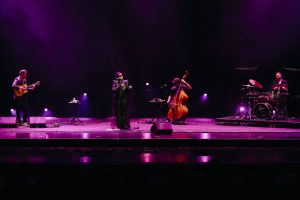
Perry Smith, Arooj Aftab, Petros Klampanis, Engin Kaan Gunaydin by Mariza Kapsabeli
I’ve mentioned before that Arooj’s music is truly something of its own accord that you don’t need to understand her lyrics in Urdu; I stand by this. The next song Arooj performed however, found me suddenly in a place of heartache, grief and sorrow all at once, and all I felt like doing was breathing in between the spaces where Arooj wasn’t singing – it made me wonder if the song was about taking the time to breathe through it all. If this is the true meaning of the song, it’s yet another testament to Arooj’s own need to sing through and with stories of “displacement, reinvention, exile, feminism and the maddening fabric of love and loss and tragedy in the world “(Shanna L. Redmond) Klampanis seemed to have shared this sentiment, ending the song with a lullaby of a whistle, subtlety and beautifully. ‘Aey Nehin’ was a welcome change of pace, lifting us to layered harmonic sequences brought to life by the guitar-harp sounds of Smith, creating almost loop-like solos throughout the song. It is known that the mark of a true artist is to witness how the recorded studio album is re-imagined for the stage; that can be said of all the musicians on stage for that matter, through Arooj’s studied and carefully crafted approach of bringing all her musical world to life.
The seemingly last song of her set (it would be in dubious to assume the audience would let her go without an encore) was ‘Bolo Na’, a track Arooj shared that she had written at 15. It’s an elemental and raw performance with a bass line that sounds almost like an earlier, dark rock influence; the track is inspired by activist Moor Mother that ultimately became a song of resistance. Now, I only wish Arooj had shared that particular backstory but in a way I’m glad she didn’t – that’s what the internet is for, right?
What a way to end a show. Until the encore of her Grammy award winning song ‘Mohabbat’, that is. Taken from her album ‘Vulture Prince’, Arooj swept into an earlier and equally powerful version of herself by bringing an almost ecstatic and wild vocalese to an infamous Urdu Love poem written about a century ago by Hafeez Hoshiarpuri. The encore couldn’t have been more perfectly chosen: the poem itself, for those that want to know, is a union of longing for a love that didn’t exist, and as one discovers there’s somehow a bit of humour in that. There’s a depth in the poetry brought to life by the ending of a story of admiration and longing.
There are always many sides to a story, and as we bore witness to tonight’s concert at the majestic Stavros Niarchos, there’s a whole lifetime of stories, dreams and visions beholden in Arooj’s music and voice.

Perry Smith, Arooj Aftab, Petros Klampanis, Engin Kaan Gunaydin by Mariza Kapsabeli
Arooj Aftab Music : https://www.aroojaftab.com
Arooj Aftab ‘Night Reign ‘ Tour : https://www.aroojaftab.com/tour/
Last modified: April 11, 2025