 Written by
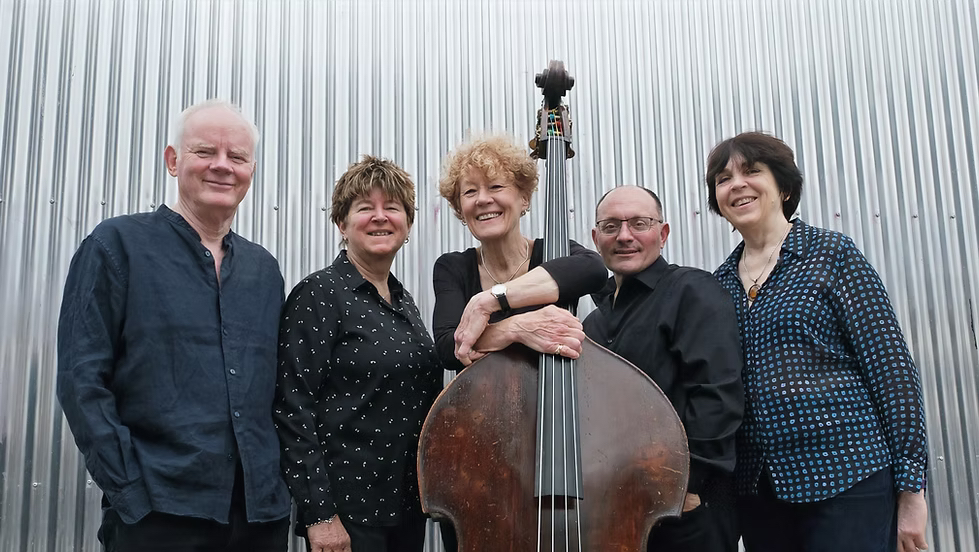
 On the 4th of April 2025, The Verdict in Brighton hosted the acclaimed Alison Rayner Quintet, a group known for its melodic invention, rhythmic subtlety, and deep musical empathy. The band features Alison Rayner on double bass, Deirdre Cartwright on guitar, Diane McLoughlin on saxophones, Steve Lodder on piano, and Buster Birch on drums. Together, they delivered a captivating performance full of emotion, storytelling, and artistic cohesion.
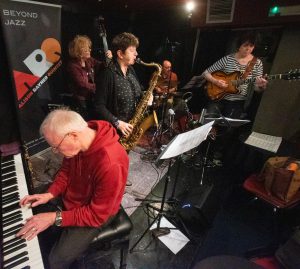
Live photo by Betty Accorsi
The set opened with “Espiritu Libre,” an original composition by Rayner from their latest album Sema4. A piece about travel and freedom, it immediately drew the audience into a rich musical landscape. The interaction between piano, saxophone, and guitar was stunning—each line weaving in and out like voices in conversation. McLoughlin’s soprano sax solo had a slightly free, exploratory character, while Cartwright’s guitar solo evoked the lyrical warmth of Pat Metheny. A second sax solo followed, more melodic and structured, reminiscent of Chris Potter, and Lodder’s piano solo brought a graceful close to the tune.
The second piece, “There is a Crack in Everything,” from the album Short Stories, showcased Rayner’s gift for arrangement. The interplay between guitar and piano was particularly strong, and the use of motivic repetition over horizontal harmonic movement recalled the free-flowing nature of Metheny’s writing. The dynamics added emotional depth, with Lodder’s fragmented piano solo delicately suggesting light breaking through the cracks. Rayner’s bass playing here was especially gentle and expressive.
Next came McLoughlin’s “Looking for a Quiet Place,” a piece full of subtle rhythmic interplay and harmonic nuance. The guitar and piano created delicate textures, with solos that were both lyrical and emotionally charged. Rayner’s bass solo was a study in calm, controlled expression. “The Handkerchief Tree” by Lodder opened with cicada-like sounds, setting a mysterious tone. The tenor sax introduced the melody before the piece transitioned into a more open, rhythmic section. The electric bass solo was melodic and heartfelt, followed by an expansive sax solo. Cartwright’s guitar solo again brought Metheny to mind, while the pianist and drummer added originality and drive.
Rayner’s nostalgic “Swanage Bay” began with an ostinato on the double bass before unfolding into a minimalistic melody shared between piano, guitar, and soprano sax. The sax solo was dreamy and melodic, later giving way to a bossa-influenced section. The piano solo here was particularly expressive, and the piece ended with a touch of dissonance that added emotional complexity. The first set concluded with McLoughlin’s energetic “Buster Breaks a Beat” from Short Stories (2019). This rhythmically intricate tune featured vibrant solos from piano and guitar, with tight sax-guitar and sax-drum exchanges. McLoughlin’s tenor sax solo pushed boundaries, at times venturing outside the harmony, culminating in an exhilarating free improvisation to close the set.
The second set began with “Trip Dance” by Rayner, where the band used motivic formulas to build the piece. The soprano sax carried the melody, while the drums and piano exchanged lively solos. The final section had echoes of Avishai Cohen’s compositions in its energetic, folk-inflected feel. McLoughlin’s “Riding the Waves” followed, featuring a sensual melody shared between guitar and tenor sax. Once again, the piano solo stood out for its elegance and nuance. Lodder’s “Hamble Horror” began with a shared melody between guitar and saxophone, evolving into a more traditional jazz feel. The tenor sax solo here was particularly engaging. “Signals from Space” by Cartwright was a gentle and mysterious tune, where the soprano sax, piano, and guitar blended in a soft, open sound world.
Rayner’s “All Will Be Well” from Sema4 expressed a collective longing for hope. The melody passed between sax, guitar, and piano, with an emotionally charged sax solo that carried a rock-like intensity. The title track “Sema4” opened with a meditative bass solo and transitioned into a cinematic, almost detective-film atmosphere. It was a vibrant, fun piece with thrilling exchanges between sax and guitar.
The final number was Rayner’s tribute to Jaco Pastorius, “Portrait of Jaco,” channeling the funk energy of the ’70s with echoes of Come On, Come Over, The Chicken, and Tower of Power. The driving piano solo and rock-influenced guitar performance added flair, while Rayner’s bass solo took a more upright jazz approach, contrasting nicely with the piece’s inspiration. The evening concluded with an electrifying drum solo by Buster Birch—full of energy and storytelling finesse.
 Throughout the night, the quintet displayed exceptional musical chemistry and sensitivity. Each musician contributed their own voice while supporting and responding to one another with deep listening and respect. It was not just a concert, but a masterclass in musical storytelling and collective expression. The Alison Rayner Quintet reminded us that jazz at its best is a conversation—full of emotion, nuance, and shared human experience.


Last modified: September 30, 2025