 Written by
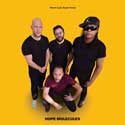
 maTrigal’s debut full-length, Between Homes, is out tomorrow on Svitzer Music: ten tracks built from cello, acoustic guitar and drums that somehow keep sounding like more than three instruments. I reviewed the record for this magazine in July. A few weeks later I got the trio on a call to talk about how they got here.
Cellist Gottfried Tadashi Forck and drummer-percussionist Maximilian Wolfgang Schwarz were already students at the Hochschule für Musik und Theater Rostock when guitarist Raphael Gamper turned up, “completely new,” as Tadashi remembers it — from a small village in the mountains of South Tyrol, in northern Italy, arriving in the flat north of Germany. It seemed to leave him, in Tadashi’s words, “somehow looking for a new kind of musical home.” None of them, as it happens, were actually studying jazz: Max and Raphael ended up together on a joint pop-and-world-music-with-classical program, while Tadashi trained as a straight classical cellist. Raphael’s opening move was modest — could he try out a couple of ideas, with a cello and some percussion? They liked what they heard, and rehearsals quickly became a fixture, regular slots through the week and most of a weekend day, broken up by long lunches at a Vietnamese restaurant called Goldner Drache. The Golden Dragon. I’d guess that’s where the title of the band’s 2019 debut EP, Age of the Golden Dragon, actually comes from.
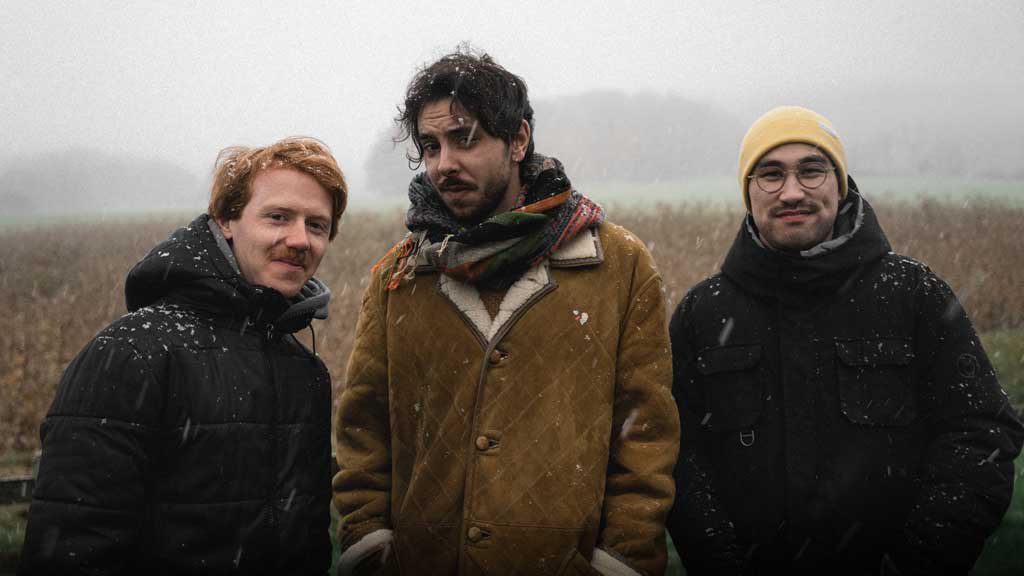
Photo by Johannes Schirbock
After the time in Rostock the three scattered to finish their studies separately: Tadashi to a master’s at the Mozarteum in Salzburg, Raphael to Dresden to focus on acoustic guitar, Max to Munich for classical percussion, where he’s still doing postgraduate work. The band’s name, maTrigal, styled with a capital T, nods to the madrigal, the vocal form that broke from church music centuries ago to sing about ordinary, personal things, in whatever language a singer actually spoke. Tadashi likes that connection: three people from three different countries, sharing something like a common tongue anyway. The capital T is also, on paper, the punchline — swap it for a D and you get “trio,” and the letters spell out their own three names besides.
Ask any one of them where the idea of mixing acoustic instruments with electronics came from, and you get three different answers, because it came from three different people. Raphael brought the “acoustic, organic” end of things, by his own description, the farm upbringing again. Max grew up on rock music and grew into electronics alongside his classical percussion training. Tadashi’s route ran through the classical cello repertoire and, at some point, lessons with a jazz cellist, which is presumably where his skill in pizzicato playing comes from — and it’s some of the best pizzicato playing I’ve heard on a record like this, locked so tightly into the guitar and drums that the three instruments seem to be reading off the same nervous system. Most of what ends up on a maTrigal record starts as a jam rather than a plan, Raphael told me: someone brings in an idea and the band works out what it wants to become. The exception on Between Homes is “Dualities,” which Max wrote alone, start to finish, and which carries a noticeably more electronic character on the record because of it.
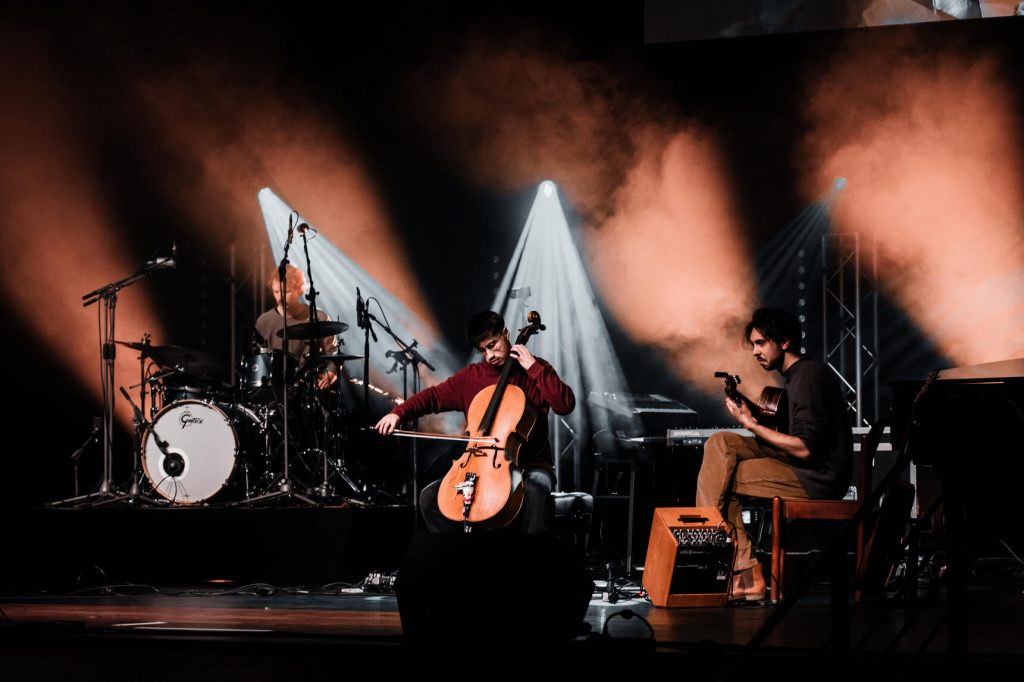
There’s also a more structural reason the trio’s sound holds together. Cello and guitar sit in a similar register, so on any given passage one of them tends to be carrying the bass line or a melodic figure while the other holds the harmony, with the drums doing double duty as rhythm section and third melodic voice. Tadashi thinks Max’s own classical training has bled sideways into his drumming as a result — less a matter of just keeping time than of treating the kit as a set of pitches to compose with, something Tadashi says opens up new questions for all three of them, together.
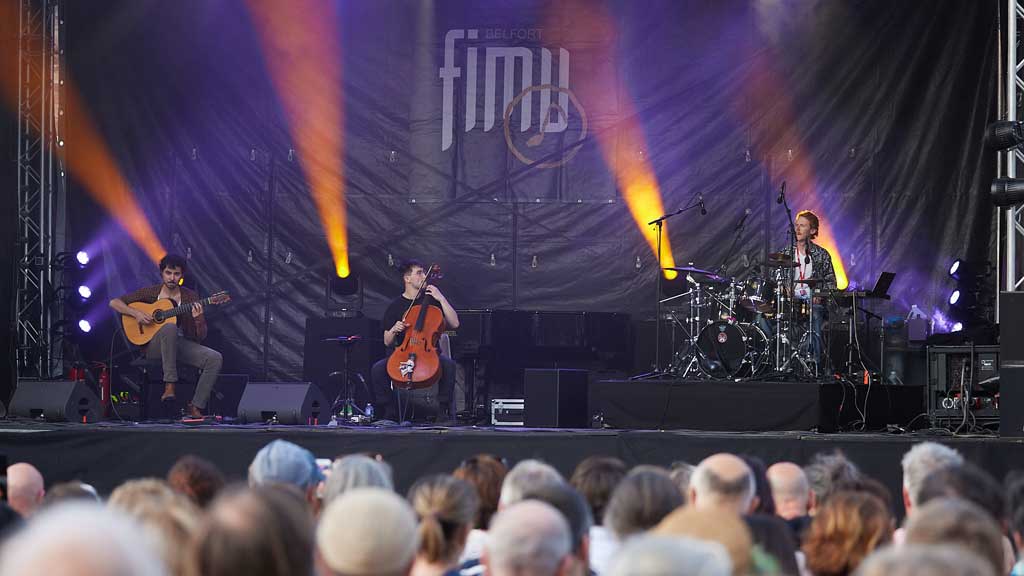
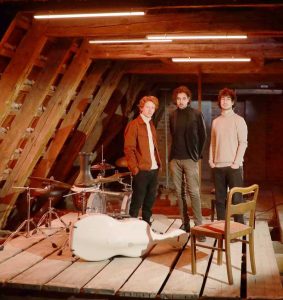 Asked to sum up their own sound, the trio has an answer ready, and it’s a fair one: world music and contemporary jazz, folded together with electronica, folk and a set of clearly audible classical roots. I wouldn’t put them on a bill at a classical festival, but I’d happily put them on almost any contemporary one, and, as it turns out, on a dance floor too. Max told me the band played a slot at the detect classic festival, at Schloss Bröllin, last year, and had people dancing to the more drum-and-bass-inflected material — the kind of groove-forward writing that comes naturally to a drummer who, on record, plays almost like a tuned-percussion soloist rather than a conventional kit player. The whole trio, at times, reads like one large rhythm instrument with different melodic edges attached. But the same band filled a room at the Stadttheater Puccini in Merano and left at least one listener somewhere else entirely. Tadashi remembers someone telling him afterward that they were still lying in bed, drifting, hours after the concert ended. He holds both sides of that as one idea: the groove and the drift belong to the same music.
Live, only one piece in the set runs to a click track: a program-heavy number from the first EP where the electronics are simply an ongoing layer underneath everything else. Everything else runs on rehearsal and trust rather than a metronome. Max keeps sample pads built into his kit for one-shots, layers, textures and drones, especially on the album’s opening track, “TGD4,” while Raphael and Tadashi each work a pedalboard of their own, shaping guitar and cello live rather than just miking them straight.
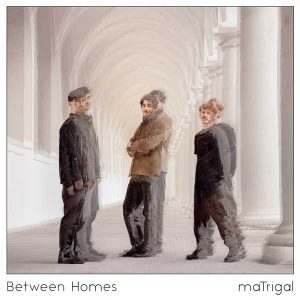 They made Between Homes almost entirely live, at a studio called Watt Matters, in the countryside near Bielefeld, not far from Osnabrück, in an old stone building with a big room for the drums and two smaller rooms wired in on either side, connected by windows, so all three of them could see each other while they played. Most tracks kept a click track running underneath; the more acoustic pieces, like “Balafon” and the title track, didn’t. A few percussion overdubs and the odd extra guitar part aside, what’s on the record is close to what happened in that room. They made it entirely independently, no label involved until the whole thing was finished, before signing to Edition Svitzer, the publishing arm of the Copenhagen label Svitzer Music, which put the record out. Max already knew the label from his own classical percussion work.
What’s next, on their own account, is more of the same, just further afield. They’ve played Raphael’s hometown in Italy, cities across Germany, and France, and they’re hoping a full-length album, rather than two EPs, opens more doors than they’ve had so far. I told them I’d like to see them in the Netherlands. The Bimhuis, TivoliVredenburg, LantarenVenster in Rotterdam would all suit this music well, and they seemed genuinely keen. There are already new songs taking shape, the band told me, with half an eye on a second album, even before this one has properly landed.
I asked, finally, what they wanted a reader coming to this record cold to take away from it. Tadashi’s answer was the simplest one of the whole conversation: curiosity. Not another piano trio, he said, something closer to a question mark, a setup of instruments people don’t expect to hear together that turns out to work. What he hears most, after shows, is people telling him they didn’t know a cello could sound like this, in a room like this. Breaking that expectation, for him, is the whole point. “How versatile it can be,” he said. “How groovy it can be.”
Find out more about Matrigal at their website. The album “Between Homes” is available on all streaming platforms and Bandcamp.
Last modified: August 20, 2026