 Written by
 Listening to four or five concerts in a single day is exhausting. Even when a festival’s setting is picturesque, you still spend the better part of the day inside a darkened hall. Yet, you will often find me at summer festivals—such as the one in Ystad, Sweden. I have been attending this festival more or less regularly since 2017—the very place where my favorite detective, Kurt Wallander, tracks down criminals.
In summer, the dark atmosphere of the crime novels vanishes; the sun makes the picturesque town—with its large ferry port and low-slung, small fishermen’s cottages—gleam. The Baltic Sea and its white sandy beaches are quickly reached via a path through the woods, passing many of those quintessential reddish-brown Swedish summer houses. The ambiance in Scania is wonderful, and a major plus during that scorching summer was that, thanks to the sea breeze, temperatures barely rose above 25 degrees.
But these are minor details. I attend festivals out of curiosity—hungry for new music and for musicians I don’t yet know, or for familiar artists bringing new material. Many of the Swedish musicians performing on the various stages here in Ystad are barely known outside their home country. Consequently, many of the concerts feel like lucky dips—full of delightful surprises. Since its inception in 2010, the Ystad festival has been curated by pianist Jan Lundgren. He contributed two new projects of his own and opened the festival—following a jazz parade through the town center and a concert by Björn Yttling at the elegant Saltsjöbad spa—at the 1894 theater.
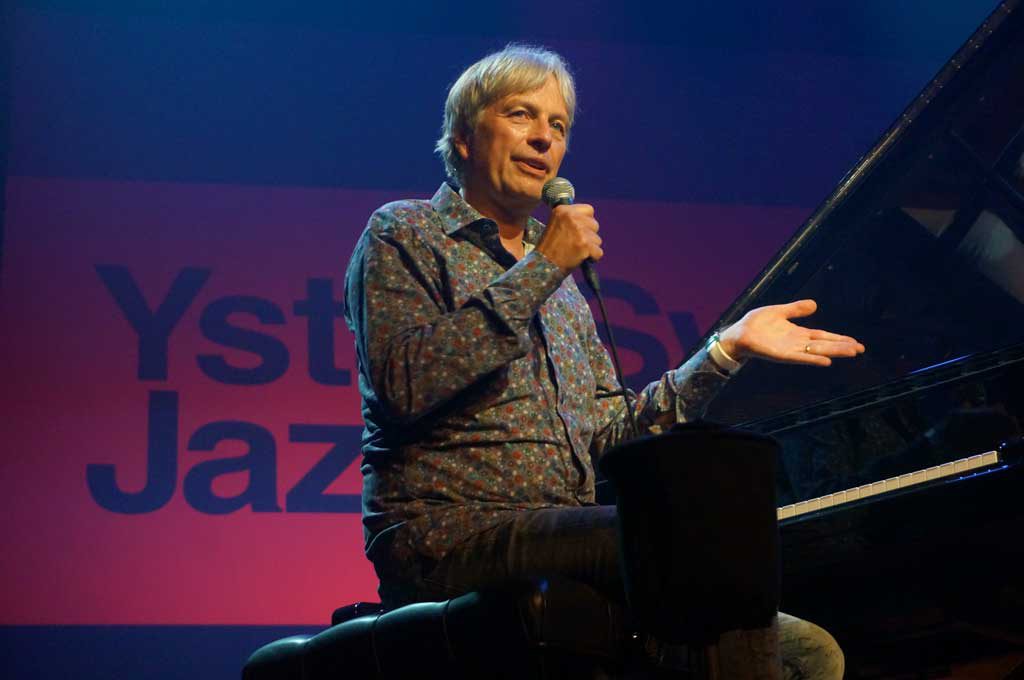
Jan Lundgren
Voice and piano were the most common sights on stage, and Lundgren, together with the Malmö Academy of Music Chamber Choir, set the bar high right from the start. Renaissance music by Orlando di Lasso and Monteverdi mingled with Bartók’s Romanian Dances and jazz.
The contrast with Kurt Rosenwinkel’s quartet was striking: modern jazz featuring driving swing drums, a spectacular Seamus Blake on tenor saxophone, and a bandleader gliding through his compositions with fluid guitar runs. While the first day of the festival always kicks off with a Dixieland band—complete with sousaphone—parading through the town center, it traditionally concludes with a musician taking over from the tower trumpeter, who plays towards the four points of the compass at night. This year, it was Norwegian musician Nils Petter Molvaer who had the privilege of climbing the 107 steps up the tower of St. Mary’s Church. Yet that was not the most extraordinary venue where Molvaer performed in Ystad; eight years ago, the festival had him play at sunrise at Ale’s Stones—Sweden’s answer to Stonehenge.
Afterwards, he performed a solo set in the church—naturally making extensive use of electronics, which he layered up to make the trumpet sound more like an organ than a brass instrument. Yet for all that opulence, the encore was the highlight: a beautifully simple rendition of the standard “Nature Boy” allowed for a genuine dialogue with the room’s acoustics—something that pre-recorded loops and parameters had previously tended to obstruct.
The second day began early with a garden concert; beneath apple and fig trees, saxophonist Frederik Kronkvist played an engaging program, with passing seagulls chiming in like a chorus.
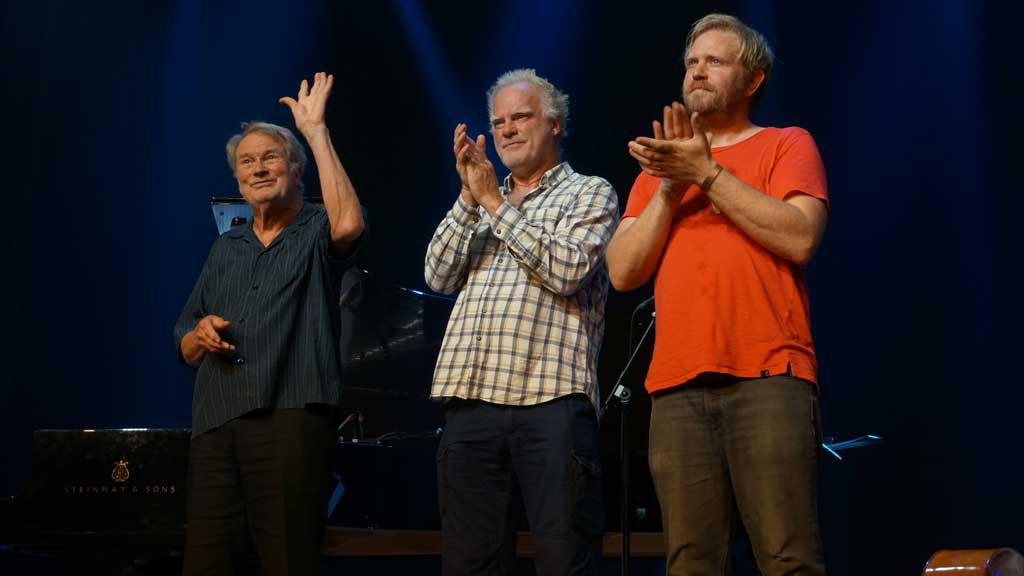
Bobo Stenson Trio
The performance by the Swedish pianist Bobo Stenson and his trio was the absolute highlight of the festival. He turned 82 just days after the event—an age completely belied by the music of this artist, who had recently received the “Lifetime Achievement Award” from Svensk Jazz. His trio—featuring Anders Jormin on bass and Jon Fält on drums and a vast array of percussion—embodied the very essence of jazz: curiosity, communication, a willingness to take risks, and a shared quest for expressive melodies and dynamic arcs. The trio captivated the audience; listeners followed the soaring musical flights from the stage with bated breath. Pieces like “Helios” and “El Mayor” thrilled the crowd, while a pin-drop silence fell over the hall during Don Cherry’s “Don’s Kora Song.” The audience gratefully received Bobo Stenson’s encore: an arrangement of a 1692 composition by Henry Purcell.
In stark contrast was the performance a day later by Italian pianist Francesca Tandoi—also leading a piano trio, though here the musical essence was often obscured by impressive technique. It was an enviable technique, yet one that occasionally tipped over into excess. Tracks tended to be over-arranged, and Billy Strayhorn’s “Lush Life” unfortunately quickly lost its depth as a result. Stevie Wonder’s “Overjoyed”—performed by Tandoi with relatively simple vocal and instrumental accompaniment—offered a redeeming moment.
“Sweden loves Italy” was the motto Jan Lundgren adopted for the occasion. The pianist has long held an affinity for Italian music and musicians; he invited saxophonist Rosario Giuliani and drummer Roberto Gatto to join him and bassist Hans Backenroth in presenting a program of Italian film music. Compositions by Nino Rota and the theme from The Godfather provided an excellent foundation for improvisation. The two Italian musicians also contributed beautifully to a rendition of Sweden’s most famous folk song, “Ack Värmland du sköna.”
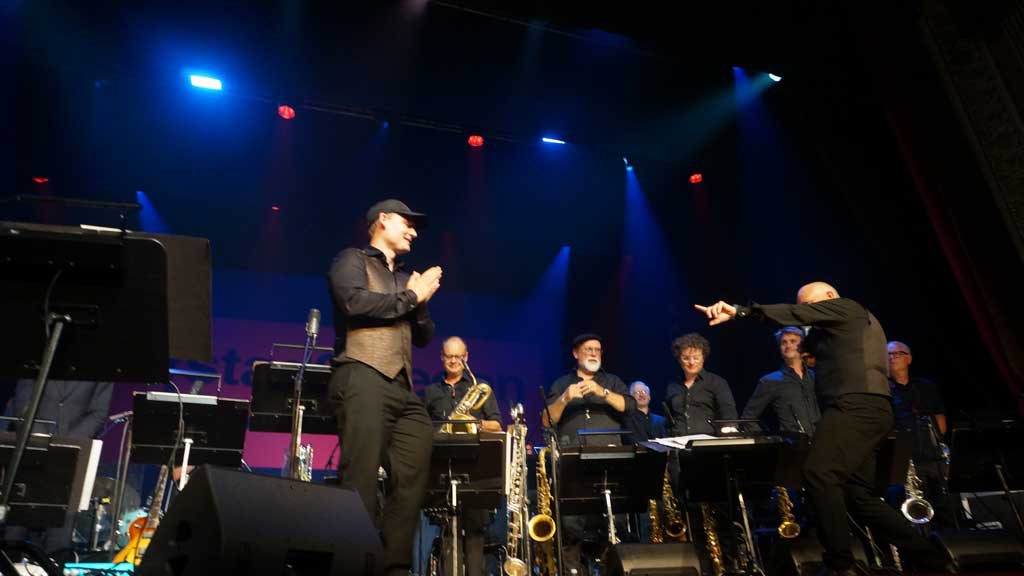
Mathias Heise with the Danish Radio Big Band
Harmonica player Mathias Heise had previously appeared in Ystad two years ago with his fusion group, Action 4. This year—marking the centenary of John Coltrane’s birth—he returned with a full big band. Together with the Danish Radio Big Band, he presented his own arrangement of Coltrane’s legendary album A Love Supreme. The Danish musician had set the bar high, yet his arrangements were breathtaking; the harmonica blended seamlessly into the saxophone section. The concert opened with the section playing from within the auditorium, building into a powerful saxophone chorale. There were heavyweights among the soloists, too: the duels between tenor saxophonists Karl-Martin Almqvist and Hans Ulrik were impressive. While the spiritual depth inherent in Coltrane’s work might be harder to convey in such a large ensemble, that was a secondary concern given the fantastic arrangements and Mathias Heise’s solo performances.
Midday concerts in the sophisticated setting of Saltsjöbad always feel a bit surreal—especially when you step out of the hall and see the Baltic Sea sparkling in the sunlight. The French artist Camille Bertault danced lightly through her entertaining program. Her drummer, Minino Garay, enriched the band’s sound with body percussion and vocal breath effects, while Bertault’s voice merged with Julien Alour’s trumpet to create a unified sound.
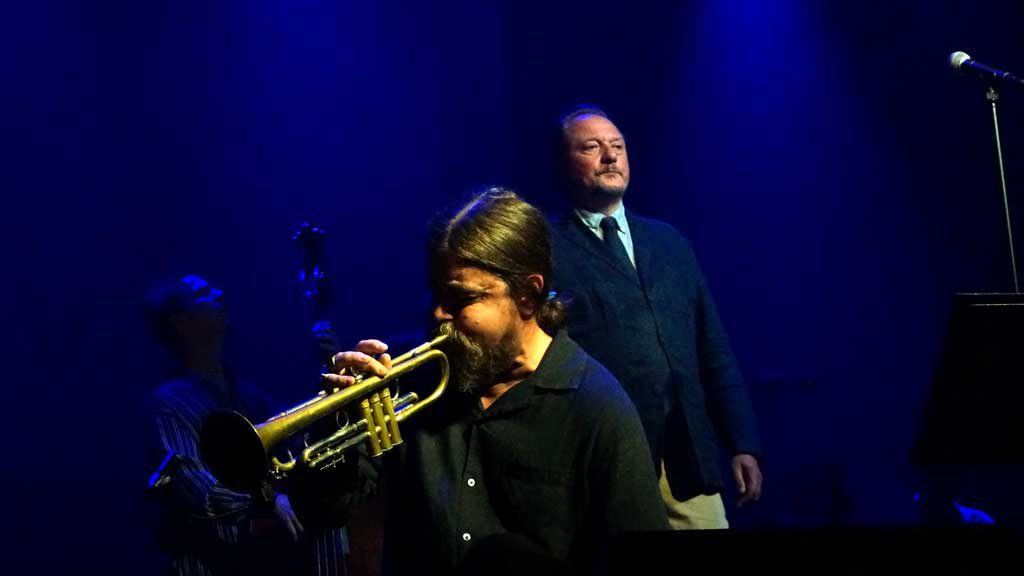
Magnus Carlsso
Over the past two years, the festival moved one day of programming outdoors to the grounds of the equally picturesque Charlottenlund Palace, where audiences could enjoy jazz while sitting on picnic blankets. The plan was to expand this to two days by 2026 to make the logistics—transporting and setting up sound equipment, catering, merchandise, restrooms, and more—worthwhile. However, as ticket sales were not particularly promising, the festival scaled back and returned the final two days of concerts to the venerable theater.
It was there that I discovered Magnus Carlson and his Moon Ray Quintet—which, interestingly, comprises seven musicians. Carlson is a household name in Sweden thanks to his indie band, Weeping Willows. His Moon Ray Quintet—featuring Goran Kajfes (trumpet), Per “Ruskträsk” Johansson (saxophone, bass clarinet), Carl Bagge (piano, organ), Mattias Ståhl (vibraphone and harmonica), Martin Höper (bass), and Lars Skoglund (drums)—has released a new album after a 15-year hiatus, offering music so beautiful it makes you want to kneel in awe. From the sparse, inventive interplay between piano and vibraphone to the counter-melodies of the expertly arranged horn parts, the solos from trumpet, piano, and saxophone, and even the multiple tambourines—everything perfectly complemented the bandleader’s expressive voice. His rendition of David Bowie’s “Where Are We Now?” was certainly one of the highlights of the festival for me.
The contrast with Ivan Lins could hardly have been greater—and yet, it worked perfectly. This year’s Guest of Honor wrapped up his European tour in Ystad, accompanied by his stunning band. For a Brazilian legend like him, even two hours aren’t enough to fit all his hits into the setlist. In high spirits, he shared the backstories of his songs and revealed which of his wives had inspired specific hits. Backed by André Sarbib (piano), Cláudio César Ribeiro (guitar), Braulio Araujo (bass), and Chris Wells, he captivated the audience in the sold-out theater. Ivan Lins had fallen so in love with the small Swedish town that he even considered moving there.
The intimate setting also benefited the Sunday Big Band program; Viktoria Tolstoy stepped in for Jill Johnson—an artist usually associated with country and pop—to perform with the Anders Lundberg Big Band, singing her way through “Song and Soul Books.” The spirited Veronica Swift was backed by the Danish Radio Big Band—and she had them firmly under her command. Having collaborated with them previously, the lively US singer only needed to double-check a few names for her introductions. She conducted the big band with economical yet precise hand gestures. Vocally and stylistically, the singer knows no bounds. However, her original composition “Sing”—written with her partner Brian Viglione of the rock band The Dresden Dolls—stood out from the rest and fell somewhat short of the high standard set by the other material.
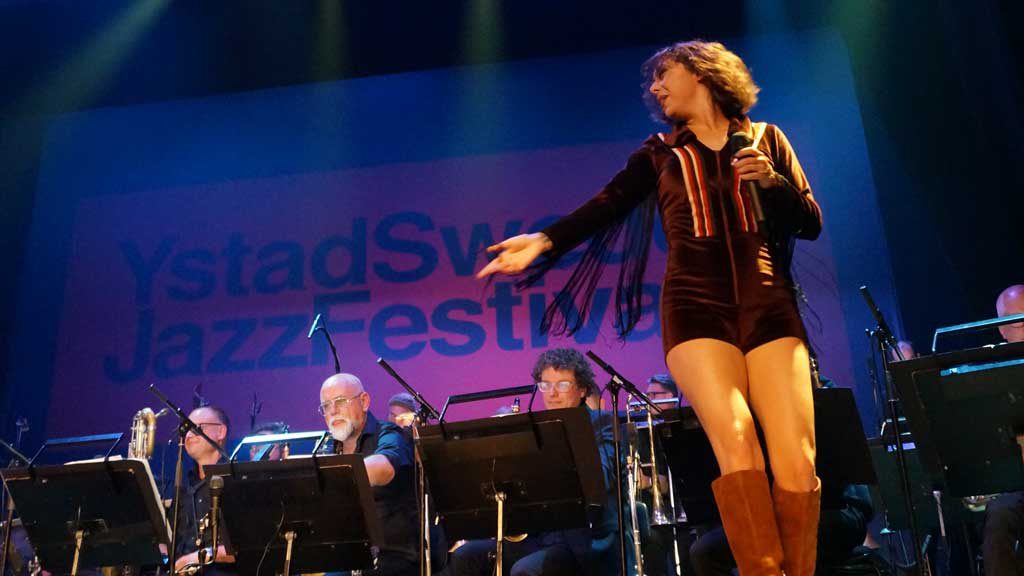
Veronica Swift with the Danish Radio Big Band
Fifty concerts drawing an audience of 11,000 is an impressive figure. The festival also provides a stage for up-and-coming musical talent; seven bands had the opportunity to perform at Bäckahästen Square. Jam sessions, a children’s program, and two concerts at retirement homes round out the offerings. The festival team also remembers those who attended concerts and supported the festival’s success story for years but can no longer make it in person—so the concerts come to them.
This speaks volumes about this wonderful team, which truly deserves special thanks:
The team spent ten months preparing for the festival; the committee and the 70 volunteers from several countries take such thoughtful care of visitors, musicians, and journalists alike. The press team is always approachable, instantly helping to track down setlists or the names of musicians performing outside the scheduled lineup. The volunteer team is fantastic—handling artist liaison, ticket checks, and local promotion—as is the amazing kitchen crew. At a nearby school, they prepare varied meals for musicians, technicians, and volunteers, stock the essential Swedish fika (coffee breaks with pastries), and traditionally serve hot dogs after the day’s final concert.
The committee responsible for the program—led by Artistic Director Jan Lundgren—is stepping down after this edition. This initially came as a total shock to us journalists: a Ystad Sweden Jazz Festival without President Thomas Lantz? Without Bryan, Itta, and Kjell? It was not an easy decision, yet it was made years ago: the plan is to make way for a new team once everyone on the committee is over 70. Mats will be taking over a festival whose machinery is sure to keep running like clockwork.
I am already looking forward to 2027; the festival kicks off on August 4th—surely accompanied once again by blooming hollyhocks, sunshine, a sea breeze, and plenty of music that sparks curiosity. And a festival team that has become like a Swedish family to me.
Last modified: August 14, 2026