 Written by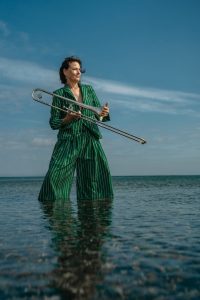
Photo by Steen Rasmussen
I get very excited when I see a female trombonist. Trombonists in general are still quite rare, but female trombonists used to be like unicorns. Historically, the mighty Melba Liston is arguably one of the only female trombonists given a platform, even though there were in fact quite a few trombonists busy working away without the deserved recognition. The International Sweethearts of Rhythm gifted us with Helen Jones Woods, Betty O’Hara, Jean Travis, there was also Velzoe Brown, Corinne and Lena Posey (and more), but sadly, most of these names are unfamiliar to most and they were not given the platforms they deserved. Thankfully, this does seem to be changing. The ever-evolving jazz scene is becoming increasingly full of glorious trombonists from across the world including Nabou, Natalie Cressman, Jennifer Wharton, Laura Impallomeni, Gunhild Carling, Rita Payés, Audrey Ochoa and of course Annie Whitehead and Angela Wellman – and this is only a small few.
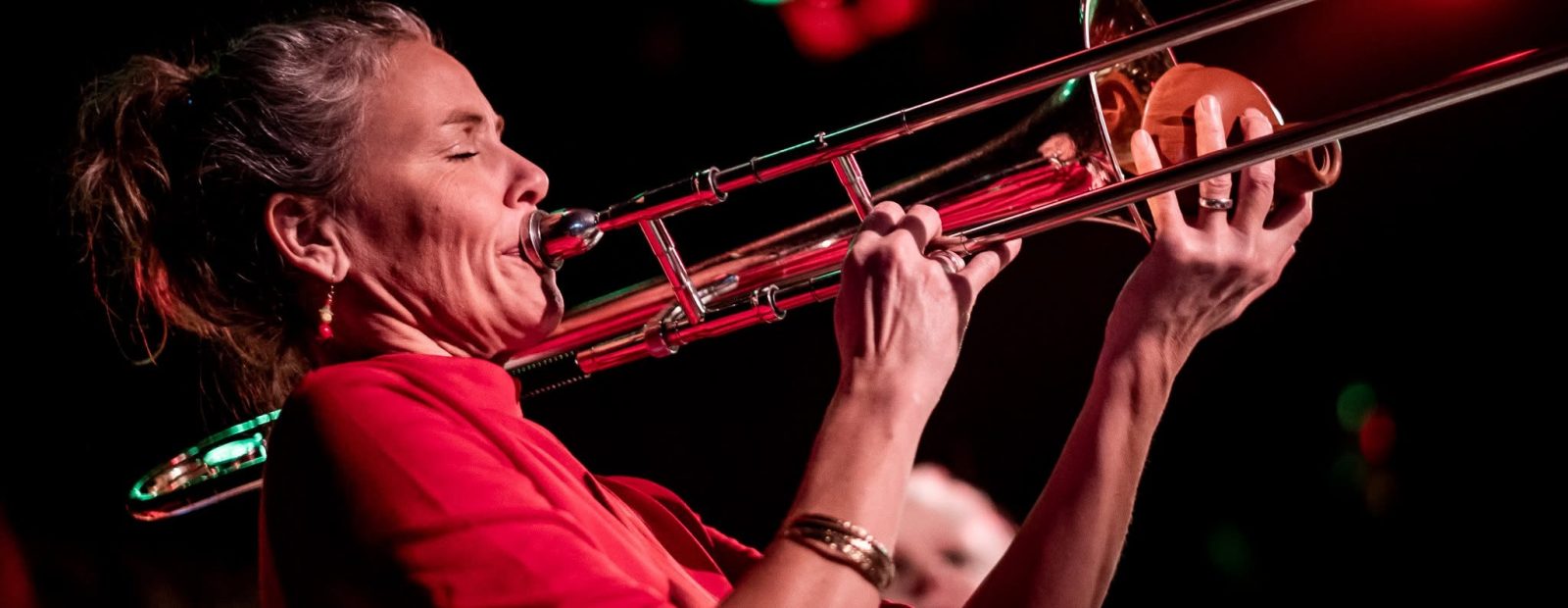
Part of this exhilarating trombone scene and at the heart of Denmark’s music scene is Lis Wessberg. Working in jazz and pop, she has played with an exquisite range of artists including Randy Brecker, Marilyn Mazur, Joyce Moreno, Kid Creole & The Coconuts, and with over 50 releases to her name, Lis Wessberg is a name we should all know.
Her debut album, as a lead artist, Yellow Map (released in 2021) showcased her breathtaking compositional skills, combining the acoustic trombone with electronic inspired grooves. This was followed by Twain Walking (2024) where Lis continued to refine and define her sound, with a range of influences from Radiohead to Miles Davis and moving into English language songwriting . Her latest release In the Wake of Blue, sees Lis move into a song-driven approach to her compositions, in an album described as ‘her most personal to date.’
I started developing writing lyrics on my second album because I felt it brought a totally new dimension – humility. I found it so beautiful playing live with a vocalist, singing my songs and so with this new album, I created five new tunes with lyrics. It was a big thing for me and why it’s so personal, because I’m writing about my family, about being human. There’s also a lot of nature and images of nature in my texts, almost like pictures of being human. English is not my first language, but there are so many colours to my music, that writing lyrics, and hearing a young vocalist singing my songs, was very beautiful. The album is also about generations. I’m 58! I’ve been in this jazz thing for so many years and was a late bloomer because I’ve been making a lot of albums for other musicians. I made my first album when I was 52.
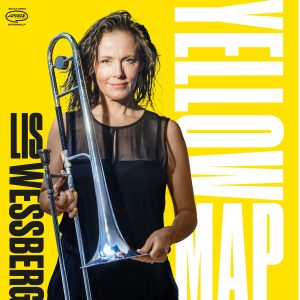 Lis’s first album Yellow Map was specifically written as an instrumental album for piano, bass and drums, along with guest collaborator drummer/percussionist Marilyn Mazur. Lis enjoys the interpretive element of instrumental music where the audience engages in their own way.
It’s free in another way, because there’s no boundaries. You can let the audience think about it and feel the music. When you are writing lyrics and presenting what the lyrics are about, you’re already tuning the people into the music. When we play instrumental music, it’s also very beautiful, because people are making their own interpretation. So, for me, I think there’s two beautiful ways to make music.
In the Wake of Blue has an underlying theme of nature, exploring the range of emotions we connect to when experiencing for example the sea, the clouds and birds. The visual element of this music is very important to Lis as a way to connect to the audience.
There are a lot of references to the images of nature, kind of like a picture of the inside. I’m trying to give the audience a kind of a frame, a freeness, because I’m talking about the skies, the plants, the earth, the soil and we are in the same kind of frame. That’s my goal.
Danish is of course Lis’s first language, but she has written lyrics for this album in English. There is always a balance to navigate when considering the commercial side of creating music, and artists often having to move into a space they are not necessarily familiar with.
It’s very interesting. I talked to my label about making songs in Danish, but they had a plan for trying to share the music outside of my country. I was also working with an Estonian singer who doesn’t speak Danish, so they said, you can, of course, write in Danish, but we would really prefer it if you didn’t, so you can work with this vocalist. So, I thought, okay, it’s a challenge for me. But I think English is a much fuller language than Danish, and it has many colours to it. I think it is a balance, because you want to write lyrics that people can understand, so they know what the music is about. I think it would be a pity if people did not understand it. At the same time, it can be a very beautiful experience, listening to a language you don’t understand, because you listen to the colour in the music.
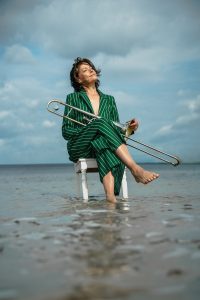
Photo by Steen Rasmussen
Lis’s choice of musician compliments and enhances her work beautifully. Having worked with Lis on her past three albums, her core team of Steen Rasmussen (Piano and Keys) Lennart Ginman (Double Bass) and Jeppe Gram (Drums) provide a beautifully subtle but essential foundation throughout, with palpable chemistry. For this album, Lis took a different approach.
I love writing music and I actually wrote this album on an island. I was there for a long time and had peace and time for writing music. I also decided that for the first time, we would tour the music before going to the studio. The other albums were made the other way around. And I think it was a very nice process. Some of the music is written sitting at a piano, and some sitting at the computer, working digitally, recording my trombone. I made demos so that it’s very precise and what I want. I wrote 11 tunes and sent them to the musicians and then we started touring! We had about 4 gigs, and then we went to the studio, and the music had been developing because there’s so much going on when you’re playing live. I will do it the same way the next time, it was very nice.
Lis, continually growing, developing her inspiring compositional toolbox, brings a new element to her work: incorporating the depth and beauty of a stunning string quartet. The whole album is beautifully cinematic with so many colours and layers. While the trombone is leading, it is leading as an equal with the stunning vocals from Veronika Rud. But Lis’s passion and focus is always on playing live and the development of her music through the live experience.
I’m looking forward to playing it live, and you never know how it will be playing live. For me, when we release a tune, an album, the music will continually develop when we are playing it live. I’m very fond of my band and we have been playing together for many years. They know my kind of music, they contribute and I love how they respect my music. It’s not finished when I release an album – it’s like giving birth to children, they will develop and have their own life. They will grow, and some people ask me, can I play your tune? I said, yes, please borrow my tune. I love that because then it can become another flavour. I think it’s a kind of a birth and I love that kind of growth. I have a band, of course, but I also play my music with other kinds of projects. People are often asking me if I want to do something and can I bring some of my music? And I bring some music, and maybe it’s a trio, maybe it’s a duo, maybe it’s a tentet, and my music gets another vibe. This is very beautiful.
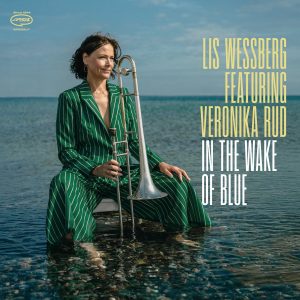 With a significant list of live dates booked up until the end of 2027 and incredible reviews, audiences across the globe are connecting with Lis and her music – and the trombone!
This is very important – the music, sitting with an audience, it’s a kind of communication. I give something to them; they give something to me. We’re in it together and I always talk about it at my concerts, that this evening will be totally unique. We have to be aware of that. It’s very important for me that the audience can kind of feel me. Not only me, the band. My music is also quite slow, kind of poetic, but also wild. I think the trombone, for me, is kind of what the cello is for the strings. It’s a kind of voice and that’s the way I use my horn. Trombone players, all instrumentalists, play in very different ways. But I don’t play very fast on my horn. For me, it’s like singing. This is why I think the trombone is the most beautiful instrument because it’s a very simple instrument. It’s been a part of me for so many years. I started playing trombone when I was 10, I think, and now I’m 58. It’s many years. I was influenced by many saxophone players and trumpet players – Miles, Coltrane, all those big heroes. But I was very attracted to trombone players playing more freely. When I went to the conservatory, I was playing a lot of bebop, and trying to be fast, and of course, you have to do it all, but for me, I liked listening to singers like Shirley Horn and kind of adapting that kind of voice to my instrument.
Melba came into my life rather late, but I have a picture of her in my studio. As the only woman of colour, and the only woman, and she’s playing with a Big Band in Denmark, and I got this photo from a friend. I think it is so beautiful. Every time I play with my trio, I play a tune of hers. She’s fantastic, and she was so well respected as an arranger, as well as a trombone player.
In The Wake of Blue is a stunning album and a truly inspiring artist. Do take some time to explore her incredible work, you will be all the better for it.
Header photo by Kim Matthäi Leland
This article was first published in the July 2026 Women in Jazz Media magazine
Last modified: September 8, 2026