
 Written by
 In my first article in this series, I made the case that AI-generated music is a bigger disruption to the major labels sitting on the largest streaming catalogues than it is to the musicians actually making the music, and that most working musicians have less riding on either the copyright fight or the royalty pool issue than the panic suggests. If you disagree with this then I urge you to go back and read my first article, it might change your mind.
I also a point worth repeating here: when the earnings model for recorded music largely dried up for musicians, the focus moved to generating income from live gigs, that was the one income stream no landlord could put a lease on. This time I want to show you why that retreat turns out to have been the right instinct, and the evidence for it is stronger, and stranger, than I expected when I started digging into it.
What Listeners Are Actually Asking For
When a fan asks whether an album or track they’re playing was made by a human artist, they are rarely asking out of technical curiosity. Research is showing that the reason they’re asking is because they have already begun to care. A study Deezer commissioned with Ipsos, surveying nine thousand listeners, is usually cited for a single striking figure: ninety-seven percent could not reliably tell an AI-generated song from a human-made one when asked to judge blind. That number gets repeated constantly, however, the one that matters more, I think, is the one that follows it. Eighty percent said they wanted fully AI tracks clearly labelled. Seventy-three percent went further, they wanted to know when the platform’s own recommendation system was pushing synthetic tracks into their mixes, not just when they searched for one directly. Put those two numbers together and the message is pretty simple: people don’t want to listen to AI slop, and they want the platform to tell them straight when that’s what they’re hearing.
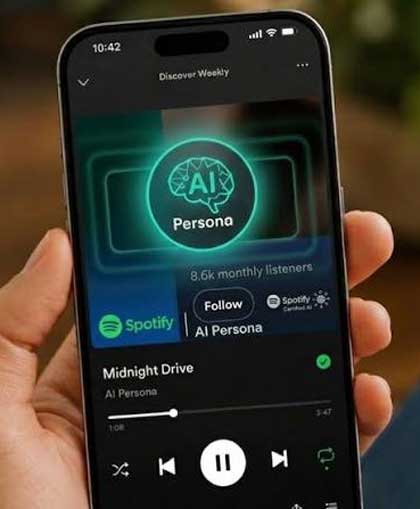 That’s the part of this story I think many in the industry keep missing. Fans don’t attach to a waveform. They attach to a person. What they actually want is simple: real artists, real authenticity. A badge doesn’t give them that. It’s just a flag, a small honest signal that says “this one isn’t human,” so the listener can decide for themselves whether they still want it.
The Generation Everyone Got Wrong
The assumption, repeated endlessly in media, is that younger listeners, raised on algorithmic playlists and short-form video, will be the most relaxed about synthetic music. The data simply shows the opposite.
Luminate, the industry’s primary data and analytics provider, tracked U.S. listener sentiment toward AI-assisted music across a six month window in 2025 and found that overall interest went net negative, sliding from minus 13 percent to minus 20 percent. The steepest decline of any group belonged to Gen Z and Gen Alpha, the youngest listeners tracked, whose sentiment fell from minus six percent to minus sixteen percent over the same period, faster than any older cohort. These are the listeners who grew up inside the algorithm, who have spent more of their listening lives with AI-adjacent tools than any generation before them, and they are the ones souring on synthetic music fastest.
The case study that makes this concrete is Xania Monet, the project built around poet Telisha Jones using Suno to generate vocals and instrumentation from her own lyrics. It briefly charted, drew a genuine record deal, and became the most visible test case yet for what a partially AI-made act can achieve on a premium streaming platform. It also drew a sharp and immediate backlash from working artists, Kehlani and SZA among them, precisely because the line between AI assisted and synthetic was hard for listeners to locate. Luminate’s broader data suggests that pattern repeats: AI-adjacent projects can spike quickly on curiosity and novelty, but rarely sustain the kind of week-on-week listenership that marks genuine fandom rather than passing novelty interest. As I was finishing this piece, Spotify announced a new “AI Persona” badge for exactly this kind of profile, and reporting on the announcement named Xania Monet as one of the artists likely to carry it, which tells you the industry is watching the same case study I am, for the same reasons.
Millennials tell a more nuanced story. They are the most open generation to AI as a production tool, showing real interest in features that let them remix or reshape licensed music using AI assistance. But they draw a hard and consistent line between a tool used by a human artist and a substitute for one, and they are the demographic most vocal about wanting clear, accurate credits, wanting to look at a track’s metadata and see exactly where AI entered the process.
Older listeners, Gen X and Boomers, use streaming platforms largely as a modern record shop, seeking out catalogue recordings by name. They’re not sitting on the fence about AI either, they’re the least open cohort of any generation surveyed, less receptive to it than even Gen Z, however it’s marketed. For an older listener, AI-generated music isn’t a curiosity worth exploring. It’s noise standing between them and the record they came to find.
It is worth pausing here on what this means for jazz specifically, because the genre’s own listening data across the streaming platforms tells an interesting story that most readers will not expect. Spotify has reported that roughly 40 percent of all jazz listening on its platform comes from listeners under 30, a share that has held steady since 2014 and grown every year since. We don’t have specific data from Apple however Deezer has recorded double-digit percentage growth in jazz streaming among 18 to 30 year-olds. The club and festival crowd for jazz still skews older, yet there are signs that this core is rapidly changing as a younger demographic across Europe appear to be trading the traditional commercial nightclub for live jazz, with venues in London, Paris, and Amsterdam reporting a noticeable surge in millennial and Gen Z patrons. But the main takeaway here is that the audience actively searching out the contemporary and the wider jazz-adjacent scene, is younger than most people in this industry assume, and it is the same demographic the Luminate data shows protecting the idea of a real artist hardest.
That is not a coincidence I think jazz can afford to ignore, and it is exactly the discovery side of streaming’s ledger I mentioned in part one. This is the side genuinely worth crediting from a musicians perspective even as the compensation side remains weighted to a model that will never benefit the largest proportion of the artist community.
What AI Cannot Do
There is a plain, structural fact underneath all of this that I think gets lost in most coverage of the subject. A generated track cannot walk on a stage. It cannot read a room, play something nobody expected, or take a request shouted from the back of a club. Liveness is not a feature that can be bolted on after the fact, no matter how convincing the recording becomes. For jazz, where the entire premise of the music is a decision made in front of an audience that will never happen the same way twice, this is not an abstract appeal to human artistry. It is close to the definition of the genre itself.

Saturation of this kind tends to make the thing that cannot be automated more valuable, not less, and the artists who have spent years building genuine relationships with audiences are likely to find that instinct rewarded now rather than sidelined. I do not think this rescues every act or every venue, and touring remains expensive and precarious regardless of what streaming platforms do next. But as a general direction, it is worth naming plainly: the more the feed fills with synthetic content, the more a real band in a real room becomes the premium experience rather than the fallback one.
So that’s the evidence: the audience is actively pulling away from exactly the thing that threatens the labels’ position, hardest among the listeners with the longest runway ahead of them. What I haven’t covered yet is how the industry itself is behaving in response to all of this, which platforms are treating it seriously, which are managing it with a press release, and how much you should trust any of them to police themselves. That’s part three, and it’s the one where I think the receipts get genuinely uncomfortable for a few companies whose names you’ll recognise.
Last modified: September 3, 2026