 Written by
 The expectant silence—the moment between two notes, between chords, the hush in which you can hear the musicians breathe before the next phrase begins, those beautiful lulls where you could hear a pin drop—was an important part of this year’s Jazzbaltica Festival at Timmendorfer Strand near Lübeck and Kiel.
The quartet Les Égarés, featuring accordionist Vincent Peirani, soprano saxophonist Émile Parisien, cellist Vincent Ségal, and kora player Ballaké Sissoko, played with silence and captivated the audience. Their interpretation of the simple composition “Esperanza” by Marc Perrone and Joe Zawinul’s “Orient Express,” where the saxophone dove into the middle voices of the accordion, were especially mesmerizing.
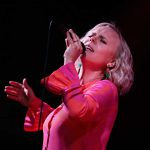
Expectant silence was a recurring theme throughout the festival curated by Nils Landgren. The new program by singer and trombonist Rita Payés and her five-piece band played with that silence: gentle lullabies for mothers and a duo with her mother, Elisabeth Roma, on guitar.

Rita Payés
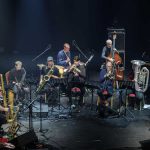
There were also louder moments. Electro Deluxe expertly warmed up the audience—the French soul band’s strong brass section encouraging dancing and singing along in vibrant waves. Big bands, by their very nature, bring more volume; the Latvian Radio Big Band from Riga again proved itself among Europe’s best. With Magnus Lindgren (saxophone, flute) and John Beasley (piano), they delivered a Charlie Parker program that included the Grammy-winning arrangement of “Confirmation.” It was a joy to observe the band’s attentiveness and respect whenever a member stepped forward for a solo. For the encore, the entire band jammed over a blues form, a rare treat to witness on stage. The large Baltic ensemble presented a more accessible program than the NDR Big Band, whose Hamburg musicians, performing for the last time under Geir Lysne, played compositions by baritone saxophonist Luigu Grassi.
“Umbaji,” the band led by Swedish saxophonist Jonas Wall—who usually plays in Nils Landgren’s Funk Unit or with the Icelandic band Mezzoforte—was also loud and funky, borrowing keyboardist Eythor Gunnarsson and trumpeter Ari Bragi Kárason from the latter group.
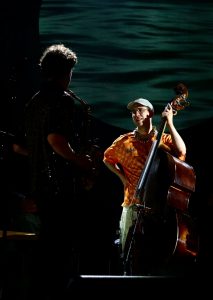
Nils Kugelmann
The concentration of young talent this year was remarkable. IB.SH Jazz Award winner Lennart Meyer, a singer and bassist, delivered an impressively mature concert. Trumpeter Peter Somuah’s spark didn’t catch until later in his set, but the fire blazed brightly during the set by pianist Shuteen Erdenebaatar and her quartet, featuring saxophonist Jakob Manz and bassist Nils Kugelmann. Still, a few quiet, breathing moments would have made the otherwise brilliant concert even stronger. Trumpeter Michel Schröder conjured a wealth of sound colors with his large ensemble, which included a string quartet. Trombonist Janning Trumann—like Schröder, once captivated by Jazzbaltica as a young audience member—presented a lively, exciting program with outstanding musicians such as Caroline Davis (alto sax), Jochen Rueckert (drums), and Matthias Akeo Nowak (bass).
Michael Wollny and his trio—Tim Lefebvre (bass) and Eric Schaefer (drums)—offered a masterclass in the use of silence, energy, dynamics, and density. With no set list, they drifted effortlessly between composed pieces and free improvisations.
A total of 19,000 fans attended the sold-out concerts and free outdoor events.
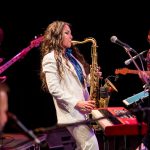
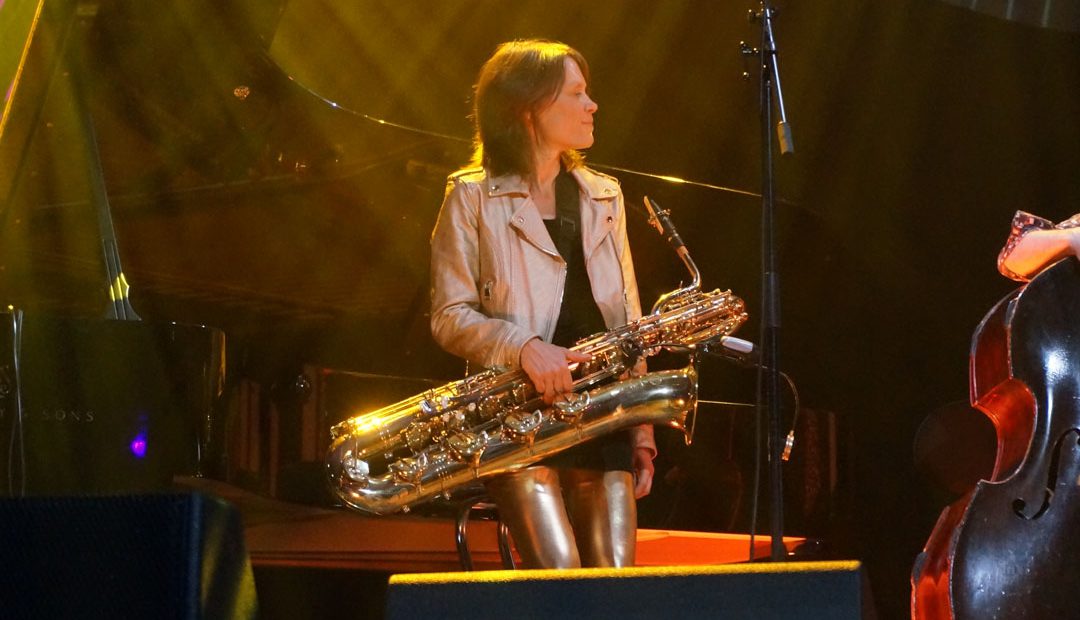
In recent years, the festival had seen a significant increase in female jazz musicians, but in 2025 that number declined somewhat. Although excellent projects by Céline Bonacina (Featured Image – Ed) and Shuteen Erdenebaatar graced the main stage, it would be fantastic to see an even stronger presence of women next year. It would also be desirable for future programs to feature more musicians from Poland, Finland, and other Baltic Sea countries—thus more clearly underscoring the festival’s name, Jazzbaltica.
Concert recordings will be available from September at the jazzbaltica website.

Last modified: September 26, 2025