 Written by
 Gran Canaria is not a place that needs to borrow its jazz credentials. The island has been a significant presence on the European jazz calendar for some years, and the Canary Islands more broadly are home to events of genuine international standing. It is in that context that Gran Canaria Jazz Day 2026 deserves to be understood — not as a first step, but as the second edition of a growing platform with serious ambitions. Running from April 29 to May 3 as an International Jazz Day event, it is a festival with a clear vision that matters more than its modest scale might initially suggest.
Gran Canaria Jazz Day is making a considered argument: that the island is not merely a venue for visiting artists but a living creative territory in its own right, one with the cultural depth, the architectural heritage, and the artistic ambition to hold its own in European terms. The goals are clearly stated — artistic excellence, European projection, international tourism promotion, and the strengthening of an Atlantic cultural identity — and the programme has been designed to serve each of them. This is a festival that is using the particularity of the island, its history, its venues, its musical community, as the basis of an outward-facing proposition to an international audience.
That ambition is legible in every element of the programme, and nowhere more clearly than in the choice of venues. Across five days, the festival moves between the historic capital Las Palmas de Gran Canaria and the southern coast, mapping a cultural geography that takes in nearly two centuries of the island’s life. The venues are not simply containers for the music. They are part of the argument.

Albert Sanz
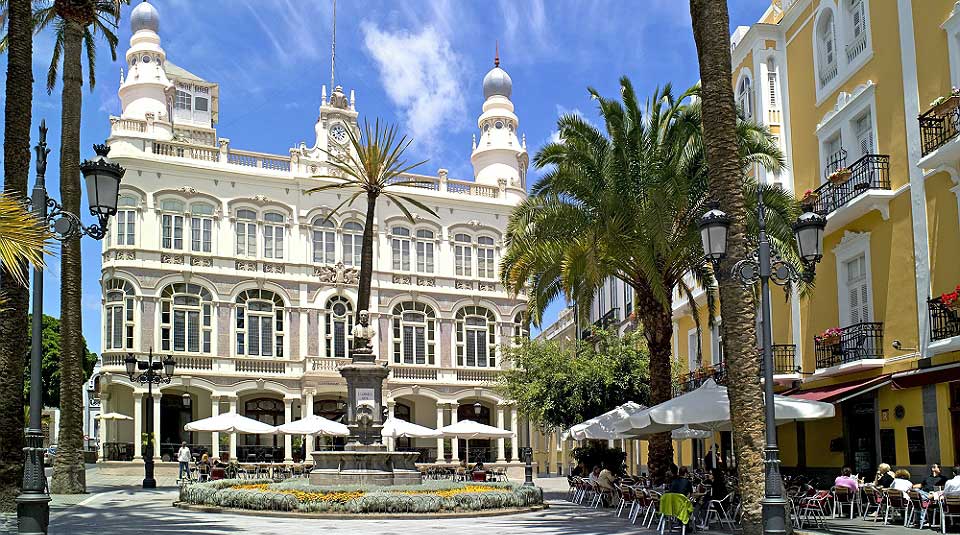
The festival opens on the evening of April 29 with a concert by Spanish pianist Albert Sanz and vocalist Carme Canela at the Gabinete Literario in Las Palmas. If there is one venue in this programme that crystallises the festival’s cultural ambition, it is this one. Founded in 1844 in the heart of the capital, the Gabinete Literario was created by the island’s educated bourgeoisie as a meeting place for literary, cultural, and scientific exchange — a formal salon in the nineteenth-century European tradition, planted at the edge of the Atlantic. The building occupies a commanding position on the Plaza de Cairasco and has been a cornerstone of the city’s civic and intellectual life ever since. Its neoclassical architecture, layered with later modernist decoration, makes it one of the most architecturally distinguished cultural spaces in the Canary Islands.
To open an internationally oriented jazz festival in the Gabinete Literario is to make a statement about cultural pedigree. This is not a pop-up event in a bar with good acoustics. It brings jazz to one of the most historically significant buildings in Las Palmas, a building that connects the island to nearly two centuries of European intellectual life. Gran Canaria Jazz Day is positioning itself as a serious cultural platform, and the Gabinete sets the register from the first evening.
Sanz and Canela are well-matched to the occasion. Albert Sanz is a Valencian pianist, composer, arranger, and educator whose career has taken him from a scholarship at Berklee College of Music in Boston to active work in the New York jazz scene and back to Spain, where he has built a parallel career as a teacher at institutions including Musikene and Berklee Valencia. His recordings — among them El Fabulador, Los Guys, Mediterraníes, and Sinhá — show a musician of genuine range, moving between trio work, orchestral projects, and vocal collaborations with equal fluency. His trajectory, from Valencia to Boston to New York and back to Europe, is itself an argument for the kind of Atlantic cultural exchange that the festival aspires to embody.
Carme Canela is one of the most accomplished jazz vocalists working in Spain today. Barcelona-born and trained at the Taller de Músics, she has been performing professionally since the age of sixteen and has built a body of work — across more than forty albums, including a number of her own as leader — that demonstrates both technical command and genuine interpretive intelligence. She has performed at the Village Vanguard and Carnegie Hall, collaborated with Kurt Rosenwinkel, Bruce Barth, and Guillermo Klein, and explored the boundary between jazz and other musical traditions with a thoughtfulness that goes well beyond genre-crossing as a marketing position. Her project setting the poetry of Nicaraguan writer Gioconda Belli to music is one of the more genuinely original things to emerge from the Spanish jazz scene in recent years. These are not local artists in any parochial sense — they are Spanish jazz musicians with international careers, and their presence in Las Palmas makes an implicit claim about the island’s place in the wider European jazz conversation.

Carme Canela | Photo by Michal Novak
The following evening, April 30, moves to the Motown Bar on the Las Canteras beachfront for a jam session hosted by local musician and festival co-organiser Louis Moreno. Las Canteras is one of the most celebrated urban beaches in Spain — a long, protected sweep of sand that has shaped the social and artistic life of Las Palmas for generations, serving as inspiration for poets, musicians, and writers throughout the city’s history. The Motown Bar sits within that living tradition, part of a contemporary music scene that has grown organically around the waterfront. The jam session format is exactly right for a festival with international tourism promotion in its brief: open, participatory, and the kind of spontaneous musical encounter that visitors remember long after the formal concerts have faded.
Louis Moreno continues leading the programme on May 1 and 2. The first of those evenings takes the festival south to the Cafetería Restaurante Maximilian in Maspalomas, where a programme described as “From Frank Sinatra to Gregory Porter” signals a deliberate reach toward the island’s international tourism market. Maspalomas, with its dunes and cosmopolitan atmosphere, is a different Gran Canaria from the intellectual city of the Gabinete Literario — a place shaped by the encounter of many nationalities, many tastes, and many different relationships to music. Programming jazz here carries the festival’s cultural argument into the very heart of the island’s tourism economy and makes the case that Gran Canaria offers something beyond beaches and sunshine to the visitors who come here from across Europe.
On May 2, the programme returns to the capital for the one ticketed event of the festival: a Tribute to Quincy Jones at the Real Club Victoria. At eighteen euros, it is a modest price for an evening that carries genuine significance. Quincy Jones died in November 2024, and a tribute of this kind feels less like a reflexive response to a headline than a considered act of cultural positioning — an acknowledgement of jazz’s place in the broader history of twentieth-century music, and of Gran Canaria’s aspiration to be part of that conversation.
The Real Club Victoria, founded around 1910 in the La Isleta neighbourhood, is a venue with deep roots in the city’s identity. It emerged during the period when the expansion of the Port of La Luz was reshaping Las Palmas as a maritime city, and it has been shaped by the sea ever since — by fishing traditions, nautical culture, and the particular social texture of a port community. More than a century later it remains a genuine neighbourhood institution, a place where local history is felt in the fabric of the building. Bringing a significant jazz event into that space connects the music to a layer of local life that conventional concert halls rarely reach, and reinforces one of the festival’s core propositions: that Gran Canaria’s cultural identity runs deep, is built into its very geography and architecture, and is worth the attention of an international audience.

Deelee Dubé
The closing concert, on the evening of May 3, is where the programme makes its most explicit gesture toward European and international projection. Deelee Dubé, a British vocalist with South African musical heritage, performs with her quintet at the Perchel Beach Club in Arguineguín on the southern coast. After four evenings that have drawn on Spanish jazz and the island’s own musical community, the festival ends at the ocean with an international artist — and the choice of Dubé in particular feels astute.
She is one of the more interesting voices to have emerged in European jazz over the past decade. The daughter of pianist Jabu Nkosi and granddaughter of saxophonist Zacks Nkosi, she grew up inside the music and trained at the BRIT School before winning the Sarah Vaughan International Jazz Vocal Competition in 2016 — the first British musician to do so. Her debut album, Trying Times (2021), won Best International Jazz Collaboration at the South African Mzantsi Jazz Awards, and she has performed at the Montréal International Jazz Festival, the Royal Albert Hall, and Ronnie Scott’s. She is also a poet and visual artist, a combination that tends to produce performers with something more to say than the repertoire alone allows. That she has an ongoing working relationship with Spanish pianist Juan Galiardo gives her inclusion here an organic quality, rooting the international closer in an already existing connection to the Spanish jazz world.
The Perchel Beach Club is the newest and most contemporary of the festival’s five venues, without the layered history of the Gabinete Literario or the neighbourhood depth of the Real Club Victoria. But it has something those venues cannot offer: the Atlantic Ocean as an immediate presence, the particular quality of light that belongs to the southern coast as the sun goes down, and all the atmospheric associations that come with a setting where sea and music meet. For a festival whose stated ambitions include Atlantic cultural identity and international tourism promotion, it is a fitting conclusion — an image of Gran Canaria that travels well.
Gran Canaria Jazz Day 2026 runs from April 29 to May 3. Most events are free entry until capacity. The Tribute to Quincy Jones at the Real Club Victoria on May 2 is ticketed at 18€, available via tickety.es. Gran Canaria Jazz Day is an official event linked to UNESCO’s International Jazz Day.
Featured Image: Gabinete Literario in Las Palmas.
Last modified: April 29, 2026