 Written by
 The first edition of Orange Jazz Days took place last weekend, from October 3rd to 5th, at one of the Netherlands best cultural temple’s, the TivoliVredenburg in Utrecht. With six concert halls spread over nine floors all connected with enough stairs to provide this vintage journalist with enough cardio to last a month, the TivoliVredenburg provided a perfect location for the inaugural Orange Jazz Days festival. As the first Dutch jazz festival to present a full program exclusively featuring Dutch artists and residents, it marked a clear focus on showcasing the strength and depth of the local scene.
 The fact that the festival was completely sold out for all three days is a sign of the strong popularity of jazz in the Netherlands. Over three days, the lineup offered a wide variety of styles, ranging from large ensembles to smaller groups, all pushing the boundaries of contemporary jazz. I had the opportunity to spend the first two days at the festival and in this piece I’ll share my thoughts and opinions. Spoiler alert, this was simply the best indoor festival I visited this season.
During the weekend Storm Amy hit the Netherlands, bringing highly inclement weather and strong winds to the inland city of Utrecht. The only thing missing from the stormy backdrop were the seagulls, but inside the walls of the Tivoli, the music was anything but dampened — it was hot, vibrant, and full of energy.
What stood out most was the balance between familiar faces and newer talent. Established artists brought a sense of continuity, while the emerging groups contributed fresh ideas and energy. The mix worked well, creating a program that respected the past while looking forward to what Dutch jazz can become. The concerts were held across four different halls within TivoliVredenburg: Hertz, Pandora, Cloud Nine, and Club Nine, the latter providing a more intimate setting for select performances. The festival program was well organized, allowing visitors to experience a broad range of concerts without excessive overlap.
The festival opened with a strong performance by the Nu-Jazz Orchestra, setting an energetic and focused tone for the days to come. The band launched their new album, “The Tivoli Sessions”, which was recorded earlier that year in the same venue. Most of the material presented was premiered during this concert, giving the audience a first listen to the orchestra’s latest work.
What stood out immediately was the fact that the group performed without a conductor, with several musicians sharing the leadership role. The band played tightly and with precision, delivering well-crafted arrangements that kept the music engaging throughout. A personal highlight was the track “Still Another Day,” which featured a compelling solo from saxophonist Tineke Postma, adding a memorable moment to an already impressive opening concert.
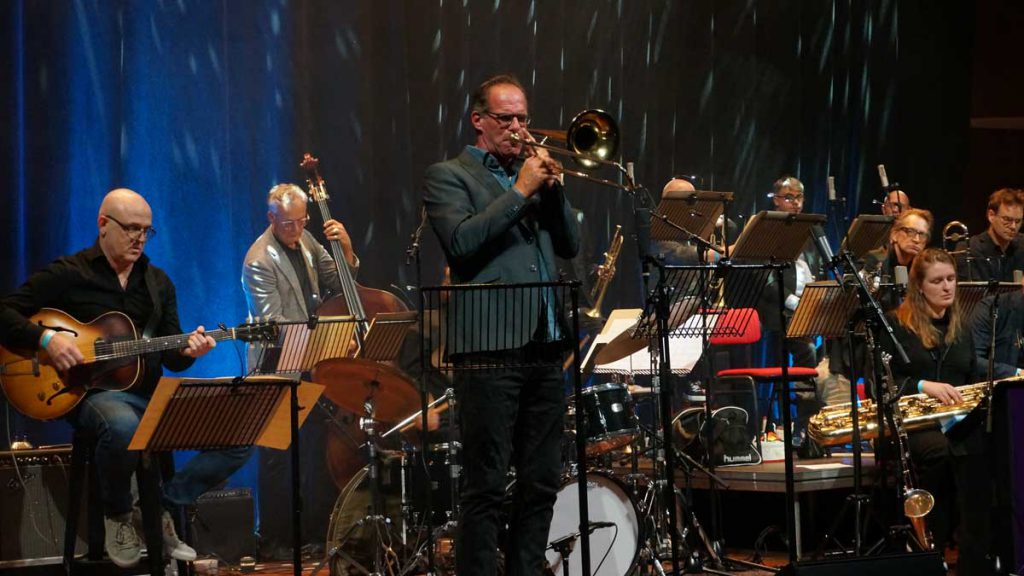
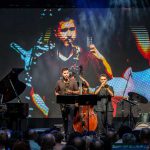
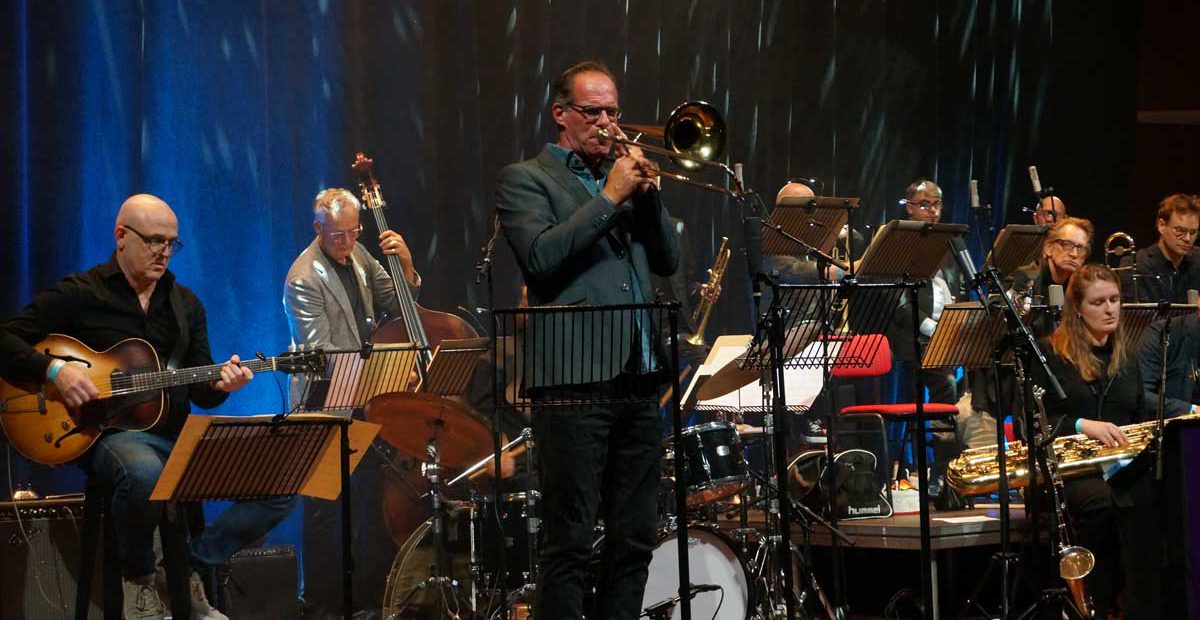
Ilja Reijngoud with the Jazz Orchestra of the Concertgebouw | Photo by Angela Balhorn
The second concert I saw on Friday featured Vernon Chatlein and his group, Chatlein i su Zumbi. Their music dives deep into the traditional rhythms of Curaçao, inspired by the Zikinza archive and Muzik di Zumbi style. They skillfully brought these old rhythms into a modern jazz context, blending jazz, Latin, and Antillean influences into a captivating and fresh sound. The whole set held my interest with its strong grooves and inventive approach.
What stood out was the way the group balanced rhythm and melody, driven by the powerful percussion duo of Chatlein and Lidrick Solognier. Meanwhile, Angelo Ursini’s woodwinds and Tony Roe’s keyboards combined to add rich color, texture, energy, and creativity, complementing the driving percussive pulse. Together, they delivered a convincing and thrilling mix of Caribbean traditions and jazz innovation, making it a memorable highlight of the evening.
Bassist and composer Zack Lober and his band NO FILL3R launched their new album “So We Could Live” at the festival with a powerful and energetic performance. Their playing was precise and full of drive, capturing a vitality that defines both the album and their live show. The band consisting of Lober, Sun-Mi Hong on drums, Suzan Veneman on trumpet and Jasper Blom displayed tight interplay, fire and depth. The concert was a standout moment, showcasing adventurous yet accessible arrangements with strong group dynamics and some dynamic solo contributions from Blom and Veneman. A unique highlight of the set was Zack Lober’s bass solo performance of referencing Besame Mucho, of mote was his use of double stops that added extra harmonic depth to the subtle melodic references to the latin classic. (Editors Note: For a detailed take on the album, a full review is available on the Jazz in Europe website.)
The final show of the first night featured Parra.dice, a fresh, explosive, and elusive nine-piece collective blending jazz, funk, Latin, and North African influences into a vibrant and danceable sound. With much of the band hailing from Utrecht, their energetic performance had the entire audience up and dancing, a perfect way to close day one.
It’s impossible to see all the concerts presented during Orange Jazz Days given the rich and varied lineup. Apart from the acts already mentioned, the first day of the festival also featured performances by the Jazz Orchestra of the Concertgebouw with a tribute to Misha Mengelberg, Martin Fondse & Femi Dawkins, Joris Roelofs, the Loek van den Berg Quintet.
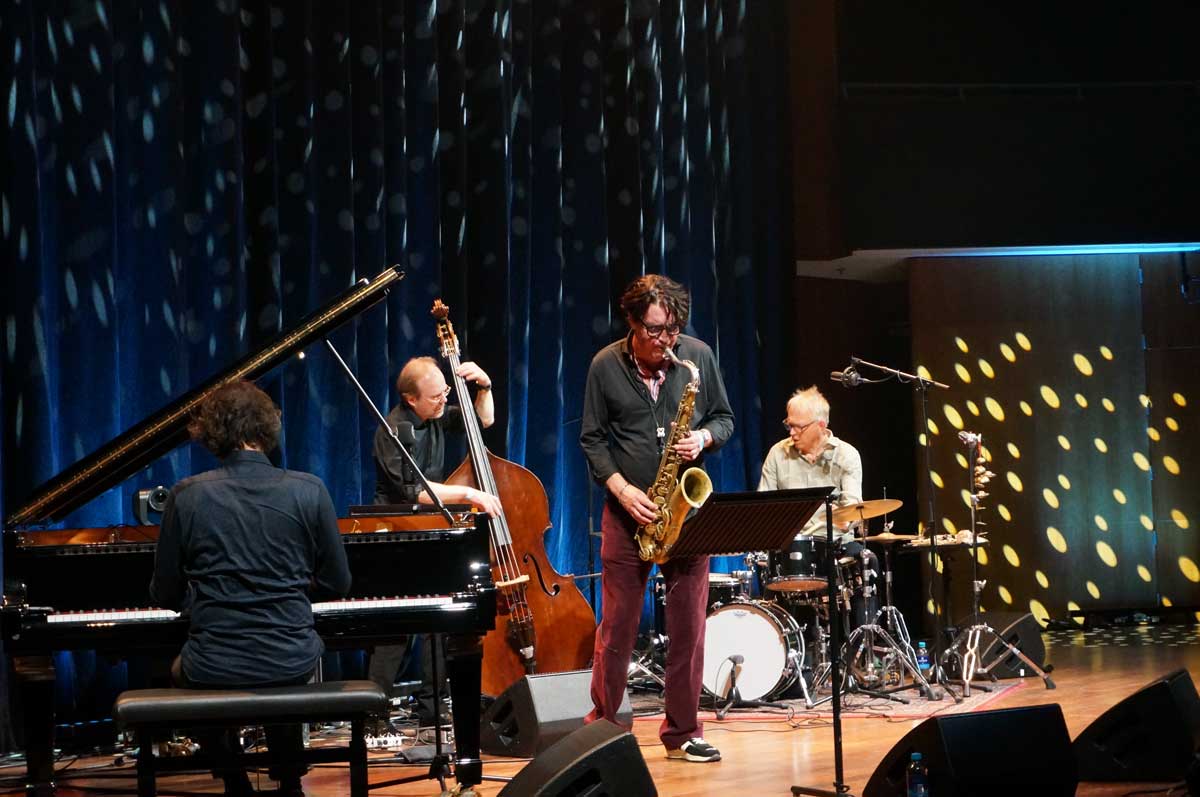
Yuri Honing Acoustic Quartet | Photo by Angela Balhorn
The first concert I caught on Saturday was by WAAN, a band that lives up to their description as bringing “a rich stew of electronically propelled grooves, atmospherically crafted melodies, and eclectic, vigorous jazz, roots, and funk.” The band led by Bart Wirtz and keyboardist Emiel van Rijthoven, blended electronically driven rhythms with improvisation, creating an energetic and dynamic sound. Their set featured mostly material from their current album but also offered a sneak peek at new compositions slated for release in January 2026.
WAAN’s live lineup, with Matteo Mazzù on bass and Mark Schilders on drums alongside Wirtz and van Rijthoven, delivered a show that combined the raw energy of EDM with the strong smell of jazz. Their set was both innovative and accessible, displaying the bands ability to merge electronic groove and improvisation making this an exciting start to the second day of the festival.
Saxophonist Yuri Honing delivered a beautiful, pensive set with his longtime acoustic quartet, featuring Wolfert Brederode on piano, Gulli Gudmundsson on double bass, and Joost Lijbaart on drums. The performance offered a dramatic contrast to the previous energetic set by WAAN, presenting music that was introspective, minimalist, and deeply penetrating. Honing’s group played with a remarkable sense of communication and subtlety, weaving thoughtful melodies and nuanced interplay that invited the audience into a more reflective space. The set’s quiet power and emotional depth made it a compelling and memorable moment in the festival program.
Eric Vloeimans was undoubtedly one of the highlights of the festival with a special commission to compose an all-new Dutch Jazz Suite for Orange Jazz Days. This suite, deeply rooted in the rich tradition and diversity of Dutch jazz, was performed for the first time on the Hertz stage to a sold-out hall, standing room only. All the compositions centered around the color orange, highlighting the creative spirit of the event.

Eric Vloeimans | Photo by Angela Balhorn
Vloeimans’ performance was nothing short of magical, combining his signature lyrical tone and subtle melancholy with an expansive musical sensibility. The ensemble’s unique lineup, trumpet, guitar, violin, cello, and drums, created an intricate interplay between structure and improvisational spontaneity. Particularly striking were the solo contributions from cellist Jörg Brinkmann and guitarist Mark Tuinstra, whose performances added depth and brilliant moments to the suite. This premiere perfectly encapsulated the festival’s artistic ambition to celebrate the genre’s heritage while pushing creative boundaries and was a memorable centerpiece of the festival.
Closing out Saturday was an extraordinary performance by the legendary ICP Orchestra, an evening that felt both like a celebration and a revelation. Having seen the group many times before, this concert still managed to feel special and most of all fresh and full of unexpected turns made it one of the festival’s high points. The hall was full of energy as the ensemble presented a tribute to Misha Mengelberg with anarchic wit and surprising tenderness.
Particularly moving was Han Bennink’s return to the stage after a recent fall that left him with several broken ribs; he joked during the set that he had four gigs that weekend and admitted being in a lot of pain, adding that “playing with such great musicians is the best pain killer of all.” At 83 Bennink remains a powerhouse, his drumming as unpredictable and galvanising as ever, and his presence clearly buoyed the whole group. Highlights included a haunting clarinet trio featuring Michael Moore and the presentation by bassist Ernst Glerum who’s humour has not diminished over the years.
True to ICP tradition, the night blurred composition and free improvisation until the boundary disappeared, moving effortlessly between mischievous chaos and rigorously shaped ideas. The performance ended to a sustained standing ovation, a fitting response to a set that honoured Mengelberg’s spirit by bringing it vividly, unpredictably, and joyfully to life.
The first edition of Orange Jazz Days was a major success, firmly establishing itself as a vital platform for Dutch jazz. The festival showcased the extraordinary talent and diversity present across the country, from established icons to innovative newcomers. Its sold-out halls and enthusiastic audiences demonstrated that the state of jazz in the Netherlands is as vibrant and dynamic as ever.
Orange Jazz Days successfully captured the rich history, creative energy, and forward-thinking spirit of Dutch jazz. By presenting a wide-ranging program that balanced tradition with experimentation, the festival offered a fresh perspective on what jazz in the Netherlands sounds like today. With such a strong start, Orange Jazz Days hopefully will become a key annual event on the Dutch scene.
Last modified: October 12, 2025