 Written by
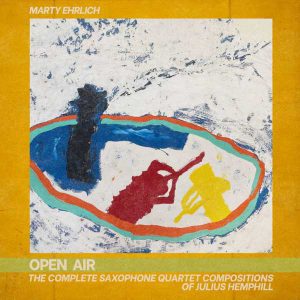
 On August 28, Out Of Your Head Records releases Open Air: The Complete Saxophone Quartet Compositions of Julius Hemphill, a two-disc set led by Marty Ehrlich that brings together all forty known works Hemphill wrote for saxophone quartet between 1978 and 1989. It is, on paper, a record. In practice, it is the end point of a much longer piece of work — one that says as much about the current state of jazz scholarship as it does about the music itself.
 I have long thought Julius Hemphill is one of those composers whose reputation runs ahead of general familiarity with the actual scores. Most listeners with a serious interest in this music will know the World Saxophone Quartet, and know Hemphill’s name alongside Oliver Lake, Hamiet Bluiett and David Murray as one of the group’s founding voices. Fewer, myself included until I got wind of this project, have reckoned with just how much Hemphill wrote specifically for that format — the saxophone choir as its own instrument, distinct from anything he composed for his small groups — and how much of it was never recorded at all.
That gap is the real subject of Open Air, and Ehrlich is uniquely positioned to close it. He has spent years editing Hemphill’s scores into three published volumes, work that grew out of his role in establishing the Julius Hemphill Archive at New York University around 2020. It was during that archival process, going through boxes of scores and parts held at Hemphill’s publisher, Subito Music, that Ehrlich turned up roughly a third of these forty compositions — pieces WSQ itself never got around to recording. That is not a small discovery. It means a meaningful portion of one of the most significant composers in jazz history has been sitting unheard and unpublished for decades, and it took a colleague’s sustained archival labour, not a reissue campaign or a record label’s initiative, to bring it back into circulation.
 There is a lineage worth pausing on here too. Hemphill and Oliver Lake first worked together in the Black Artist Group in St. Louis between 1968 and 1972, a collective whose importance to the broader story of Black experimental music in America still doesn’t get the attention it deserves outside specialist circles. That partnership carried through into WSQ, rounded out by Bluiett and Murray, and the quartet went on to headline festivals across Europe and America for decades — its recordings remain essential listening for anyone serious about the period. But WSQ was always a performing and recording entity with its own practical limits on repertoire, and Hemphill kept writing for the saxophone choir format well beyond what the group could get to. From his early multi-tracked pieces “The Blue Boye” and “Roi Boye and the Gotham Minstrels” through the large-scale “Water Music for Woodwinds,” and on into his own Julius Hemphill Saxophone Sextet from 1989 until his death in 1995, the saxophone ensemble was consistently where his compositional voice found its fullest expression. Open Air is, in that sense, less a tribute record than a completion of an unfinished archive — the two-thirds WSQ did record now standing alongside the third that never had a chance to be heard.
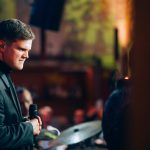
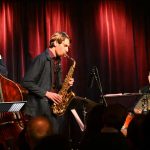
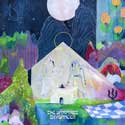
Ehrlich has organised the forty pieces into what he calls six galleries, a curatorial structure that runs through the set, with cover art by painter Oliver Lee Jackson framing the collection as something closer to an exhibition than a conventional album sequence. The performing personnel shift across the sessions — Allan Chase, Rob DeBellis, Brian Landrus, Andy Laster, Jeff Lederer, Lisa Parrott and Jason Robinson all appear in various combinations alongside Ehrlich, recorded across several sessions and studios through 2025, with one piece drawn from a 1997 session at Avatar Studios featuring the late Sam Furnace and Andrew White. That span of dates is itself a quiet reminder of how long this project has been taking shape.
What comes through most clearly in Ehrlich’s own account of the recording is how personal the undertaking has been. He describes marvelling, even after decades of playing Hemphill’s music in various ensembles, at how each piece carries its own distinct expressive logic — hardly the language of someone simply working through a back catalogue. The set closes with a piece Ehrlich wrote himself, a homage to Hemphill as what he calls a dear friend who left too early but left a great deal behind. That closing gesture feels like the right way to think about the whole project: not an academic exercise in completism, but one musician making sure another’s full body of work finally gets to exist in the world as intended.
Whatever the record turns out to sound like — and with a cast of players this strong, drawn from across the current generation of saxophonists working in this tradition, there is every reason for confidence — Open Air already matters as an act of documentation. Jazz has lost too much material to scattered archives and incomplete estates over the years. This is one composer’s work being given the complete treatment it should always have received.
August 28 is the official release date, and the full album will be released as a double CD available in stores and on Bandcamp on that date. For streaming the label are splitting the release into Vol. I + II, with Vol. I coming out on August 28 and Vol. II a month later on September 25.
You can pre/order or pre/save the release here.
Last modified: July 11, 2026