 Written by
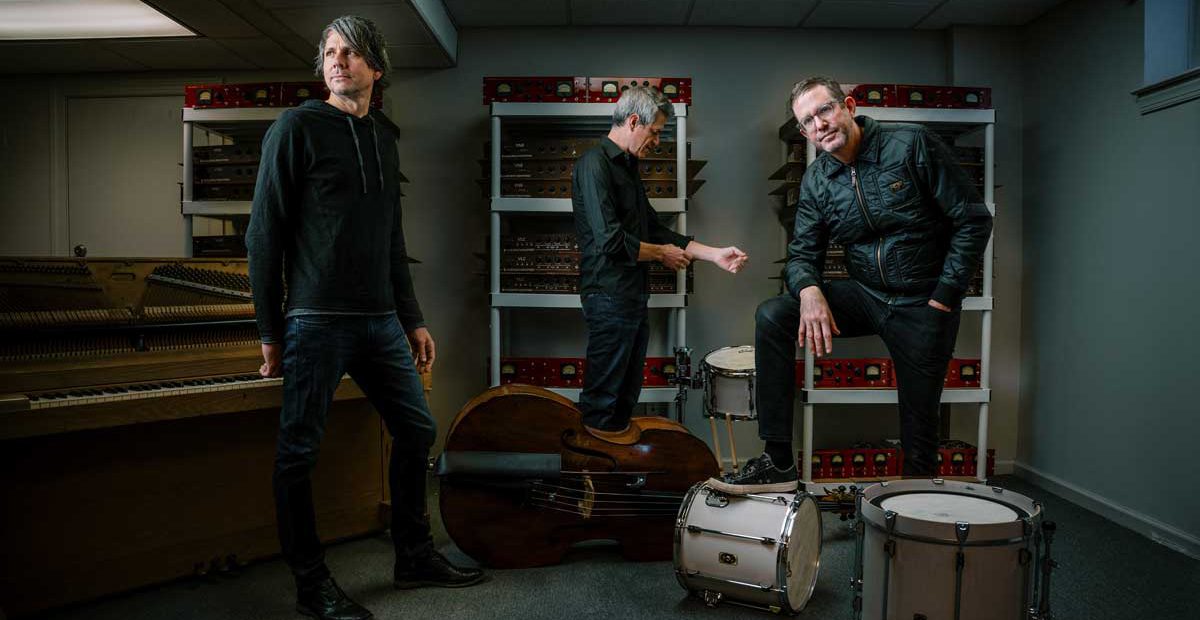
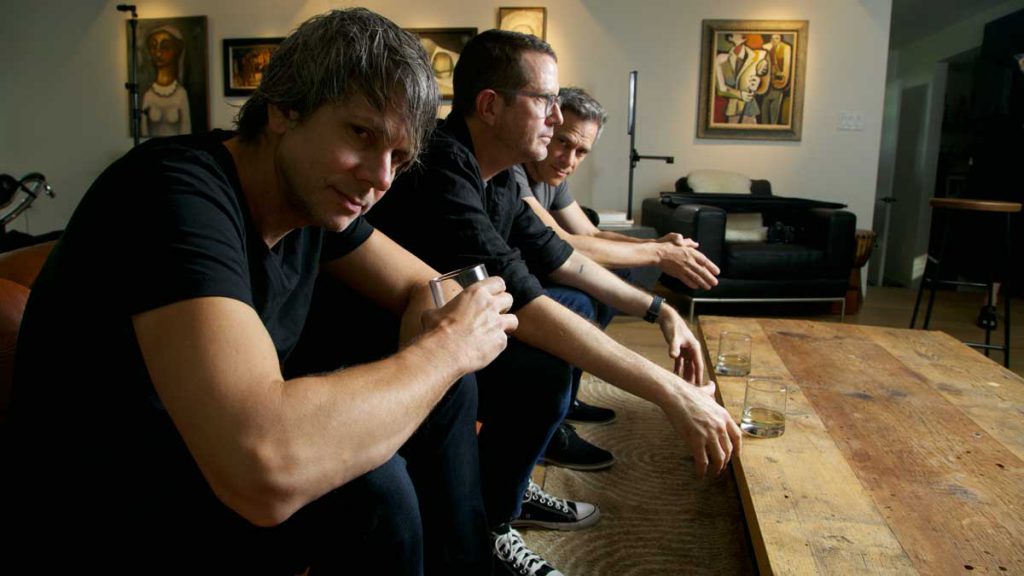
 It’s been some time since I last sat down with the Hazelrigg Brothers, George and Geoff, pianist and bassist respectively and the creative minds behind Hazelrigg Industries. Since our previous conversation, they’ve released two albums and continued to blur the lines between performing and high-end audio engineering. Our discussion picks up with a look into their recent work, their philosophy on repertoire, their uncompromising approach to recording, and their ongoing quest for recording excellence.
Hazelrigg Industries, founded in 2017 by brothers Geoff and George Hazelrigg, is a boutique manufacturer of high-end, all-tube recording equipment, hand-built in Bucks County, Pennsylvania. Drawing from their extensive backgrounds as performing musicians, recording engineers, and producers, the Hazelrigg brothers design their products from an artist’s perspective, with a deep understanding of the practical and sonic challenges faced by musicians, engineers, and producers in both world-class studios and home project recording spaces. Their product line, which includes the acclaimed VLC all-tube mic preamp, VNE compressor, and other units, is rooted in a tradition of uncompromising audio quality—an ethos inherited from their close collaboration and exclusive licensing agreement with legendary designer Doug Fearn, whose D.W. Fearn equipment they now manufacture and market alongside their own.
With this unique perspective, bridging the space between performance and the technical aspect of audio engineering, the Hazelrigg Brothers offer rare insight into the intersection of two worlds and the relentless pursuit of fidelity. So with no further ado, let’s get into the interview.
Andrew: So guys, welcome back, and it’s been a long time since we last spoke. I think at that time you guys had had your “Songs we Like” album out, and there’s been a lot going on since then. Maybe you could just bring us up to date with what’s been going on with the trio.
Geoff: Yeah, we’ve released two records since we last spoke, the first one being “Synchronicity”, a re-imagination of the The Police album of the same name, we did arrangements of the entire album, plus “Murder by Numbers,” which was their bonus track on the CD. It’s also our bonus track.
George: And the most recent one is entitled “Where the Path Runs Straight and High”, which is a collection of arangements of Led Zeppelin songs.
Andrew: Okay cool, is that last one out yet?
George: It is.
Andrew: So when did that come out?
Geoff: We released that about six Months, right?
George: Yeah, it was October, middle of October last year, and we only released that on Vinyl, Native DSD, Hi-Res Download, and Apple Spatial, so no CDs, no Spotify, nothing like that.
Andrew: I take it that that’s a strategic decision to do it that way?
Geoff: Yeah, we think that’s a good strategy. We earned more just on Native DSD than we ever would on all the streaming platforms combined.
Andrew: I agree, Native DSD is a great platform but hasn’t been really adopted yet by most jazz labels. I sort of get it because studios that are able to produce in DSD are still pretty rare.
Geoff: Yes, that’s for sure.
Andrew: Getting back to the repertiore, It seems to continue a bit of a trend, right, in re-imagining classic pop music. What are your thoughts?
Geoff: That’s mostly a matter of circumstance for us. We aren’t tied to that whole thing, and in fact, we do arrangements of classical music, too. But the thing is, if you go back to the heyday of jazz, that’s what it was—guys playing a lot of pop music. Charlie Parker was playing a lot of pop music, and so for us, what’s the difference? In a way, we’re kind of keeping more with that tradition than a lot of other jazz musicians.
Andrew: I would agree. Is there not a sort of wish to write your own material, or is that on the cards for later?
George: The problem with writing your own material is then you have to ask the audience to invest time to learn your material, and I don’t know that audiences are capable of that any more, especially here in the States.
Geoff: Yeah, yeah. I would expand on that. We deal in aesthetics. What we play is less important than how we play it. And we feel that our approach to performing whatever material we’re performing is, in a lot of ways, more original than what a lot of people’s so-called original music is.
I hear a lot of modern trios playing original compositions, and these are things that very rarely sound like anything that couldn’t have been written in the ’60s or ’70s. A lot of the time, it seems like the object is to just be weird or strange or shocking, and that’s been done, and it was done a long time ago, and it was done well. There are exceptions to that—Avishai Cohen comes up with some pretty original stuff.
George: The flip side of that is introducing a lot of technology, bringing in digital elements to performances. We do that in our other work, producing pop and more contempory music.
Geoff: Yeah. But in this context, we’re just not interested in that. This is an acoustic group, and if we can play a show, and we have, without anything really being plugged into the wall socket, that’s ideal for us.
Andrew: I did hear the “Synchronicity” album, in fact I believe we reviewed on the website. But speaking of the lastest one I have to ask the next logical question, Why Led Zeppelin?
Geoff: My wife told us to do it. The thing is, we’ve been playing Led Zeppelin since we were kids. It’s music that we really connect with, the imagery, the whole thing. When other people cover Led Zeppelin, it’s often a trite thing—they do it for the shock of it. We’re more into the compositions themselves.
George: That’s our approach with everything. We play a lot of Jimi Hendrix, too, and people are always like, “Oh, I never imagined Jimi Hendrix without the guitar.” But the guitar wasn’t really the main substance of Jimi Hendrix compositions. The guitar was just a vehicle. It’s the music that matters—the depth of the harmony, melodies, and conceptual stuff. You have to dig deep into these things and figure out what’s important. If you’re looking at a lot of that ’70s rock music, Led Zeppelin compositions were way ahead of what was going on at the time from a compositional point of view.
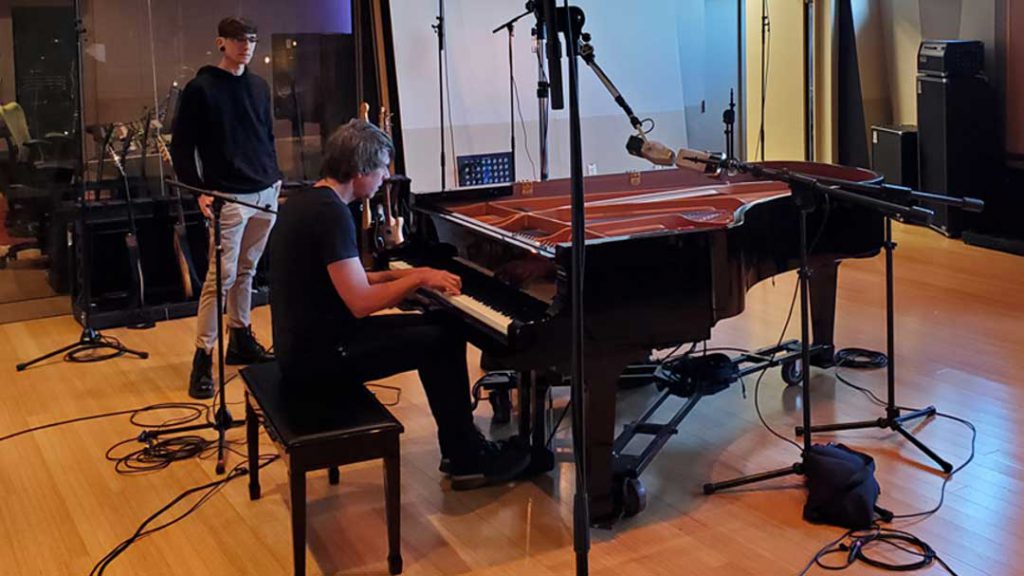
Andrew: I agree, there is a lot to dig deep into there. How did you go about it? Did you look at it from the point of view of, OK, let’s shred it and start again? What was your approach when looking at that music?
George: Well, it’s like design objectives for the album. The first thing was that we decided that it had to fit on vinyl. So we limited our selection to a certain amount of time. As far as compositions we chose, some of them we’ve played for a long time, some we haven’t. Only a few, though. We play “Kashmir” with the band, but we certainly weren’t going to record that for this.
Geoff: Yeah. That’s like, “Oh, yeah, they’re doing Kashmir.”
George: That wasn’t going to do anybody any favors. So we were picking out things that were way more unlikely. Geoff’s idea was to do “Friends,” which had never even occurred to me. But it’s such an odd tune, even for a Zeppelin fan. There’s things to anchor like that, that string melody in there kind of foreshadows a lot of stuff they had going on later in their careers, this Middle Eastern influenced aesthetic. So there was a lot of stuff like that where we were just trying to get away from the mainstream and get into something a little deeper.
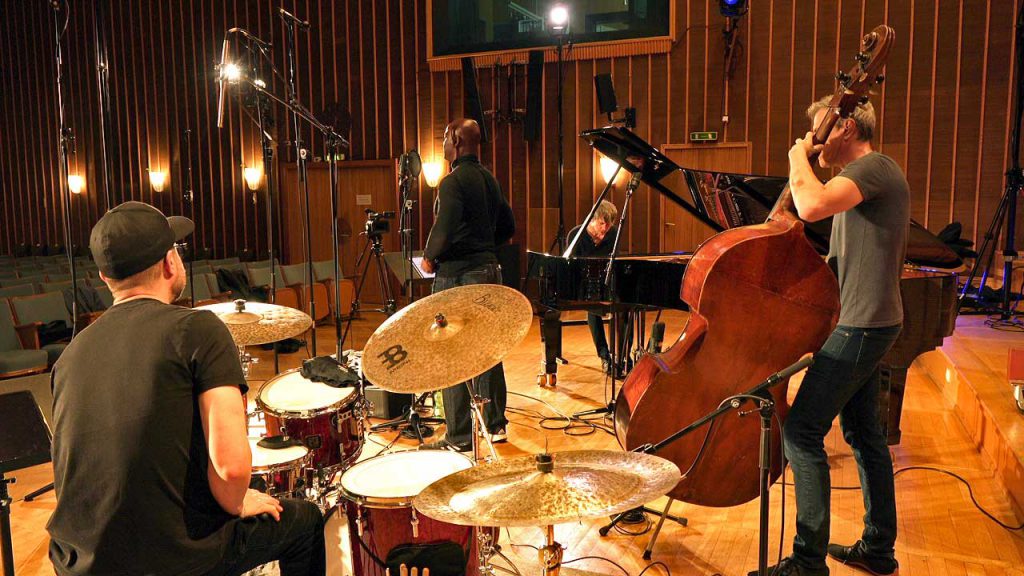
Andrew: Cool. You mentioned vinyl before. I remember last time we spoke about the Synchronicity album and bringing that out on vinyl. At that time you had some reservations about doing that. Maybe you could just refresh us on what that was about?
Geoff: Well, it was a real challenge to get a lacquer master cut that we were really happy with, that’s what it came down to. It’s a bit of a long story so I don’t know if I can go into detail.
Andrew: You can go into detail. Don’t worry.
Geoff: Well, we had to know that it was going to be produced right and we were having dificulties getting a good cut. We did a lot of consulting with different people. We ended up being in contact with Dave McNair, he’s got a whole collection of Grammy’s, to do the cut. We’ve also been working with Studio 4 Vinyl, which is a new record plant. They’ve been in business, what, three years?
George: Yeah.
Geoff: It’s a partnership with Phil Niccolo, who is a legendary engineer, and Obie O’Brien, who’s been John Bon Jovi’s right hand man for decades. They opened this plant and their aim was to produce the highest quality vinyl available in the world.
George: Yeah. They are. It was a big challenge.
Geoff: And they’re doing it. They’re doing top flight work so we’re pressing there.
Andrew: Speaking about cutting the master, the last time we spoke you mentioned reverse engineering the electronics for the cutting process, how is that going.
George: Yeah, right, we’re actually trying to figure out more of the electronic sides of these lathes and try to adapt our own electronics to run them. That’s going to be an ongoing process for the next several years till we can get there. In the meantime, we’re using a mastering engineer in LA, Nick Townsend, who has a Neumann, what is it, VMS80 I think.
Geoff: Yeah, VMS80. And that seems to work pretty well for right now. We are never happy with the outcome of anything that we do. That’s just our thing. It’s a terrible way to live, but it’s how it is for us. So for now we’ve concentrated on trying to get our master’s as optimized as possible so when it comes to the cutting it’s as good as it can be.
Andrew: Let’s talk a little bit about the recording process. One side of the Hazelrigg Brothers is the music side. But the other side is Hazelrigg Industries, which builds some seriously high-end recording gear, particularly preamps, compressors, EQs. How do these two sides interact, if they interact at all?
George: The funny thing is we never set out to own and manufacture audio equipment.
Geoff: Yeah. We set out to make great recordings. The problem is we’re always trying to make a better recording than we made the last time. So, you know, where do we begin? We were DIYing a lot of our own audio equipment along the way with a lot of the records we were producing. Any money we ever made from producing a record, we always just turned back into gear. We ended up building microphone preamps or compressors or things for ourselves. We came across D.W. Fearn, Doug Fearn, who’s somewhat local to us. I started working for him back in 2010. And we quickly found that his preamps did a lot more for our music than any other preamps—they captured the audio in such a way that it was sort of like the least offensive, the best that we had heard. So we kind of went all in on that.
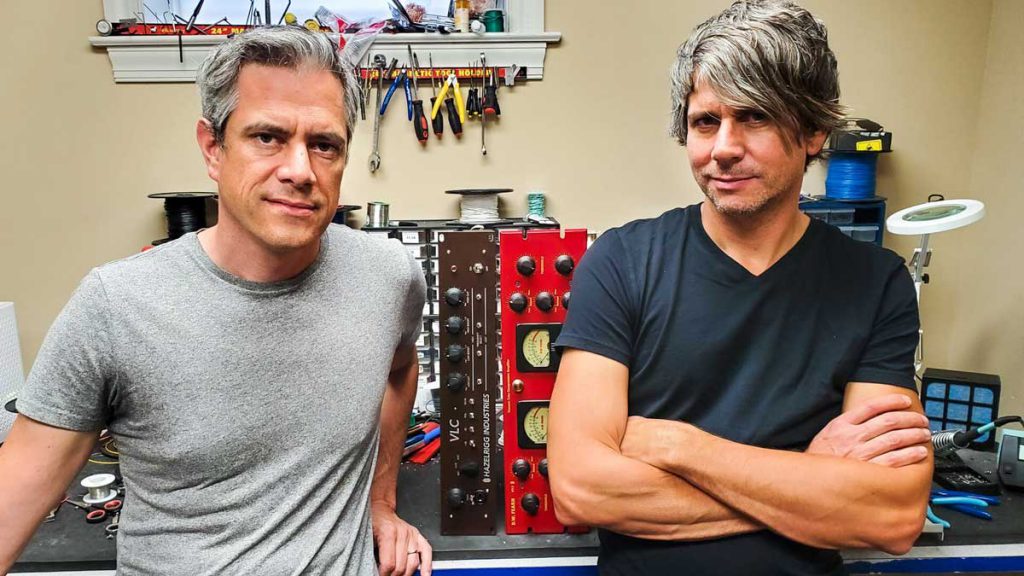
George: When we put Songs We Like out, we recorded that with the preamp that we had developed based on Doug’s topology. Since that time, Doug turned everything else over to us. So we now manufacture the entire line of D.W. Fearn equipment. And then we’ve essentially got two separate lines of our own equipment right now. So it’s effectively D.W. Fearn equipment that completely came out of the brain of Doug.
Andrew: But you’ve got your own brand of gear, right, that’s being developed under the brand Hazelrigg Industries. Can you describe the link between the two?
Geoff: All of our designs are based essentially directly from Doug’s designs. They’re built in the same shop and using the same parts and a lot of the same methodology, but they are two separate lines.
Andrew: Doug was saying in an interview that he started building his own equipment to be able to produce what he wanted. It sounds like it’s pretty much the same with you guys. So there seems to be a pretty good analogous link between the two of you.
George: Absolutely. We spent a lot of time making trio recordings that we just weren’t happy with. Something would happen in the room and it would feel great and sound amazing. Then we would listen back and it just never really connected. So we really struggled for several years to try to get something that we were happy with, that really translated what was going on. The process that we use now, the microphone setup, the equipment and the way that we record now, was all developed about five days before we cut Songs We Like. That was it. We landed on that and it was like, oh, finally, here it is, this works.
Geoff: It’s minimalistic and low tech. Recording acoustic music is really not that complex, it’s a good room, good instruments, good mics and preamps, and you’re done. You don’t need a lot of wizardry going in.
George: DSD plays a major role in this as well.
Geoff: We’ve gone down the Pro Tools (PCM) path and done that whole thing. So many people don’t know that you can just do better than that. There’s a lot of people who just don’t want to hear that. We get so much pushback for the DSD thing. So many people argue, “Oh, well, it doesn’t make any difference,” or “You’ve just bought into the marketing hype.”
George: What marketing hype? Nobody’s marketing this. Nobody’s marketed it in 20 years.
Andrew: If anybody’s marketing anything, they’re marketing that you don’t need to record any higher than 48 kilohertz.
George: Absolutely. That’s the marketing hype.
Geoff: That’s the current narrative in the business. I was watching a movie last night, and this high string line comes in and it’s so aliased that it doesn’t sound at all in tune with the rest of the music. Are you people telling me this doesn’t matter? This is unlistenable. It’s absolutely irritating. It sounds like a fly is going by, not a violin section.
George: It does matter. They just think that people don’t care about anything. But you have to give them a chance to, you know. They don’t care because they’re not fed enough good stuff.
The Hazelrigg Brothers’ journey is a study in duality: relentless musicianship paired with a deep commitment to the science of sound. Their approach to repertoire is rooted in jazz tradition, but their arrangements and recordings are unmistakably modern—driven by a desire to connect, to challenge, and to elevate. Whether discussing the intricacies of vinyl mastering, the philosophy of interpretation, or the pursuit of the perfect preamp, their answers reveal a rare blend of technical mastery and artistic conviction.
Their story is not just about the music they play, but how they play it—and how they capture it for the world to hear. For professional musicians, engineers, and audiophiles, the Hazelrigg Brothers offer a compelling model of what’s possible when you refuse to compromise on either side of the glass.
Last modified: September 17, 2025