 Written by
 For almost twenty years, Tobias Klein has built a clear path in modern jazz and improvised music. As the leader of Spinifex, an Amsterdam-based group known for mixing composition and improvisation, Klein has led the band through different members, changing music scenes, and tours in places like Siberia. In this interview, Klein talks about his unusual entry into music, how Spinifex started and changed, and the methods behind his work. He describes a career shaped more by curiosity and flexibility than by sticking to one style.
Klein’s start in music was different from the usual story of early talent raised in a musical home. “I was a bit of a late starter being really serious about music,” he says, explaining how he slowly found his way into music on his own. He began with the clarinet, but it wasn’t until he switched to saxophone in his teens—and later, bass clarinet—that he decided to pursue music professionally. His main goal was not just to play well, but to bring the music in his head to life. “My motivation to learn to play an instrument well was also to be able to perform the music that I wanted to write,” he says.
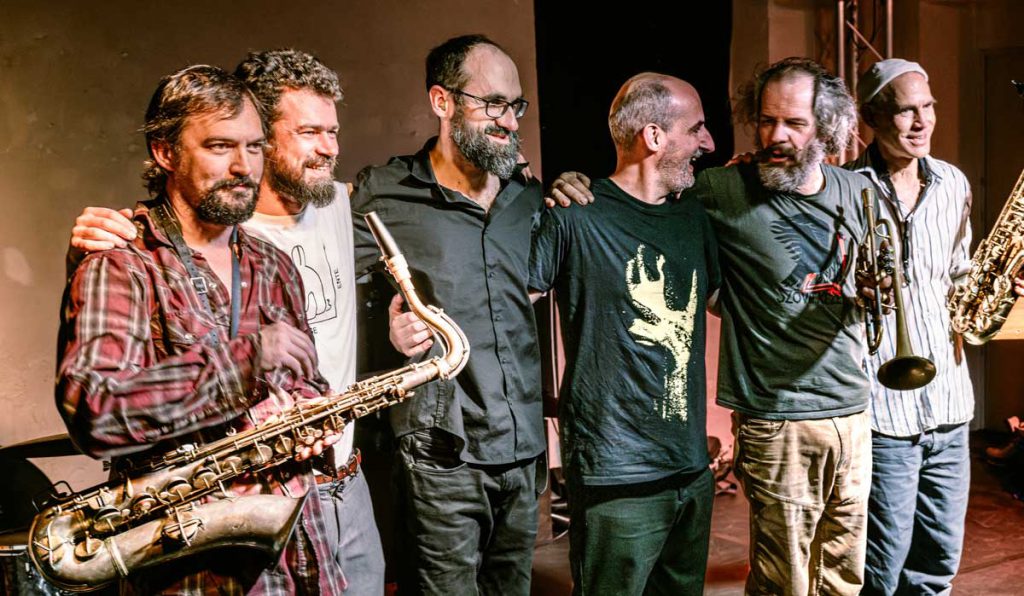
Spinifex: Live at the Moers Festival in Germany.
his focus on writing music set him apart. While most musicians start by performing and later try composing, Klein did the opposite. Early on, he experimented with synthesizers, samplers, homemade instruments, and home recording. “I had a fascination for creating music. You could say writing music, but often around then it was without actually writing it, notating it, but creating it,” he says. His drive to compose was natural and self-taught, coming from a need to shape the sounds he imagined.
Klein grew up in Saarbrücken, Germany. He decided to move to Amsterdam because he wanted a change and had heard good things about Dutch music schools. “I wanted to study music and I had heard that there are good schools in the Netherlands. And… also, I felt like I needed a change. And I liked the idea of moving to the Netherlands,” he says. He didn’t choose Amsterdam for a specific teacher or program—he just visited, liked the city, and signed up.
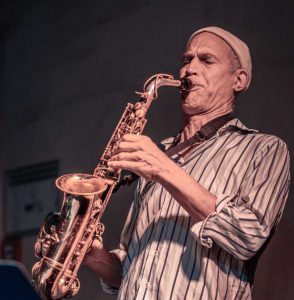
Tobias Klein
He was lucky to find out that the world’s top bass clarinet player was teaching at the Amsterdam Conservatory. Even though Klein had little experience with the bass clarinet, he was accepted as a student. “I didn’t know anything about the bass clarinet itself. But yeah, I could go ahead and be his student,” he says, still sounding a bit surprised at how things worked out.
At the conservatory, Klein focused on jazz saxophone at first, then added bass clarinet. He also took a course on Non-Western Techniques, but mostly taught himself composition. It wasn’t until 2010 that he started private lessons with Amsterdam composer Rosalie Heers, whose work in spectralism gave him new ideas.
Klein’s approach to composition is marked by a fascination with the interplay between structure and freedom. When hearing his work, there’s little doubt that he operates in the spaces between genres, drawing on both jazz and contemporary classical traditions. “There’s definitely areas that overlap,” he explains. Klein is less interested in defining these boundaries than in exploring them. “I don’t really have a theory or fixed way of thinking about this. I’m more like in a state of wonder. And, yeah, I’d like to be newly fascinated by this every day,” he says. The ideal, for him, is a meeting point where musicians from different traditions can understand and inspire each other, escaping the “trenches” that genres can create.
Spinifex, the Dutch jazz ensemble that Klein leads, emerged from this spirit of exploration. The band was founded in 2005 by Klein, trumpet player Gijs Levelt, and flute player/composer Ned McGowan. The trio had previously played in Bhedam, a sextet featuring two Indian percussionists from Bangalore. When Bhedam ended, Klein and his collaborators wanted to continue developing some of the musical ideas they had enjoyed, but in a new ensemble.
Unlike many groups that form around a specific project, Spinifex was conceived as a platform for ongoing exploration. “It was not for a particular project or—yeah, we just wanted to have a band that we could write for in this way,” Klein says. Initially, Spinifex was a nonet—a medium-sized band in jazz terms, almost a large ensemble, offering a broad palette of possibilities.
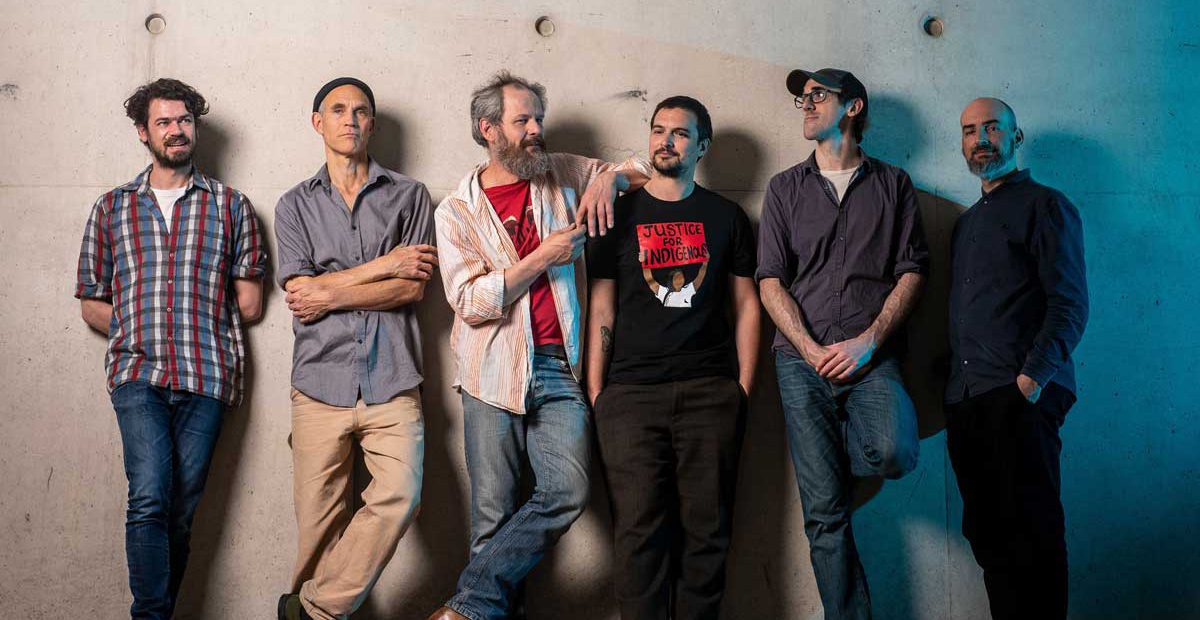
Around 2010, Klein and Levelt decided to create a parallel, more flexible version of Spinifex—a quintet that could tour more easily and play smaller venues. This quintet, featuring drummer Philipp Moser, bassist Gonçalo Almeida, guitarist Jasper Stadhouders, Levelt, and Klein, became the core of Spinifex as it exists today. For a time, both the orchestra and the quintet operated in parallel, but eventually the quintet took precedence with Levelt leaving the band in 2014 to focus on other projects.
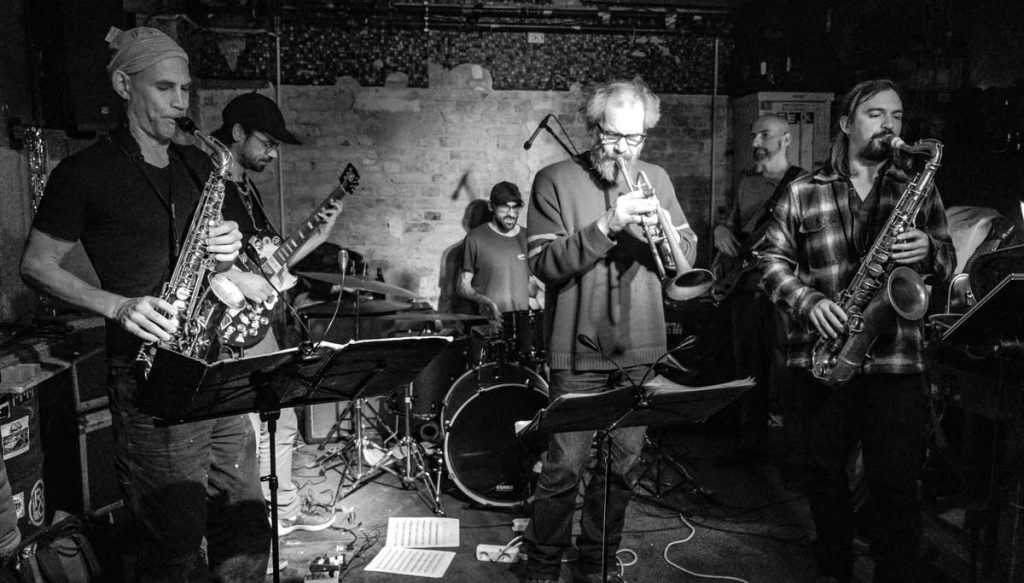
Defining Spinifex’s artistic profile is a challenge, even for its leader. “When Gijs and I started this quintet, we described it as having rigorously composed structures and radical free improvisation. And to juxtapose those two and to explore the tension that those two elements would have between each other,” Klein explains. This tension remains at the heart of the ensemble’s identity, though the forms it takes have evolved over the years.
In recent years, Spinifex has explored areas previously left aside, but the core remains the interplay between structure and improvisation. “That juxtaposition between the structure and composition and the free improvisation and the tension and that’s created between the two… that gives you a mandate to take it anywhere you want, really,” Klein observes. Spinifex’s music resists easy categorization. “If people ask me, what is it, what’s this music that you play? Is it jazz? I have a hard time answering the question. Yeah, it’s an impossible question to answer,” he admits. The band’s albums might be found in the jazz section of a record store, but their music could also fit into world music or contemporary classical—though perhaps not always neatly enough packaged for the latter.
 This resistance to categorization brings both opportunities and obstacles. Spinifex’s openness to diverse influences means they are invited to perform at a wide range of events—sometimes on jazz bills, other times at festivals focused on experimental, improvised, or cross-cultural music. Yet, Klein points out, there are boundaries: “When it comes to festivals that really focus on the more traditional aspects of world music, then often we’re not world music enough. And that also goes for contemporary composed music festivals. So there’s many places that we wouldn’t fit, but thankfully there’s many venues and festivals that like to explore the gray zones.”
For Klein, these in-between spaces are where the most interesting work happens. “The true interest is in the gray zone. It’s not in the tradition. We’ve sort of been there, done that, you know, but it’s the gray zone where the interesting shit’s happening,” he says, reflecting a view shared by many musicians who are interested in the intersections and overlaps of established styles. One of the most distinctive features of Spinifex’s music is the seamlessness with which it transitions between through-composed passages and improvisation. Sometimes, the two are so closely intertwined that it is difficult to distinguish where one ends and the other begins. Achieving this balance is not a matter of following a formula, but rather the result of years of collaboration and experimentation.
 “It’s very much something that grew out of the dynamic of the band and out of the specific way that these people work together,” Klein explains. The group’s sound is shaped by collective experience—by playing together in different contexts, developing an intuitive sense of what works, and being willing to discard ideas that do not serve the ensemble’s identity. “It’s about trying to understand the point of a composed cell or a starting point and then blowing life into it… from whatever direction it needs. That can work both ways. It could be an improvised starting point and it needs structure. So we insert structure or it could be a composed starting point and it needs freedom or looseness and we insert improvised looseness,” he elaborates.
This approach requires trust and flexibility among the musicians, as well as a willingness to embrace uncertainty. The result is a music that is neither fully notated nor completely free, but something in between—a living process that evolves with each performance.
This year marks the 20th anniversary of Spinifex, a rare milestone for an ensemble that began as a project-based group. Over two decades, the band has undergone significant changes in personnel, format, and artistic direction. Yet, the core ethos—exploring the tension between structure and improvisation—remains intact.
The band’s longevity is notable given the often ephemeral nature of such projects. “It’s extremely uncommon for a group that was formed for a project to still be around 20 years later,” Klein acknowledges. The ensemble’s adaptability has been key to its survival, allowing it to morph from a nonet to a quintet and to embrace new influences and ideas as members come and go.
Spinifex’s history is marked not only by musical innovation but also by adventurous touring. One of the most memorable episodes was a tour through Siberia, part of the so-called MuzEnergo tour organized by Iouri Lnogradski. “He would rent a bus and load it full of musicians, jazz musicians, mostly from Europe, also some Russian musicians. And during two and a half or three months, go from Moscow to Vladivostok and play concerts along the way,” Klein recounts.
The idea resonated with Klein’s long-standing dream of traveling the Trans-Siberian Railway. In 2015, Spinifex spent about a week performing in smaller towns around Moscow and then flew to Irkutsk, where they joined the MuzEnergo bus for the journey east. “We got on the bus and then completed the trip to almost the last stop before Vladivostok. There we got off. They went on for another week and finished the tour at a festival. For some reason, we couldn’t do that. So we just skipped out the last week, but we flew back from Vladivostok,” he recalls.
 The tour was both challenging and rewarding, pushing the band out of its comfort zone and exposing it to new audiences and environments. Such experiences have become part of Spinifex’s identity, shaping both the music and the relationships within the group.
Throughout his career, Klein has resisted easy definitions. This ambiguity is both a challenge and an opportunity. On the one hand, it can make it difficult to market the band or to find the right festival or venue. On the other, it allows for a freedom and openness that is central to Klein’s artistic vision.
His attitude toward genre is pragmatic. He recognizes the utility of labels for practical purposes—finding a CD in a store, applying for a festival—but ultimately sees them as secondary to the music itself. What matters is the process of exploration, the willingness to embrace uncertainty, and the commitment to ongoing growth.
With Spinifex about top enter its third decade, Klein remains focused on the process rather than the product. He is less concerned with defining the band’s legacy than with continuing to explore new possibilities. “I’d like to be newly fascinated by this every day. And, yeah, just work out where my path is there,” he says.
Tobias Klein’s story is one of curiosity, adaptability, and a refusal to be confined by boundaries—whether of genre, geography, or tradition. From his self-taught beginnings in Germany to his leadership of Spinifex in Amsterdam, he has pursued a path defined by exploration and collaboration. The music of Spinifex, with its seamless blend of composition and improvisation, is a testament to the possibilities that arise when musicians are willing to inhabit the spaces between established categories.
As Klein and his ensemble look to the future, their journey offers a model for creative work in an increasingly interconnected and genre-fluid world: stay curious, embrace uncertainty, and keep searching for the places where boundaries blur and new forms can emerge.
Text by: Steven James | Photos by: Andre Symann, Elmar Petzold, Christina Marx, Michel Mees.
Last modified: June 27, 2025