 Written by
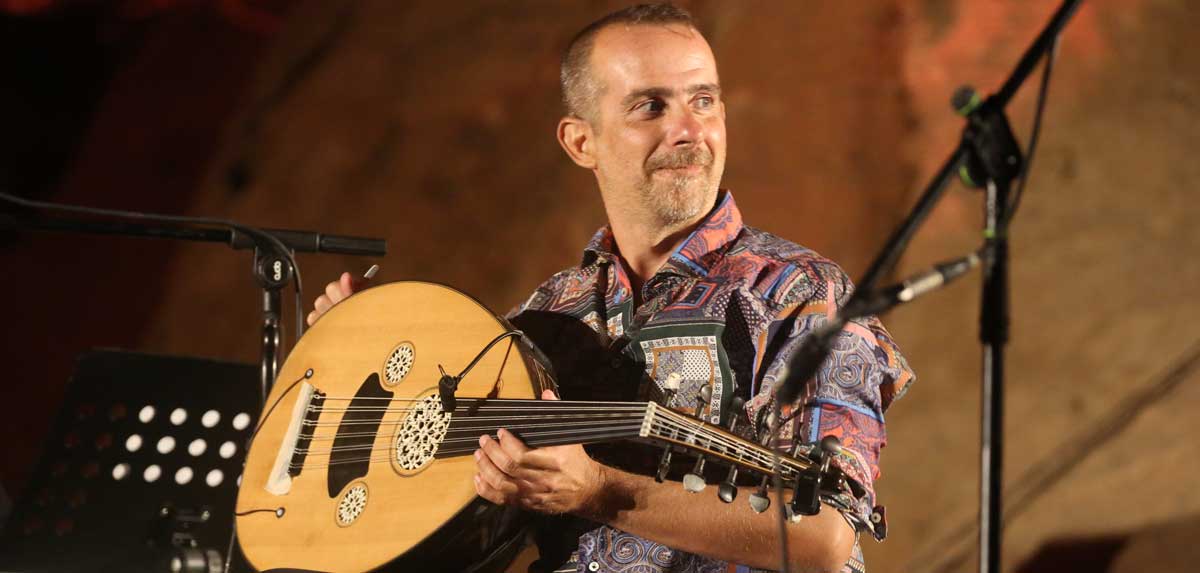
 When I first sat down with Mauro Sigura, I was struck by his quiet intensity—a musician whose journey has been shaped by both geography and curiosity. Mauro is not just a performer; he is a bridge between cultures, a seeker of new sounds, and a relentless innovator. Our conversation, which ranged from his early days in Turin to his current explorations with prepared piano and acoustic innovation, revealed a musician deeply committed to the art of fusion—not just of genres, but of histories, emotions, and identities.
Mauro’s story begins in Turin, a city in northern Italy known for its industry and its role as a crossroads for people from all over the Mediterranean. “I was born and lived in Turin for 30 years,” Mauro recalls. “Turin is a big industrial city with many people from southern Italy and the Mediterranean. They brought their culture and music with them, which was fascinating to me.”
It was in this melting pot that Mauro’s musical journey took root. He started, as so many do, with the guitar—specifically, as a blues guitarist. “At first, it was just a hobby, not a job,” he says. “I studied music but didn’t play professionally until I transitioned to these Mediterranean instruments.” The transition was not immediate, but rather the result of a series of encounters and discoveries that would shape his artistic identity.

The turning point came during family travels to Greece and Turkey. “Italy, especially the south, is heavily influenced by Mediterranean sounds,” Mauro explains. “Listening to music from regions like Puglia, Sicily, Sardinia, and Naples, I noticed a strong connection between European and Arabic music. My parents and I often traveled to Greece and Turkey, where I first encountered these instruments.”
The instruments in question—the baglamas and bouzouki—were not part of Mauro’s original plan. “Initially, I tried them out of curiosity, not intending to make a career out of them, but I became increasingly involved with their unique sound.” What began as an experiment soon became a passion, and Mauro found himself drawn deeper into the world of Mediterranean music.
Mauro’s first significant professional experience came in 2010, when he joined Agricantus, Italy’s most important world music band at the time. “They were very famous in the late 1990s,” he tells me. “I played baglamas and bouzouki with them for three years, performing across Italy and Europe. Although we didn’t have many concerts, the ones we did were of very high quality.”
It was during these tours that Mauro realized music could be more than a passion—it could be his life’s work. “After those tours, I decided I wanted to pursue music as my profession and started working on my own projects and promoting myself.”
While Mediterranean music provided the foundation, Mauro’s artistic vision expanded further when he encountered jazz. “In Turin, I played with a musician who was very interested in black music, starting with blues and then jazz. He introduced me to artists like Miles Davis and Coltrane. Listening to jazz for the first time was amazing, and I wanted to understand the energy and creativity behind it.”
This openness to new influences would become a hallmark of Mauro’s approach. He is quick to point out that the north of Italy, despite its differences from the south, is a place where musical boundaries are constantly being redrawn. “There is a significant difference between the north and south, but in the north, you can find many interesting projects that mix and blend different influences. Cities like Milan and Trieste are real melting pots, with influences from the Balkans and beyond. Even before international immigration, there was internal migration from the south, which shaped the culture and music in the north.”
In 2013, Mauro took a bold step by forming his own acoustic quartet—a group that would blend jazz and world music in new and unexpected ways. “I started my acoustic quartet in 2013. It was a mix of jazz and world music. I played with musicians from Sardinia, my hometown, which is a small town of about 30,000 people.”
Starting a quartet on an island presented unique challenges, but Mauro and his collaborators were undeterred. “Despite the challenges of starting a quartet on an island, we performed internationally in places like Japan, Africa, the Middle East, and Europe. We recorded two albums with the label Sard Music, distributed by EJR.”
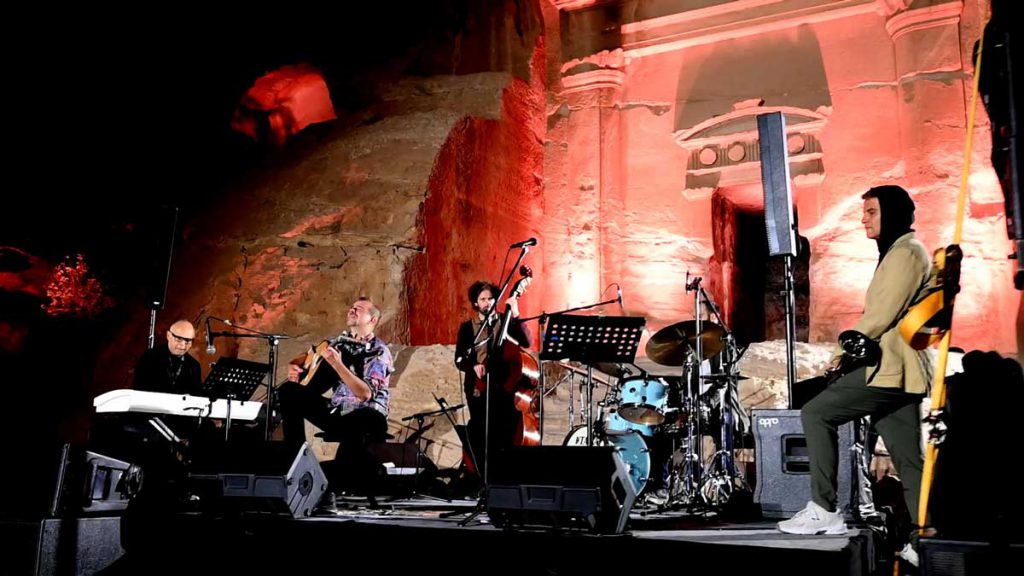
Live at the ancient Jordanian city of Petra.
These experiences not only broadened Mauro’s horizons but also deepened his commitment to musical exploration. The quartet became a laboratory for blending traditions, experimenting with form, and pushing the boundaries of what Mediterranean music could be.
As Mauro’s career progressed, so did his desire to experiment with new sounds and formats. In 2023, he created a new, more electric band and recorded the album “Dunia” with the same label. “For this album, I collaborated with some of the best musicians in Sardinia and Italy, including guitarist Pierpaolo Ramieri and drummer Evita Polidoro, who is currently touring with Didi Bridgewater. We presented the album in Cagliari and Petra, Jordan.”
The move from acoustic to electric was not just a change in instrumentation—it was a statement about the possibilities of fusion. Mauro’s music, always rooted in tradition, now embraced the energy and dynamism of contemporary jazz and rock, creating a sound that was both familiar and entirely new.
Never one to rest on his laurels, Mauro soon began exploring even more flexible formats. “I wanted to explore more flexible formats, so I started new projects: a duo with pianist Andrea Manzoni, a trio with an accordionist and drummer, and another duo with a Sardinian diatonic accordion player. In total, I have five active projects: two duos, a trio, and the previous two quartets (acoustic and electric).”
Each ensemble offers its own set of challenges and opportunities. The smaller groups allow for greater intimacy and improvisation, while the larger ensembles provide a platform for more complex arrangements and sonic experimentation. For Mauro, the key is to remain open—to let the music evolve organically, shaped by the personalities and talents of his collaborators.
One of the most striking aspects of Mauro’s music is its ability to balance complexity and simplicity. “My approach is to create music that is complex yet simple, blending different influences and musical cultures. For example, I might start with an Arabic scale (maqam) and then arrange it in a more European way, using European jazz chords and rhythms. I also incorporate microtones, which I initially avoided but now find interesting for creating unique sounds if managed carefully.”
This willingness to embrace both the familiar and the unfamiliar is what gives Mauro’s music its distinctive character. He is not afraid to take risks, to challenge his own assumptions, and to invite listeners into a world where boundaries are constantly being redrawn.
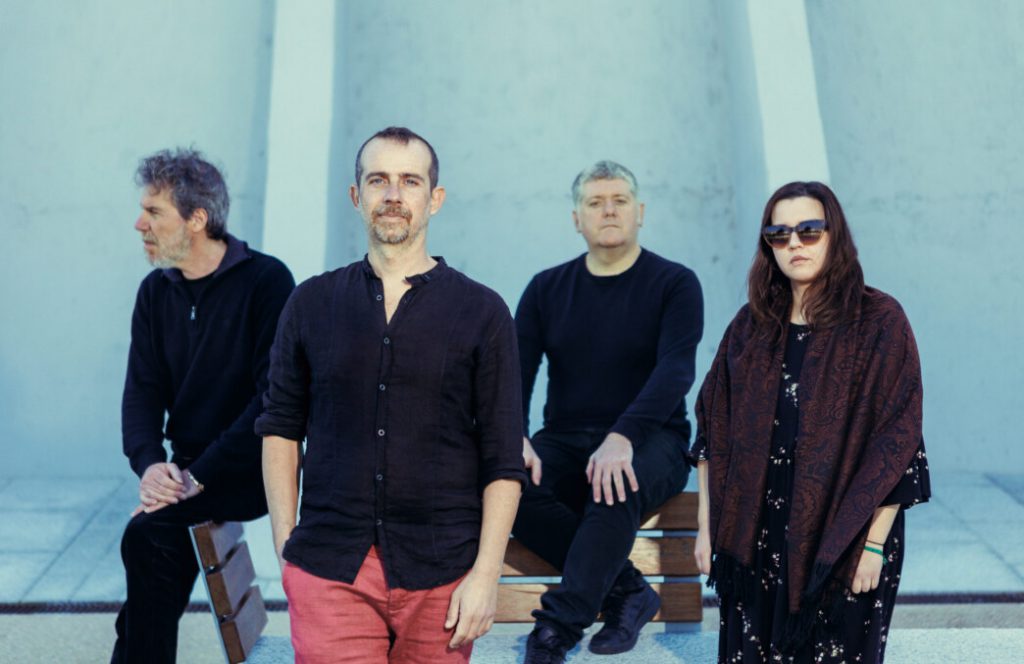
When asked about his influences, Mauro is quick to mention two names: Anouar Brahem and the Esbjörn Svensson Trio. “In terms of composition, I’m influenced by Anouar Brahem, especially for the oud. For the European side of my music, the Esbjörn Svensson Trio has been a major influence.”
These influences are evident in Mauro’s work, which combines the lyricism and depth of Brahem’s oud playing with the adventurous spirit and harmonic sophistication of Svensson’s jazz trio. The result is a music that is at once rooted and restless, grounded and searching.
For Mauro, the challenge is not just to blend different musical styles, but to do so in a way that feels authentic. “In Italy, there are many musicians from Morocco, Tunisia, Egypt, and Syria. If you play only traditional music, it doesn’t make sense because you’re not from those cultures. If you play only modern jazz on the oud, it can sound like a guitar. My goal is to blend these styles, both in composition and performance, to create something unique.”
This commitment to authenticity is what sets Mauro apart. He is not interested in imitation or pastiche; instead, he seeks to create a music that is true to his own experience, while remaining open to the influences and traditions of others.
Mauro’s discography reflects his restless spirit. “I have two albums with the acoustic quartet and one with the electric band (‘Dunia’). With the smaller ensembles, we plan to record in February, possibly at La Scala Theater’s studio. For the duo with the pianist, the concept is ready, but I want to play more concerts before recording to develop the project further.”
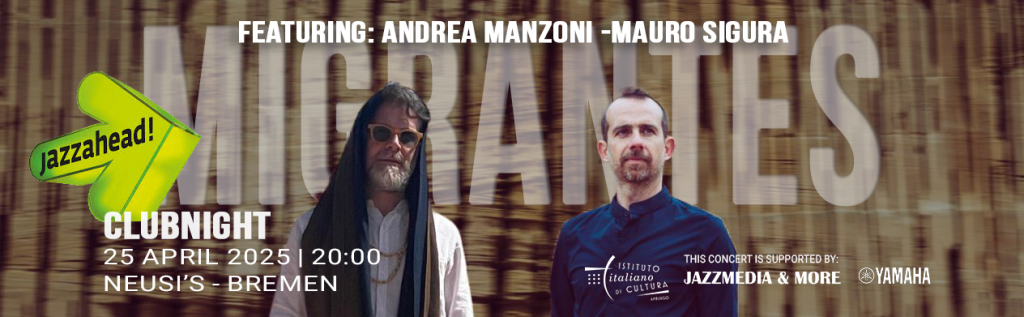
Live performance remains central to Mauro’s artistic process. He mentioned several key dates he recently played. On February 14th, he and his duo partner played at Casa del Jazz in Rome, followed by a performance the next day in Bellinzona, Switzerland. Later that month, on February 25th, his electric quartet performed at Watermill Jazz Club in the UK. In March, the trio played in Zadar and Zagreb, Croatia, on the 14th and 15th, respectively. Adding to this vibrant schedule, Mauro looks forward to a performance with Andrea Manzoni as a duo in Bremen on April 25th, as part of the jazzahead! clubnight, further solidifying his commitment to sharing his unique sound with diverse audiences. These performances, he emphasized, were vital opportunities to test new material and refine his artistic vision.
The Duo with Andrea Manzoni explores the experience of migration. “The concept is to express, through music, the emotions and experiences of migrants coming to Europe. We try to convey their emotional journey and thoughts through our compositions and performances.” This commitment to storytelling is evident in every note Mauro plays. His music is not just an exploration of sound, but a meditation on identity, belonging, and the search for home. It is a music that speaks to the heart as well as the mind, inviting listeners to share in the joys and sorrows of the migrant’s journey.
One of the most fascinating aspects of Mauro’s collaboration with pianist Andrea Manzoni, particularly their use of prepared piano. “There’s a part in the show where I play a theme and he plays the same on the piano—specifically, a prepared piano. The sound blends so well that you can’t tell which is the oud and which is the piano. This is very cool because it creates a unique sound field.”
The tradition of prepared piano comes from modern classical music, where objects are placed inside the piano to alter its sound. But for Mauro and Andrea, the approach is more improvisational. “He doesn’t prepare the piano from the beginning in a fixed way. He knows there are certain parts where we play the theme together, so he puts something inside the piano—usually just paper, as you mentioned. It’s not a permanent preparation; it’s more improvisational. Sometimes, he uses one hand to mute certain strings while playing with the other hand on the keyboard, creating percussive effects.” This willingness to experiment, to blur the boundaries between instruments and traditions, is at the heart of Mauro’s artistic vision.
As our conversation turns to the future, I ask Mauro about the possibility of incorporating electronic elements into his music. His answer is thoughtful and revealing. “For this album, we’re keeping everything 100% acoustic because we don’t have time to experiment with electronics. However, Andrea has thought about introducing keyboards or electronic sounds in the future to create new textures. Personally, I appreciate his effort to create new sounds acoustically, and I find that very interesting. We’ll discuss whether to add electronic elements later, but for now, I like the challenge of recreating different sounds with just acoustic instruments.”
For Mauro, the focus is on acoustic innovation—on pushing the limits of what is possible with traditional instruments. But he remains open to the possibilities of technology, always looking for new ways to expand his sonic palette.
What emerges from my conversation with Mauro Sigura is a portrait of an artist driven by curiosity—a musician who is never satisfied with easy answers, who is always searching for new sounds, new stories, new ways of connecting with the world. Whether he is playing the oud, the baglamas, or the bouzouki; whether he is collaborating with jazz musicians, classical pianists, or folk artists; whether he is performing in a small Sardinian town or on a stage in Japan, Mauro brings the same spirit of openness and exploration to everything he does.
His music is a statement of the power of fusion—not just as a musical technique, but as a way of life. It is a music that refuses to be confined by borders or categories, a music that invites us all to listen more closely, to imagine more boldly, and to dream more freely.

Last modified: June 27, 2025