
 Written by
 Recently, I had the chance to listen to some pre-release tracks from SADA’s upcoming album “Echoes of Maqam”, and I was immediately fascinated by the band’s unique blend of Arabic maqam traditions, improvisation, and contemporary rock influences. Intrigued, I decided to delve deeper into the story behind the band, to understand how this collective came together and how their captivating musical language evolved.
I reached out to both Mohamad Fityan, the Syrian nay virtuoso and founding figure, and Matthias Kurth, German guitarist and key creative partner. During our interview, they offered a glimpse into the band’s origins, the challenges they faced, their evolving collaboration, and the philosophical underpinnings of their music. This conversation revealed not only the technical and cultural fusion at play but also the personal stories and shared vision that breathe life into SADA’s vibrant sound.
SADA’s music is inseparable from the personal journeys of its members, none more so than band founder and nay virtuoso Mohamad Fityan. During the interview, Mohamad’s recounting of his route to Germany shines light on both the circumstances underpinning the band’s foundation and the spirit of resilience woven through the band’s evolving sound.
Mohamad’s first encounter with Germany dates back to 2006, when he performed in Kassel as part of a tour with a French-Syrian composer. This partnership seeded a follow-up project, which joined German and Syrian musicians and resulted in a CD featuring Mohamad alongside guitarist Matthias Kurth. Their initial collaboration, as Mohamad notes, “was by accident… We just met and began playing together.”
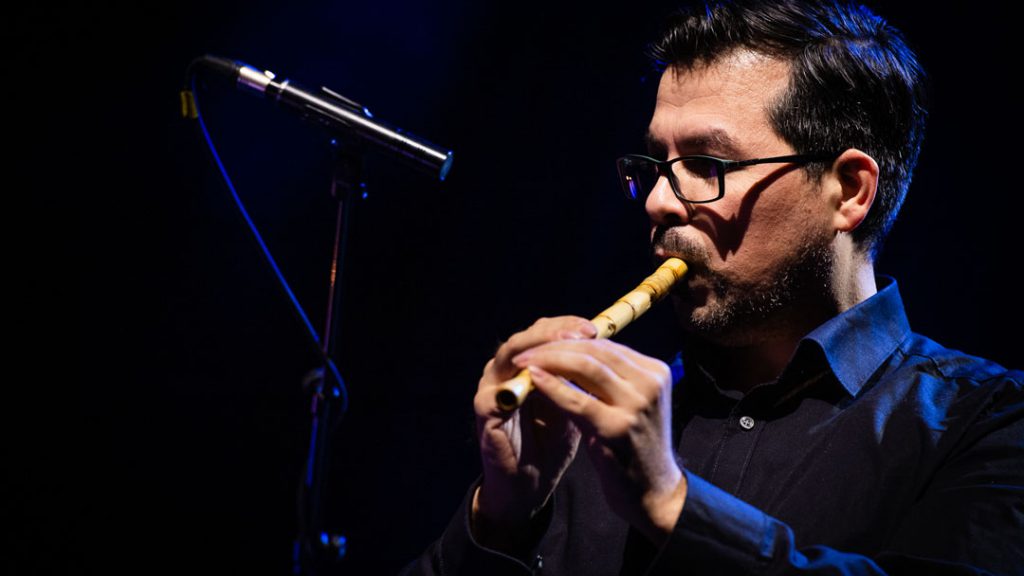
Mohamad Fityan | Photo by Torsten Redler.
Life soon drew Mohamad back to Syria, but the consequences of war and compulsory conscription grew impossible to avoid. “I had to go to the army, it was mandatory,” he explains. “I was lucky to get out, but I was arrested for 38 days. Friends helped, paying to have me freed.” After his release, Mohamad embarked on a period of uncertainty, escaping Syria and traveling to Lebanon, enduring months separated from family and searching for any opportunity that might allow him to leave the region behind. Luck met preparation when an invitation arrived from the Young Artists Festival in Bayreuth, Germany. The opportunity to perform abroad became a lifeline, but bureaucratic complexities remained. “My wife was in Jordan, waiting… We hoped to be reunited in Germany.” Navigating government permissions and legal counsel, Mohamad endured a year-long wait in Jordan before a second festival invitation allowed them to try again, this time with the hope of settling together in Germany.
“Those decisions were hard. Just to wait, and maybe they decide ‘no, you cannot bring your wife.’ That was stressful,” he admits. The story is an example of persistence under pressure: music as the passport, music as the bridge. Mohamad’s path, defined by resilience, reflects the spirit that animates SADA. The result is not just a migration story but the first echo of a band built to confront and respond.
Once Mohamad had settled in Germany with his wife, the next challenge was rebuilding a musical life from scratch. The process of forming what became SADA began when he reached out to some of the musicians he encountered on his previous trips to Germany. Fityan describes how a conversation with bassist Jonathan Sell led to introductions with local musicians, most notably guitarist Jörg Teichert and drummer Konrad Wiemann who he had previously met through a Big Band project back in Syria.
“The idea was to bring together musicians who had connections to both Arabic and Western musical traditions,” Fityan explains. Jörg’s inclusion brought compositional strength, while Konrad’s earlier work with Mohamad in the Syrian Big Band project established a foundation. The chemistry in those early rehearsals and concerts was evident, they were not just blending styles, but actively experimenting with original material, even fusing Bavarian folk melodies with Arabic modes.
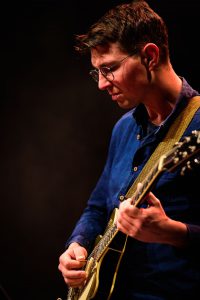
Matthias Kurth | Photo by: Torsten Redler.
Tragedy struck the group in the years following its initial formation. Jörg Teichert, one of the band’s founding creative voices, was killed in a highway accident after the COVID period. “Jörg’s death was a shock for all of us,” Fityan recalls. “We were left with the decision: should we continue, or should we stop? It was difficult and required reflection.”
The loss forced the band members to confront the purpose of their collaboration. After much discussion, The band decided to persevere. The network that had built the original group now provided support, leading to the invitation of Matthias Kurth, both a friend and a colleague to several members. Kurth’s versatility on guitar, his experience with fretless and quarter-tone instruments, and his openness to the fusion of cultures made him a natural fit.
With Kurth joining the group, SADA not only survived tragedy but emerged with renewed vision. The period of uncertainty became a turning point, strengthening the band’s commitment to innovation, dialogue, and the synthesis of musical cultures. This spirit continues to define SADA’s creative trajectory, as they carry forward both the memory of lost collaborators and a collective drive to push boundaries.
Matthias went on to describe his joining of the group at a time still charged with uncertainty for everyone involved. “Mohamad wasn’t sure about continuing after Jörg’s passing,” he recalls. The invitation came from Jonathan. he remembers “Jonathan called me, sort of still in tears, telling me about Jörg’s tragic accident. The band had an upcoming concert and they were considering cancelling or going ahead if I could step in.”
Kurth’s decision to join was immediate and although he had only met Jonathan briefly before, they had mutual friends and a healthy respect for each other’s work. “I didn’t hesitate, partly out of respect for Jonathan and Mohamad, whom I knew from the Tamas project. But also because I understood that helping meant more than just playing music.”
Matthias’s first engagement was with the former Fityan group for a concert, but the year quickly evolved: “We met again at Bayreuth later that year, with a larger ensemble. There was a clear effort to enhance the band, to evolve the quartet into something broader. It was an idea Jörg had contributed to before his passing, so his spirit was still part of the project.” Those sessions in Bayreuth introduced an expanded lineup, featuring Fadhel Boubaker, Kenan Tülek, Salah Maraka, and Johannes Stange, and on occasion Iranian singer Golnar Shahyar. “Three days of rehearsing and three concerts with an octet—it was intense and productive.”
At this point in the conversation, I wanted to cycle back to Mohamad to find out a little more about his background and how he started his journey in music. I was also curious to find out more about his instrument of choice, the nay. I quickly found out that his passion for the instrument is neither a tool nor a professional necessity, it is a lifelong companion, a source of creative passion, and a defining element of his musical identity.
“I still remember the very first time I heard the nay,” Mohamad recalls with unmistakable affection. “I was fifteen, walking the old streets of Aleppo when a man played al-azan on the nay. That sound went straight to my heart—like an arrow. In that moment, I was determined to learn.” His first encounter was spontaneous and serendipitous. With the help of friends, he scraped together enough money to buy his own flute and then faced the humbling challenge of coaxing a single note from it.
What followed was not easy: “It was frustrating at first. I thought the instrument was broken! But after weeks of trial, and with the guidance of a local teacher, something clicked.” The nascent love quickly became an obsession, Mohamad practiced constantly, haunting the stairwells and rooftops of his family home, sometimes to the chagrin of his father, later with his blessing. “I didn’t want to lose a moment without the nay in my hands. Even on the street, I’d keep it under my arm, ready to slip it out and play.”
Fityan’s deep, almost spiritual connection with the nay has defined his musical journey ever since. After winning a national youth music competition, he entered the Higher Institute of Music in Damascus, where a pivotal encounter with jazz opened his eyes to western music in the form of a Big Band project. “The first time playing in this setting was confusing! The Western forms and harmonies were so different from Arabic music. The concept of improvising within set harmonic structures wasn’t something I knew from home. In Arabic traditions, the improvisation is modal, often freer, and not bound by strict chord changes.” It was a steep learning curve he explained. “I had to train my ear to the harmonic language of jazz. I really had to listen carefully to the melody, absorb it, and then look for where I can bring my own identity into the music. It’s not just about the notes, but about adding a signature, an ornament, a feeling that comes from my musical background.”
This sensitivity is at the core of SADA’s musical concept. Fityan emphasizes that the band does not aim for just a blend of Arabic and Western styles, but rather for an exploration of identity and bridges that connect rather than merely blend cultures. “Our identity emerges from all our experiences through experimenting, recording, listening, and reflecting, that our own color comes to life.”
In 2023 the band took the decision to streamline from an eight-piece ensemble to a six-piece band. This move came from an acute awareness of the challenges that the larger group faced. “Playing in an eight-piece band brings complexities,” Matthias Kurth explained. “Balancing the stage levels of such a large and diverse line-up of acoustic is tough when touring. Even with a dedicated sound engineer, we often found ourselves struggling to hear each other on stage. It’s also expensive and taxing to tour with so many musicians, which puts strain on the group’s cohesion.”
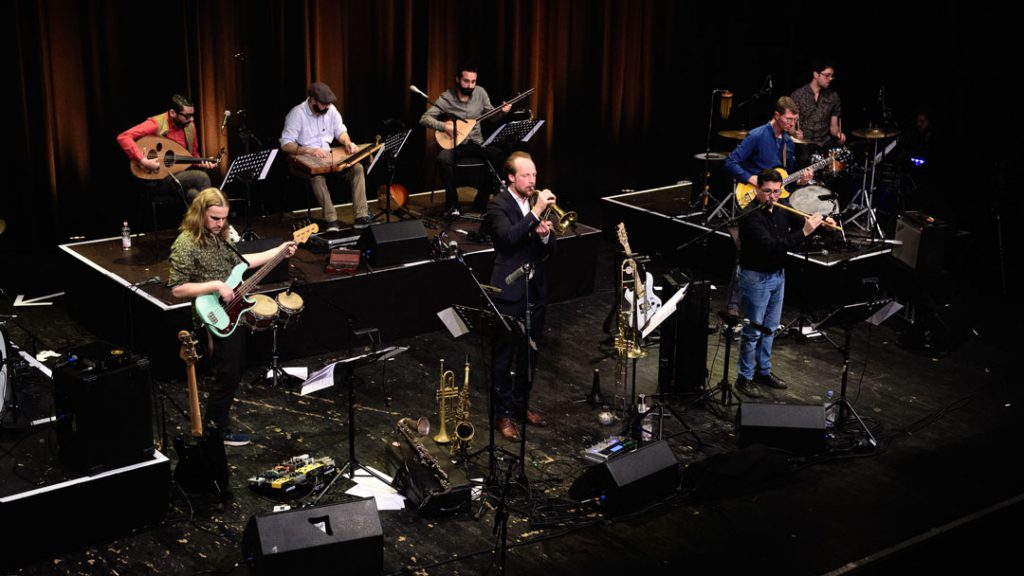
SADA Live at the Capitol Theater
As the ensemble refined its core, Laila Mahmoud joined the group, bringing both mastery and a fresh approach to the qanun, an instrument central to the sonic character that defined SADA’s sound. Known for her versatility and expertise in Middle Eastern classical and contemporary music, Laila’s background perfectly complemented SADA’s cross-cultural ambitions. She had been known to the band through previous collaborations with Jonathan Sell and Mohamad Fityan and her arrival was described by Matthias as an “easy and comfortable decision.”
Laila’s contributions extend beyond technical proficiency. She embodies SADA’s ethos of dialogue between cultures and traditions. Her playing weaves into the band’s fabric with delicacy and authority, enriching the collective sound. This smaller, more agile ensemble format not only meets the demands of touring but allows greater interplay and intimacy among musicians. The transition from a larger octet to this six-piece formation was not just a logistical adjustment but a deliberate artistic choice, one that continues to shape SADA’s evolving language and vision.
It was also around this period that the band decided to transition from a project centered on Mohamad Fityan’s personal journey to a fully collaborative band moving forward under the name SADA. Changing the band’s name became a logical and defining step Matthias explains “The change really came down to two main reasons. First, the band’s sound had grown so much bigger and different that a new name felt necessary. This wasn’t just the Fityan Band anymore; it was something completely new.”
More importantly, Matthias highlights, the new name better represents the collaborative nature of the group. “Early on, having Mohamad’s name as the band’s label made perfect sense—it was his story coming to Germany and starting something fresh. But as the band grew into a collective, that story expanded. The name no longer reflected the shared ownership and musical contributions of all members.”
The name *SADA* resonates deeply with the band’s spirit and philosophy. Derived from Arabic, “Sada” means “echo,” but the word carries a richness beyond that. It can mean a person’s reputation, evoke the call of an owl, even refer to rust or extreme thirst depending on context. Crucially, the root of the word ties to the idea of reaction, response, or confrontation.
Matthias sees the name as symbolic of their journey. “It’s no longer just about one person; it’s about a collective voice that reacts, resists, and reflects. Having a group name instead of an individual’s makes it easier for everyone to invest—not just musically, but in composing, arranging, organizing, and communicating. It reinforces the sense that we are all part of something bigger.”
With their debut album set for release in spring 2026, SADA’s journey comes full circle with a statement rooted in their earlier work. “The repertoire on the album essentially comes from our first phase, the Bayreuth period when we worked as an eight-piece,” Matthias Kurth explains. “Jonathan’s idea was to feature compositions from all the non-German members from that period, Fadhel Boubaker from Tunisia, Mohamad Fityan with the nay, Kenan Tülek on saz and vocals, and Salah Maraka on qanun. We took these sketches and spent a lot of time rearranging, experimenting, testing how these melodies and ideas could sound in this setting.”
As Matthias describes, the process was intense and iterative: “We made countless versions of each piece, always searching for the right balance between the Arabic melodies and the harmonic possibilities of the jazz-rock ensemble. A typical Arabic melody often lacks chord structures—so for us, the challenge was: what happens when the trumpet plays that line and we add complex chords underneath? It took a lot of trial and error but also unlocked new creative spaces.”
An essential part of the album’s character is its blending of composition and improvisation. “We deliberately avoided the typical jazz-solo-hierarchy. Instead, our solos often become dialogues, a conversation between two or three musicians, not isolated spots to shine. This collective improvisation is something we’ve deeply trusted from the beginning. It’s not just a performance; it’s an exchange.”
Matthias notes the rich diversity on the album, highlighting contributions such as Kenan Tülek’s vocals—the only track with sung Turkish lyrics—and a distinctly jazz-inspired piece called “Prayer,” composed by trumpet player Johannes Stange. The inclusion of free improvisations inspired by Arabic and Turkish taksim traditions further enriches the album’s tapestry. Taksim refers to a style of improvisation that traditionally frames a melody but is not bound by its structure. SADA adapts this by exploring taksim in duo or trio settings, creating improvised sections that flow naturally between composed pieces.
The album’s title, “Echoes of Maqam”, reflects the band’s artistic interrogation of tradition and innovation. “Maqam is often translated as scale, and you can relate that to Western music through the concept of scales. But it also means mood. Each Maqam name brings a set of rules, moods, and possibilities — how to modulate, how to develop melodies, and which emotions to evoke.” The album’s title speaks to our exploration of what happens when musicians outside the maqam tradition engage with its essence, it’s our response, our echo to that rich, complex world.”
Along with the album’s release in spring 2026, SADA is also preparing to bring their music to live audiences across Europe. Matthias offers insight into how the band’s live performances differ from their studio work—and what he hopes listeners will take away from their concerts. “The intensity of being completely in the moment is the same whether we’re in the studio or on stage,” Matthias explains. “But what’s crucial is that when we’re playing live we’re not just reproducing something from a recording. Every performance is a recreation. The studio is just a snapshot of an ongoing process, an evolving conversation.”
For SADA, this means that every live show is an opportunity to redefine their music. “If we returned to the studio to make new versions, they would be different again. The concept of being fully present, connected to each other in communication, and trusting the moment drives both our studio sessions and concerts.”
Looking ahead, Matthias has a clear message: “Be open, be curious, and be respectful towards cultures that might feel unfamiliar. Listen deeply and try to find the common ground.” He urges listeners to embrace humility: “Before judging, it’s important to admit there’s so much we don’t know. Arabic and Middle Eastern music harbor rich traditions going back thousands of years. For instance, the Arabic oud is the great-grandmother of the guitar. The roots of Western music are deeply entwined with these histories.”
His final thought offers both a challenge and an invitation: “Let’s find the common ground—not dismiss or devalue other musical cultures. There’s so much to learn, appreciate, and explore. I personally love it, and I hope audiences will feel the same”.
Last modified: September 30, 2025