 Written by
 Having barely survived the “inner city blues” (more on that later) of intense London temperatures during three successive heatwaves it was with some relief to revisit the Canary Islands to enjoy some cool jazz at their annual jazz festival. This, the 35th edition of the “Canarias Jazz Y Mas” festival featuring both American and European artists proved to be as invigorating and innovative as were the previous years. Set over all 8 islands of the archipelago some of the best shows are to be enjoyed on the islands of Tenerife and Gran Canaria in the capital and surrounds of Santa Cruz de Tenerife and on Gran Canaria in and around the capital of Las Palmas de Gran Canaria.
Wednesday 15th July – La Granja Santa Cruz De Tenerife – The Marco Mezquida Trio
The first concert we saw was situated in the Espacio La Granja, a centrally situated Performing Arts Centre in Santa Cruz featuring the Marco Mezquida Trio. The Menorcan born pianist Mezquida has been proclaimed one of the most promising and talented pianists of his generation, known for effortlessly weaving together an exciting and lyrical web of modern jazz together with Latin and classical music and even drawing on Folk influences along the way. As well as accompanying jazz icons such as Lee Konitz and Dave Liebman, Mezquida has been declared “Musician Of The Year” no less than four times at the Catalan Jazz Awards (AMJN). The trio have been together for the past ten years with Cuban Martin Melendez on cello and the Catalonian drummer and percussionist Aleix Tobias, under the banner of pianist and composer Mezquida, and their recently released album “Táctil” is a celebration of their shared musical journey.

Marco Mezquida Trío
The evening featured numbers from the new album, opening with the title track showcasing the trio’s skilful playing, featuring some progressive percussion from Tobias, followed by Melendez’s harmoniously plucked pizzicato notes on the cello, with the richly melodic piano chords of Mezquida showing off the dramatic skills of the pianist to superb effect. Among other high points in this well received set were “World’s Hope,” a tribute to the Swedish social activist Greta Thunberg, opening with a delicate solo piano introduction from Mezquida before concluding in a dramatic finish, and “Cavalcanti,” a swinging and soulful affair with dazzling technique from Mezquida, who suddenly switched tempo and rhythm along the way with Melendez and Tobias both exploring the new direction.
“Quartet F” displayed Mezquida’s baroque and impressionist influences of classical composers Ravel and Handel whilst bringing his own singular style to the piece. The well received concert continued at pace with all members of the trio looking as if they were truly enjoying themselves whilst displaying perfect timing to complement Mezquida’s astonishing technique; at one stage reaching into the piano to dampen, pluck and strum its strings in a percussive tease on the upbeat “Felice,” and Tobias making use of the framed Iberian drum, “Pandero Cuadrado,” a square percussion instrument which he played using both a drumstick and by hand to create a distinctive staccato sound on the Latin and Folk influenced “Cádiz.” Melendez, who handled the cello as if it were a double bass, gave an almost oriental and orchestral feel to his playing when he switched to using the bow on some of the numbers, whilst Mezquida showed us more of his dazzling improvisational skills on the encore tunes, “Brújula” and “Carpe Diem,” which ended with a percussive flourish from Tobias to send the delighted audience off still talking about the concert long into the night.

Marco Mezquida
The following evening we travelled to the colonial Spanish town of San Cristóbal de La Laguna, the former capital of Tenerife, for the second concert on the island, set in the historic Teatro Leal, featuring a new project from the American vocalist José James. Before the concert five specially invited jazz journalists – Christoph Giese from Germany, Jose Nuno Catarino from Portugal, Mery Zimny from Poland, Rosarita Chrisafi from Italy and myself, Larry Pryce from the UK – attended a “Jazz Chat” hosted by Miguel Ramirez, the Artistic Director of the Canarias Jazz Y Mas festival. There the panel discussed a range of topics including the existence and future of a “European jazz identity,” together with the challenges involved, and what the educational opportunities were for young European jazz musicians moving forward.
Thursday July 16th – José James & Celia Kameni at Teatro Leal, San Cristóbal de La Laguna

José James & Celia Kameni
The show at Teatro Leal was Marvin Gaye’s “I Want You,” in honour of one of the great voices of R&B, featuring the international vocalist José James together with the French singer Celia Kameni. The project was timed to celebrate the 50th anniversary of the iconic album, which was produced by the legendary Leon Ware for Motown Records. James, who collaborated with Ware during the creation of his own album “No Beginning No End” for Blue Note Records, has long cited Marvin Gaye as a guiding inspiration. “He had the courage to transform not only his music but also the world around him,” says James, noting that this new project was a way to give back to both Marvin and Leon.
For this live show James was joined on stage by Celia Kameni, who is considered one of France’s most distinctive vocalists with a conservatory background in both classical music and jazz. Together with a world class rhythm section featuring Marcus Machado on lead guitar, Masayuki Hirano (BigYuki) on piano and synthesiser, Parker McAllister on electric bass and Jharis Yokley on drums, the stage was set for some distinctive fun and funk. The concert began with the rhythm section putting down a steady groove for the title track, “I Want You,” with James’s voice capturing the sweet soulful sexuality of Gaye’s singing. It was a good call having a female vocalist in the show – James having previously worked with China Moses on the project – and it gave an additional dimension to the concert, with Celia Kameni providing a nice foil to James’s style, her voice showing both sensitivity and intensity to the proceedings. This was followed by two more numbers from the “I Want You” album, “Come Live with Me Angel” and “I Wanna be Where You Are,” with James’s yearning vocalisation perfectly in step with Kameni’s nuanced phrasing.

A version of “Mercy Mercy Me (The Ecology)” from the “What’s Going On” album was given a stripped down treatment with Kameni standing tall as ever, her voice in perfect tandem with Machado’s guitar chords. However, with James leaving the stage to his guest vocalist for a while, the show seemed to lose some of its direction, only gaining the original momentum on his return. As James explained to the audience, he always regarded John Coltrane, Billie Holiday and Marvin Gaye as the Holy Trinity, the “sound of the cry” as he put it, whilst reminding us that whilst Marvin Gaye was an R&B singer wanting to become a jazz singer, he was conversely a jazz singer wanting to become an R&B singer.
The concert soon regained its energy with the band on excellent form, showcasing BigYuki’s flowing keyboard and synth patterns along with McAllister’s driving bass lines, Machado’s funky guitar riffs and Yokley’s impressive percussive work, the musicians showing off some interesting solos along the way. James also engaged us with a little deconstructing of Gaye’s style, bringing some rapid Hip Hop and other improvisations into the mix, showing that this was not merely a tribute show but more of an interpretation of his hero. There was another number from the “I Want You” album, “Park Bench People,” whilst “Inner City Blues (Make Me Want to Holler)” and “What’s Going On” were among further standouts, with James and Kameni finishing with a well-received encore of Bill Withers’s “Lovely Day” to round off this remarkable project.
Friday July 17th – Las Palmas de Gran Canaria
The following day our jazz pack took the ferry across to Las Palmas de Gran Canaria, a sometimes-adventurous journey depending on weather and tide conditions. That evening saw part two of the “Jazz Chat – Jazz in Europe” discussion with the same attendees of guest journalists plus the addition of local musician guitarist Yul Ballesteros, where the conclusion seemed to be that the future of European Jazz seemed for now to be in safe hands, thanks largely to the likes of festivals such as Canarias Jazz Y Mas. It was agreed, however, that budgets will always continue to be a challenge for festivals, the recent collapse of the UK’s Heritage Live Festivals being a prime example.
Saturday July 18th – Santa Brigida, Las Palmas – The Manon Mullener Quintet
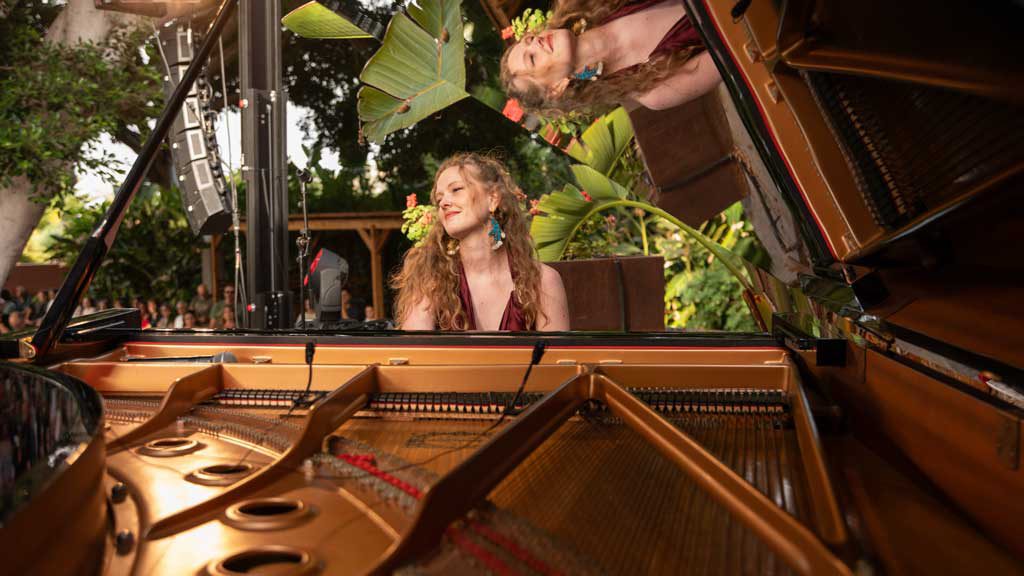
Manon Mullener
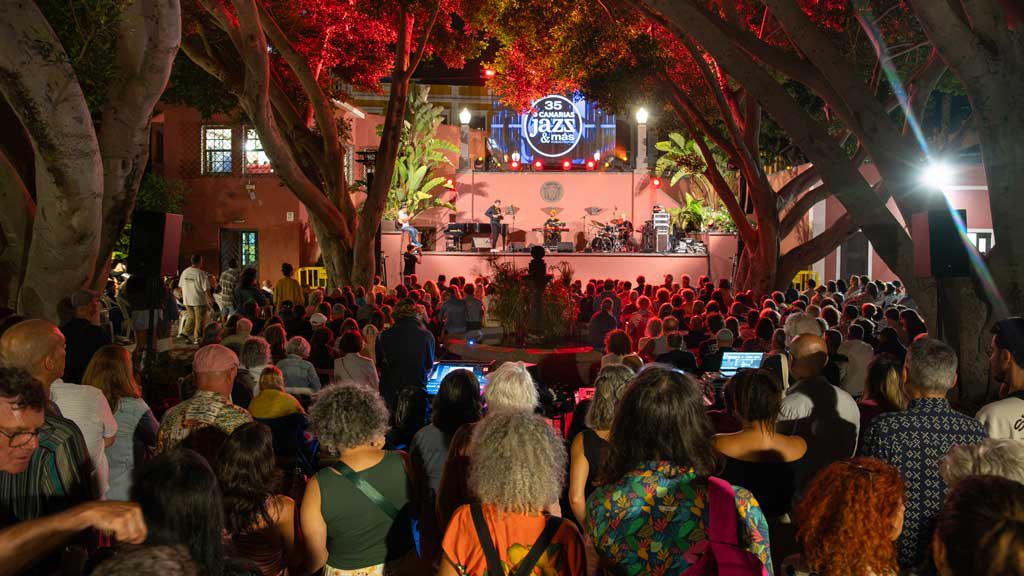
Saturday evening saw us visit the mountain town of Santa Brigida in the northeast of the island, where we were due to see two acts playing at a free concert in the town’s open air Municipal Park. The first of these featured the Swiss pianist Manon Mullener performing in a 5tet format with Victor Decamp on trombone, Manuel Schwab on saxophones, Rodrigo Aravena on electric bass and Lucian Mullener on drums. The music, a mix of original compositions and Latin pieces, showed off Mullener’s Cuban influences experienced from her time spent studying and playing there. With the trombone and saxophone leaving the stage halfway into the concert, Mullener continued in a more acoustically centred trio format with bass and drums. The well attended audience enthusiastically applauded the return of the brass section, which seemed to give the show a musical leg up, referencing some Brazilian and even a suggestion of Mexican Mariachi rhythms in the repertoire.
Santa Brigida Second Concert – The Hamilton De Holanda Trio
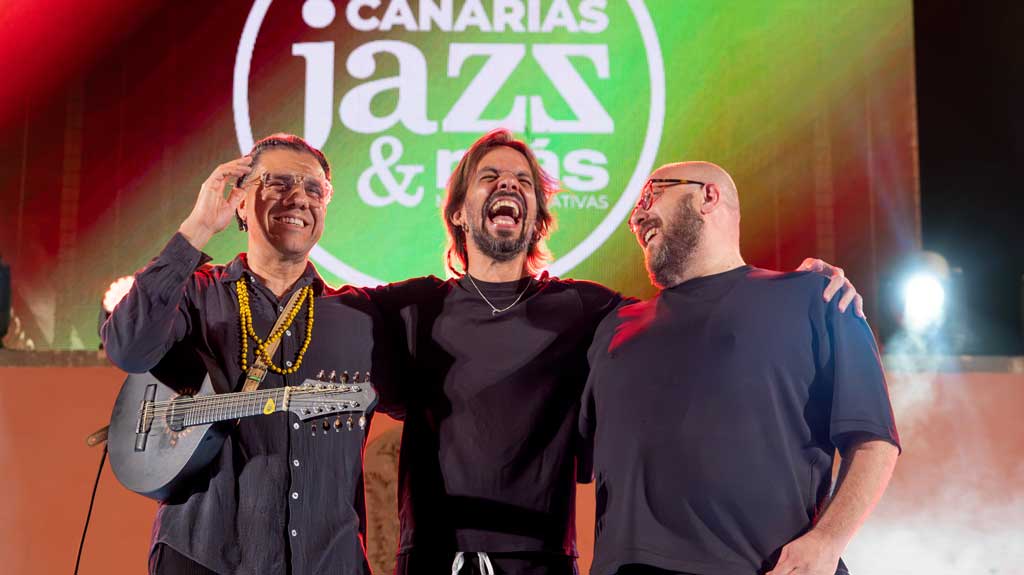
The Hamilton de Holinda Trio
The Brazil effect continued in a big way for the second concert of the evening, with the virtuoso Brazilian Bandolim player Hamilton de Holanda and his trio, featuring fellow countrymen Salomão Soares on keys and Moog synthesizer and Thiago “Big” Rebello on drums, presenting their highly creative blend of jazz, choro, samba and other contemporary Brazilian music. The Bandolim, part of the Mandolin family, was in this case a 10-string instrument especially crafted for De Holanda. Tuned like a violin and in the hands of such a skilled player, it resonated with a highly expressive tremolo sound together with a rapid and crisp syncopation, as if the instrument had a special musicality and energy of its own. Soares’s sophisticated harmonies and atmospheric textures painted a highly atmospheric palette, whilst Rebello’s drumming provided the dynamic and versatile percussion that bridges the rich blend of Brazilian music with other genres. The packed audience watched and listened in appreciation at the contrast between the vibrancy and vivid improvisation on numbers such as “Afro Chora,” which connected Brazil’s rich musical heritage of the Samba groove and the inspiration of African rhythmic traditions, only to be enchanted by the sudden tenderness of “Mono No Aware,” a Japanese influenced piece, with De Holanda’s delicate and sensitively played chords falling like gentle blossoms of emotional melody.
A fine concert to end what was a wonderfully inspirational festival at every level. Congratulations to Miguel Ramirez, the Artistic Director, for organising such a musical feast, and thanks also for the support of the Turismo de Gran Canaria.
Last modified: August 12, 2026