

 Written by
 Ineza Kerschkamp’s “IBUKA” is like opening a window in a genre sometimes clouded by tradition and imitation. For regular followers of UK jazz circuit, Ineza has been an up and coming presence for some time, but this first full-length album goes a long way to justify the attention she’s steadily attracted. What’s most immediately welcome about “IBUKA”, and something that is still all too rare, is that here is a jazz vocalist launching with a suite of original material, rather than the parade of well-worn standards.
 The album’s title, “IBUKA” (Kinyarwanda for “remember”) signals its autobiographical roots. Like much about Ineza’s artistry, it derives its force from her lived experience, not affectation. The biographical thread is unmissable throughout: born in Rwanda but raised in Belgium by her adoptive mother following the turmoil of 1994, Ineza’s path weaves together significant loss, migration, and ultimately, self-invention through jazz.
But it’s not just subject matter that rings true. From the outset, what distinguishes Ineza is melodic sensibility. The songs are highly accessible—memorable hooks and strong lyric lines abound—yet these are consistently offset by compositional complexity that never calls attention to itself. Fans familiar with the harmonic modernism of Gretchen Parlato or the narrative songwriting of Becca Stevens will recognize some kinship, but what “IBUKA” brings is unforced and unselfconscious.
From the first listen, “IBUKA” stands out by virtue of content as much as performance. Here, all eight tracks are original, a still unusual feat for a contemporary jazz vocal debut and they hold their own against the genre’s often canonical repertoire. Each song addresses a facet of Ineza’s experience, memory, identity, belonging, but does so in language and melody that refuse to lapse into sentimentality. This is especially evident in standouts such as “Silence,” a track marked by its neo-soul influence and contemporary rhythmic feel. Here, a lyrical hook that would be at home in the work of Jill Scott is framed by nuanced modern jazz harmony and tight group interplay.
“Silence” emerges as a clear highlight. It’s an accessible, soulful piece, but for all its smoothness there’s both a questioning emotional undertow and melodic craft. The lyrics resist cliché, reflecting an uneasiness that is resolved only partly by the instrumental dialogue. Saxophonist Michael Lack’s solo is particularly effective here, echoing the vocal line and then spiraling into new territory, a sign of the way improvisation is written into the record’s DNA rather than tacked on.
“Walking Away” is another anchor, notable not only for its contemporary feel but for the ways in which Ineza’s own sense of line and phrasing shape the band’s direction. There’s real synergy between vocalist and group; rather than the accompaniment simply following the singer, each player is an active participant in the storytelling. Michael Lack again stands out, his saxophone providing counterpoint and commentary.
A contrasting moment comes with “Song For My Mother,” which roots itself more firmly in the jazz ballad tradition. Here, Ineza’s delivery is strikingly direct, the lyrics simple but effective, and Rob Brockway’s piano solo is a reminder of the band’s credentials: harmonically rich, rhythmically poised, supportive without being showy.
“IBUKA” is, in every sense, a band record. Ineza’s vocals are front and center, but the group’s contribution forms a crucial part of the album’s identity. The interplay between voice and saxophone, especially, gives the tracks a conversational quality that at times recalls the classic Nancy Wilson/Cannonball Adderley collaboration, but updated for a modern context.
Throughout the record, there’s a sense that each musician is not just supporting the leader but fully inhabiting the material. The sonics are clean without being clinical: enough air in the production for subtle interplay, with a warmth reminiscent of small-room jazz recordings.
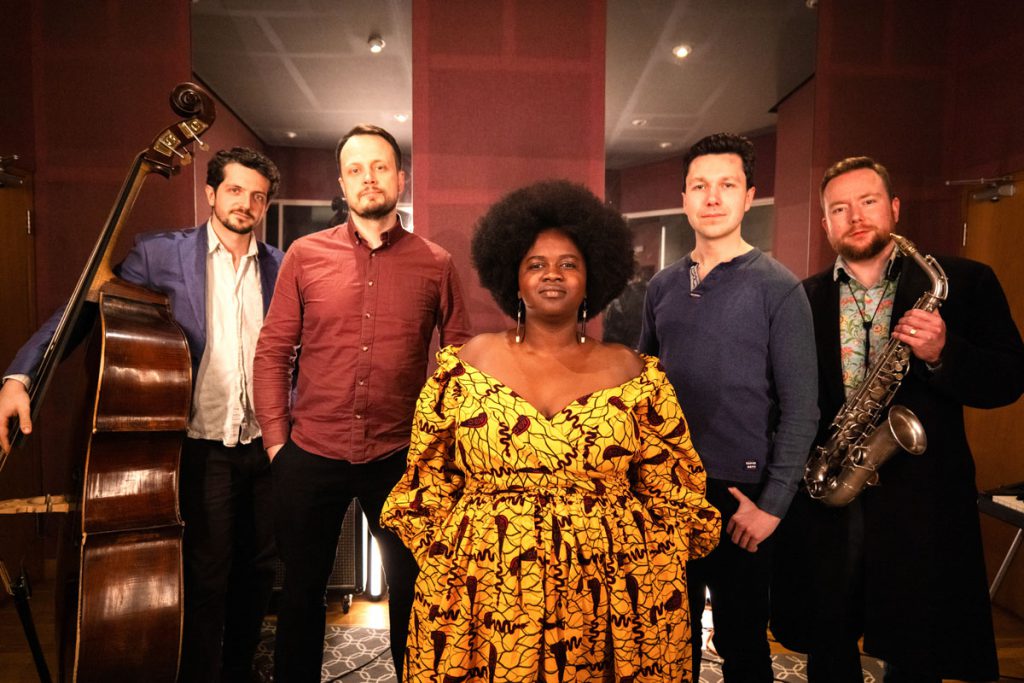
Perhaps what most singles out Ineza’s writing is her ability to walk a line between accessibility and ambition. The choruses are memorable—“Silence” and “Grow” especially—but the harmonic and rhythmic underpinnings avoid the formulaic. Songs might begin with an ear-catching phrase, but unfold into unfamiliar territory or open doors for improvisational statements. It’s this quality that suggests Ineza has the potential to become a formative influence in vocal jazz going forward.
Themes of identity and overcoming loss run throughout the album, giving it not just cohesion but emotional ballast. The album’s closing track “Kwibuka”—written for the 2024 genocide commemoration shows Ineza’s willingness to engage with difficult historical terrain without lapsing into grandiosity or melodrama. There’s a steady, restrained dignity to the performance that marks it out from so many “tribute” pieces in the jazz repertoire.
Personaly, one of the album’s underlying pleasures is simply encountering a vocalist so committed to personal vision, who neither traffics in nostalgia nor turns away from deep musical roots. For listeners who want vocal jazz that is at once highly musical and genuinely fresh, “IBUKA” offers real substance. It is encouraging, invigorating even, to hear an artist so early in her career already marking out a distinct path.
Having first heard Ineza at Jazzahead two years ago, I’m thrilled to see the promise of that past performance bear fruit and ripen into this recording making a strong case for following her future work closely. “IBUKA” is neither an exercise in jazz orthodoxy nor a calculated genre crossover. Instead, it’s a record that treats songwriting, improvisation, and storytelling as complementary aspects of one tradition—a tradition that, for all its roots, is still evolving.
Perhaps the best recommendation is this: “IBUKA” is the debut of a vocalist-composer who, I firmly believe, will be part of a generation that will help shape jazz’s next chapter. It’s an album that deserves repeated listening and reveals new depths each time. In a year crowded with new releases, “IBUKA” is an album to linger with, discuss, and return to. Highly Recommended.
Track Listing:
1. Another Time | 2. Waking Up Hungry | 3. Silence | 4. Song For My Mother | 5. Grow | 6. Walking Away | 7. The Garden | 8. Kwibuka
Line-Up:
Ineza Kerschkamp – vocals, compositions | Michael Lack – saxophone | Rob Brockway – piano | Ben Crane – double bass | Kuba Miazga – drums
Release Date: 12 September 2025
Format: CD | Vinyl | Streaming
Label: Self Release
Editors Note: Keep an eye out for a feature interview with Ineza in the next edition of the Jazz In Europe Magazine.


Last modified: September 18, 2025