 Written by
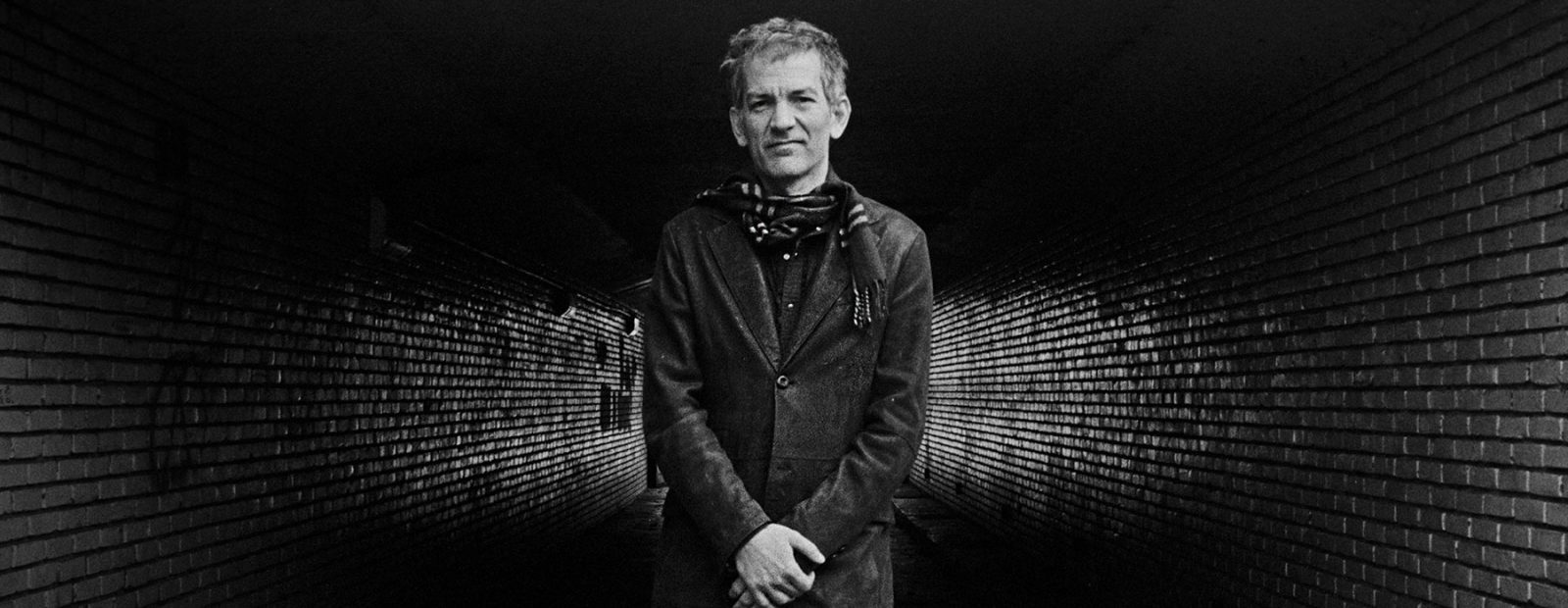
 Just a week ago, I purchased Brad Mehldau’s second album, After Bach II, which offers his reflections on some of Bach’s keyboard pieces. Since then, I’ve listened to both this album and the first After Bach so frequently that I nearly know them by heart.
First, I believe the title After Bach is particularly fitting, as it holds various meanings—musical and philosophical alike. Musically, it suggests using Bach’s compositions as a foundation for new interpretations and inspirations. Mehldau demonstrates this with pieces like Rondo and Ostinato from the first After Bach album, which draw directly from the atmosphere and material of Bach’s original works. For instance, Rondo and Ostinato are inspired by the Prelude No. 3 in C# Major from the WTC I, BWV 848, and the Fugue No. 16 in G minor from the WTC II, BWV 885, respectively and Toccata from the actual recording is inspired by Prelude No. 6 from WTC I, BWV 851.1 It seems Mehldau has a particular affinity for the preludes, as there are only two fugues on the first album and just one on the second. Perhaps this preference relates to the German word “präludieren,” which can be understood as a form of improvisation.
Philosophically, “After Bach” could also reflect on what follows Bach, considering his music as perhaps the origin of Western Classical Music. It raises the question of why we —myself included— continually return to Bach. I sometimes wonder if our reverence for Bach might partly be the result of cultural and musical propaganda, especially over the last century. Would things be different if history had favored another composer? But then, I listen to Bach’s music again, and it simply feels… right.
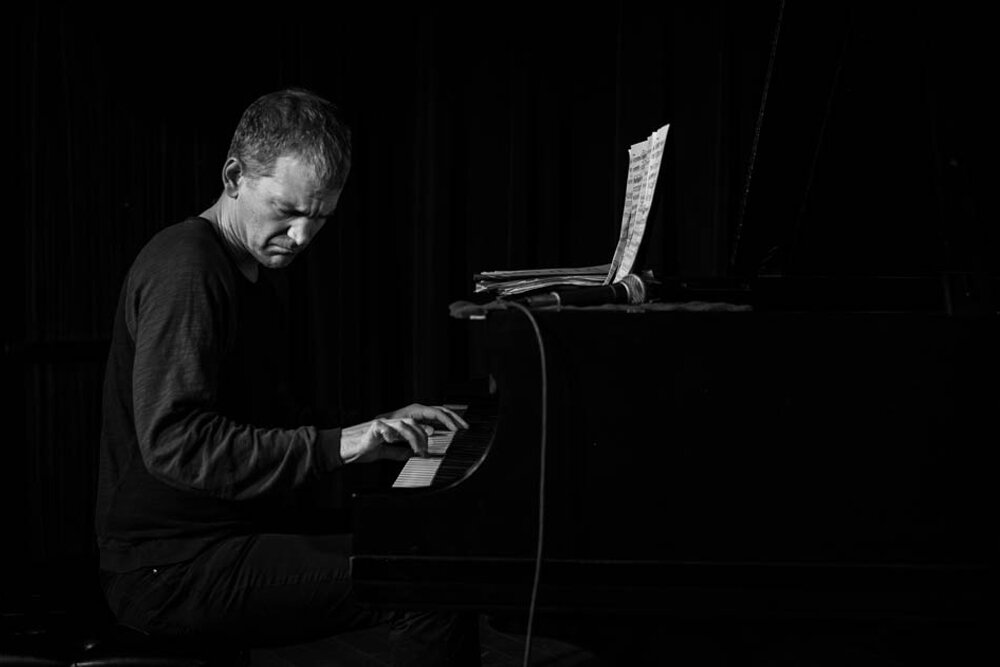
As I delve deeper into the album, I’d like to focus on the end of After Bach II, particularly Mehldau’s variations on the Goldberg theme. In the album’s booklet, Mehldau writes:
With the Variations on Bach’s Goldberg Theme, I adhere to Bach’s own ‘frame’—the harmonic and formal structure he introduces in the famous opening Aria—in my own improvised variations. Bach’s frame is so strong in its own right, independent of the endless invention he found in his own variations. Perhaps my contribution can celebrate Bach the formalist, who receives comparatively less attention than Bach the harmonist/melodist.2
Mehldau’s view of Bach as a formalist is intriguing. It highlights what can be achieved when working within a solid structure, and it pays tribute to Bach as an investigator of musical possibilities. I often think of Bach as a kind of musical explorer, testing the limits by deliberately imposing constraints on himself, whether harmonically or formally.
In these six variations, you can clearly hear the harmonic structure established by Bach in the opening Aria-like piece. Mehldau’s musical journey takes you on a creative rollercoaster, from the meditative Aria-like to the frenetic Variation VI, Finale. Mehldau conceived the idea of improvising on the Goldberg theme after receiving an invitation to perform the original Goldberg Variations at the Swiss Verbier Festival, which he declined in favor of an improvised version, as he mentions in the liner notes.
Let’s take a closer look at these six or seven variations. Aria-like maintains the original spirit of the theme, introducing some subtle musical sparks from Bach’s work. Variations I and II, in a minor key and 5/8 time, are more playful, with some lovely melodic ideas in the middle. The two variations are also subtitled “a” and “b,” leading me to wonder if Variation II is perhaps the formal second part of Variation I, given their similar playful and bouncing character. Variation III, in a major key and 7/4 time, continues this playful, joyous atmosphere, with echoes of the original theme surfacing here and there. This joyful improvisation sets the stage for something new.
Variation IV, Breakbeat introduces cool rhythmic patterns, leaning into jazz while nodding back to the original theme. Listening to this piece, it feels as though Johann (Sebastian Bach) is transforming into John, who is, in turn, becoming Brad’s bro’. This transformation becomes even more apparent in Variation V, Jazz and Variation VI, Finale, where the improvisation becomes wildly creative, pushing the simple original theme to its limits. I believe that JSB, the great improviser, would have approved. JSB approved!
But let’s return to the beginning. The first After Bach album from 2018 is structured around a Bach prelude followed by a musical reflection from Mehldau, framed by the opening piece Before Bach: Benediction and its closing counterpart Prayer for Healing. The opening piece is described in detail by American composer and pianist Timo Andres in his liner notes for the album:
“The album’s prologue, Before Bach: Benediction, begins indelibly, its falling fifth calling to mind the same interval which opens Bach’s Art of the Fugue. But right off the bat, Mehldau’s subject wanders through brazenly distant harmonies—one quickly realizes that this fugue will not abide by Bach’s rules. Development begins immediately, rolling triplets pushing inexorably higher, that falling fifth ringing out from all registers of the piano. Rhythms increase in speed and complexity, the triplets turning into 16th notes and finally vertiginous 16th-note triplets, ascending the keyboard until they literally run out of space. The piece ends in the pensive mode it begins, its harmonies still restless, finally sticking the landing with a last-minute swerve into D major.”
I’ve quoted Andres at length because I believe this description is crucial for understanding the album’s musical and philosophical intentions. Just as Johann Sebastian Bach, the acknowledged master of the fugue, explored the potential of a fugue’s principal theme, Mehldau captures the spirit of the theme from Bach’s Art of the Fugue and transforms it into something contemporary and deeply personal. It doesn’t need to conform to Bach’s rules; it’s a creative evolution that, in the end, circles back to its origins. What a powerful musical and creative statement, especially for an album centered on Johann Sebastian Bach! That’s impressive!

Following this prologue, we move on to the first set of two pieces: the Prelude No. 3 in C# Major, WTC I, BWV 848, and its reflection Rondo. In Rondo, Mehldau’s “syncopation and recasting of the initial 3/8 measure, followed by a brief 20/16, give the impression of familiarity while quickly veering away from Bach’s territory.”
Another highlight of the album is the set featuring the Prelude and Fugue No. 12 in F minor, WTC I, BWV 857, and its meditative reflection Dream. Here, Mehldau “completely unmoors us, letting the intensely chromatic motion of Bach’s F-minor fugue drift into unknown territory. Arching arpeggios take over the range of the keyboard, churning inexorably through harmonies as Bach’s subject carries them along.”5 In Dream, Mehldau uses the fugue theme subtly as a starting point, rather than the prelude’s idea, suggesting a kind of musical lineage—a piece by Johann Sebastian Bach evolving through the musicality of Brad Mehldau.
Prayer for Healing serves as the counterpoint and another “afterthought,” as Timo Andres points out. This meditation on chord progressions reinforces the idea that the album’s pieces were not selected by chance. It’s a highly conceptual album, inviting listeners to engage in their own afterthoughts on the music of these two great musicians.
Both recordings are currently available on nonesuch records.
Tracking List:
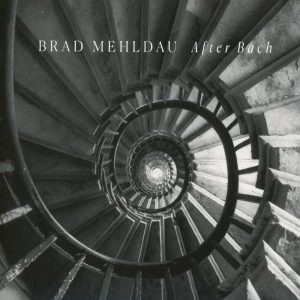 After Bach (2018)
1.Before Bach: Benediction 05:27 (B. Mehldau) | 2. Prelude No. 3 in C# Major from The Well-Tempered Clavier Book I, BWV 848 01:21 (J. S. Bach) | 3. After Bach: Rondo 08:21 (B. Mehldau) | 4. Prelude No. 1 in C Major from The Well- Tempered Clavier Book II, BWV 870 02:36 (J. S. Bach) | 5. After Bach: Pastorale 03:46 (B. Mehldau) | 6. Prelude No. 10 in E Minor from The Well- Tempered Clavier Book I, BWV 855 02:16 (J. S. Bach) | 7. After Bach: Flux 05:06 (B. Mehldau) | 8. Prelude and Fugue No. 12 in F Minor from The Well- Tempered Clavier Book I, BWV 857 06:10 (J. S. Bach) | 9. After Bach: Dream 07: 50 (B. Mehldau) | 10. Fugue No. 16 in G Minor from The Well- Tempered Clavier Book II, BWV 885 03:04 (J. S. Bach) | 11. After Bach: Ostinato 12:20 (B. Mehldau) | 12. Prayer for Healing 11:06 (B. Mehldau)
Album Credits:
All music by Brad Mehldau and Johann Sebastian Bach (1685- 1750)
Produced by Brad Mehldau, piano
Recorded, mixed and mastered by Tom Lazarus
Recorded April 18- 20, 2017, at Mechanics Hall, Worcester, MA Additional mixing by Brain Montgomery
Release Date: 9 March 2018
Format: CD | Digital Download | Streaming
Label: nonesuch records.
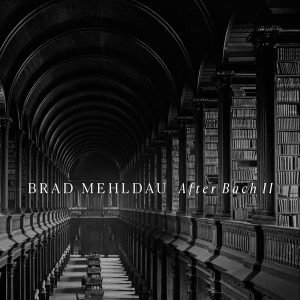 After Bach II (2024)
1.Prelude to Prelude 01:22 (B. Mehldau) | 2. Prelude No. 9 in E Major from The Well- Tempered Clavier Book I, BWV 854 01:48 (J. S. Bach) | 3. Prelude No. 6 in D Minor from The Well-Tempered Clavier Book I, BWV 851 01:18 (J.S. Bach) | 4. After Bach: Toccata 14:42 (B. Mehldau) |5. Partita for Keyboard No. 4 in D Major, BWV 828: II. Allemande 08:11 (J. S. Bach) | 6. After Bach: Cavatina 05:16 (B. Mehldau) | 7. Prelude No. 20 in A Minor from The Well- Tempered Clavier Book I, BWV 865 01:07 (J. S. Bach) | 8. Between Bach 06:05 (B. Mehldau) | 9. Fugue No. 20 in A Minor from The Well- Tempered Clavier Book I, BWV 865 03:55 (J. S. Bach) | 10 Intermezzo 01:26 (B. Mehldau) | Variations on Bach’s Goldberg Theme: 11. Aria- like 03:39 (B. Mehldau) | 12. Variation I, Minor 5/8 a 02:12 (B. Mehldau) | 13. Variation II, Minor 5/8 b 01:10 (B. Mehldau) | 14. Variation III, Major 7/4 02:31 (B.Mehldau) | 15. Variation IV, Breakbeat 01:40 (B.Mehldau) | 16. Variation V, Jazz 02:03 (B. Mehldau) | 17. Variation VI, Finale 01:25 (B.Mehldau) | 18. Prelude No. 7 in E- Flat Major from The Well- Tempered Clavier Book I, BWV 852 03: 59 (J. S. Bach) | 19. Postlude 02:16 (B.Mehldau)
Album Credits:
All music by Brad Mehldau and Johann Sebastian Bach (1685- 1750)
Production Coordinator: Tom Korkidis
Engineered, mixed and mastered by Tom Lazarus
Recorded April 18- 20, 2017 and June 21, 2023 at Mechanics Hall, Worcester, MA
Additional mixing by Brian Montgomery
Release Date: 10 May 2024
Format: CD | Digital Download | Streaming
Label: nonesuch records.

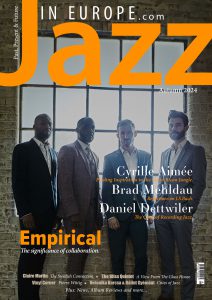 This article is featured in the Autumn 2024 edition of the Jazz In Europe Magazine. This edition features in-depth interviews with notable artists such as UK band Empirical and Brad Mehldau. Readers will find insightful pieces on the craft of recording jazz with Daniel Dettwiler, and explorations of the jazz scenes in Budapest and Sweden through conversations with artists like Veronika Harcsa, Bálint Gyémánt, and Claire Martin.
The magazine also includes a special “Vinyl Corner” segment featuring Pierre Wittig, an audio technician specializing in high-quality amplifier restoration. Additionally, readers can enjoy album reviews, a thoughtful editorial on jazz’s response to corporate consolidation in the music industry, and a feature on Cyrille Aimée and finding musical inspiration in Costa Rica.

Last modified: January 3, 2025